Pakistan Exports to Europe Fall Despite GSP+ in FY26
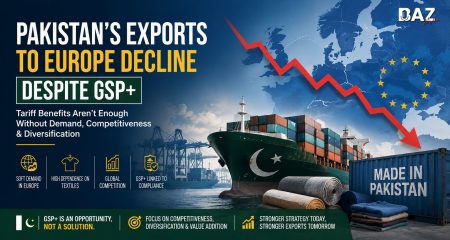
Pakistan’s exports to Europe declined slightly during Fiscal Year 2026 (FY26), highlighting an important reality for exporters and policymakers: preferential trade access alone cannot guarantee export growth. While the European Union’s Generalised Scheme of Preferences Plus (GSP+) continues to provide Pakistan with tariff-free or reduced-duty access to European markets, weakening consumer demand and increasing competition have limited its impact.
According to State Bank of Pakistan (SBP) data reported, Pakistan’s exports to Europe decreased marginally to $9.089 billion in FY26, compared to $9.106 billion in FY25. Although the decline appears small, it reflects broader challenges facing Pakistan’s export sector, especially its heavy dependence on textile products and key European markets.
Pakistan’s Export Performance in Europe During FY26
The overall decline in exports was relatively modest, but the regional breakdown reveals important trends.
Pakistan continued exporting significant volumes of textiles, garments, leather products, sports goods, and surgical instruments to European countries. However, slower economic activity across several major European economies reduced import demand.
According to SBP figures:
- Total exports to Europe: $9.089 billion
- FY25 exports: $9.106 billion
- Overall decline: Slight year-on-year decrease
The biggest weakness came from Western and Northern Europe, traditionally Pakistan’s largest export destinations.
Regional Performance Across Europe
Not every European region recorded lower imports from Pakistan.
Regions That Declined
Several of Pakistan’s largest trading partners purchased fewer Pakistani goods during FY26, including:
- Germany
- Netherlands
- France
- Belgium
- United Kingdom
Northern Europe also recorded a decline of approximately 1.31%, while exports to the UK slipped slightly compared to the previous fiscal year.
These countries account for a significant share of Pakistan’s textile exports, making slower demand particularly impactful.
Regions Showing Growth
Some European regions posted encouraging results.
Southern Europe recorded growth of approximately 3.35%, while Eastern Europe expanded by roughly 3.36%.
Although positive, these gains were insufficient to offset weaker performance in Pakistan’s largest export markets.
This uneven regional performance demonstrates the importance of diversifying export destinations instead of relying heavily on a handful of major economies.
Why GSP+ Was Not Enough
The European Union’s GSP+ programme provides Pakistan with preferential tariff treatment on thousands of products.
This reduces import duties and improves price competitiveness compared to countries without similar trade preferences.
However, tariff advantages cannot overcome every market challenge.
Several factors limited export growth during FY26:
Weak Consumer Demand
Many European economies continue facing slower economic growth, inflationary pressures, and cautious consumer spending.
When retailers receive fewer orders, imports naturally decline even when tariffs remain low.
Heavy Dependence on Textiles
Pakistan’s exports remain concentrated in textile and apparel products.
While textiles are Pakistan’s strongest export industry, overreliance on one sector increases vulnerability whenever global clothing demand weakens.
Greater diversification into engineering products, pharmaceuticals, processed foods, information technology services, and value-added manufacturing could reduce this risk.
Rising Global Competition
Countries including Bangladesh, Vietnam, India, and Türkiye continue strengthening their export sectors.
These competitors increasingly offer:
- Lower production costs
- Faster delivery
- Better supply chain efficiency
- Higher product innovation
Productivity and Cost Challenges
Pakistani exporters also face domestic issues including:
- Higher energy costs
- Currency volatility
- Financing constraints
- Logistics challenges
- Infrastructure limitations
These factors reduce overall competitiveness despite preferential market access.
Future of Pakistan’s GSP+ Status
Another important consideration extends beyond trade performance.
The European Union evaluates GSP+ eligibility based on compliance with multiple international conventions covering:
- Human rights
- Labour rights
- Environmental protection
- Good governance
- Press freedom
- Political rights
Future extensions of GSP+ will therefore depend not only on export figures but also on Pakistan’s continued compliance with these international commitments.
Maintaining GSP+ remains strategically important because European markets represent one of Pakistan’s largest export destinations.
What Pakistan Needs to Boost Export Growth
Experts increasingly argue that Pakistan must adopt a broader export strategy rather than relying solely on tariff preferences.
Key priorities include:
Diversify Export Products
Expanding beyond textiles into higher-value manufacturing and technology-based exports can improve resilience.
Explore New Markets
Increasing trade with Africa, Central Asia, Southeast Asia, and Latin America would reduce dependence on European demand cycles.
Improve Industrial Competitiveness
Lower production costs, better infrastructure, modern manufacturing, and improved logistics can help exporters compete globally.
Invest in Value Addition
Instead of exporting raw materials or low-value products, Pakistan can generate greater export earnings through branded and higher-value goods.
Strengthen Innovation
Research, automation, digital transformation, and skilled labour development will play increasingly important roles in future export success.
Economic Outlook
Despite the slight decline, Europe remains one of Pakistan’s most valuable export destinations.
The continued availability of GSP+ provides an important competitive advantage that many countries do not enjoy. However, FY26 demonstrates that preferential access alone cannot guarantee rising exports.
Long-term success will depend on stronger competitiveness, broader market diversification, innovation, improved productivity, and sustainable economic reforms.