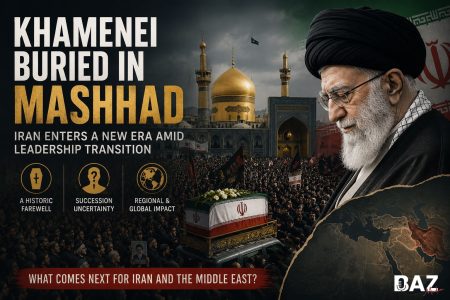
Khamenei Buried in Mashhad: Iran Enters a New Era Amid Leadership Transition
Iran has entered one of the most consequential chapters in its modern political history following the burial of Ayatollah Ali Khamenei in Mashhad, the country’s holiest religious city. The state-organized funeral ceremonies drew massive crowds and were presented as a symbol of national unity, resistance, and continuity after the assassination of the longtime Supreme Leader.
However, while the funeral projected strength, it also highlighted growing questions surrounding Iran’s political future. Reports indicate that Mojtaba Khamenei, widely identified as Khamenei’s successor, has yet to make a significant public appearance since assuming leadership. His absence has fueled speculation about how power is being consolidated behind the scenes and what this transition means for Iran and the wider Middle East.
Why Mashhad Was Chosen for Khamenei’s Burial
Mashhad holds immense religious significance for Iran’s Shiite Muslim population. Home to the revered Imam Reza Shrine, the city attracts millions of pilgrims annually and represents one of the country’s strongest symbols of religious authority.
By burying Khamenei in Mashhad instead of Tehran, Iranian authorities reinforced both the spiritual and political legacy of the late Supreme Leader. The funeral procession, which traveled through multiple cities before reaching Mashhad, was carefully orchestrated to emphasize national solidarity during a period of heightened uncertainty.
State media portrayed the ceremonies as evidence of public resilience while highlighting anti-Western rhetoric and messages of resistance, themes that have long defined Iran’s leadership narrative.
A Carefully Managed Political Message
Beyond the religious symbolism, the funeral served another important purpose it demonstrated that Iran’s governing institutions remain intact despite the unprecedented loss of the country’s highest-ranking leader.
Large-scale public gatherings, coordinated security arrangements, and nationwide broadcasts were designed to reassure supporters that the state remains stable. Such displays are common during major political transitions, particularly when governments seek to minimize perceptions of vulnerability.
The funeral also became an opportunity for officials to reinforce the idea that Iran’s strategic direction will continue despite the leadership change.
direction will continue despite the leadership change.
Mojtaba Khamenei’s Absence Raises Questions
Perhaps the most discussed aspect of the transition has been the limited public visibility of Mojtaba Khamenei, who has reportedly assumed the position of Supreme Leader.
In political systems where symbolism carries significant weight, public appearances often serve as demonstrations of authority and legitimacy. The absence of Iran’s new leader from major public events has naturally led observers to question how the transition is being managed internally.
Analysts suggest several possible explanations:
- Security concerns following the assassination.
- Internal consultations among Iran’s senior political and military leadership.
- A deliberate strategy to carefully manage the public rollout of the new leadership.
Regardless of the reason, the lack of visibility has intensified international interest in Iran’s internal power dynamics.
What This Means for Iran’s Future
Leadership transitions in Iran rarely affect only domestic politics. Because the Supreme Leader plays a central role in shaping military, foreign policy, intelligence, and nuclear strategy, every leadership change has significant geopolitical consequences.
The coming months will likely determine whether the new leadership chooses continuity or gradual policy adjustments.
Key issues likely to dominate include:
- Iran’s regional alliances.
- Relations with Gulf countries.
- Nuclear negotiations.
- Economic sanctions.
- Military posture toward Israel and the United States.
Regional Implications Could Be Significant
The funeral took place against an already volatile regional backdrop. Ongoing tensions involving Iran, Israel, the United States, and Gulf nations continue to shape security calculations across the Middle East.
Public mourning ceremonies combined with strong anti-US and anti-Israel messaging may strengthen domestic cohesion inside Iran. However, they also increase concerns that future retaliation or strategic responses could prolong regional instability.
Neighboring countries are closely monitoring developments, particularly regarding:
- Maritime security in the Persian Gulf.
- Energy markets.
- Regional proxy conflicts.
- Diplomatic engagement.
- Military readiness.
Even without immediate escalation, leadership uncertainty often creates periods of heightened geopolitical risk.
The International Community Is Watching Closely
Global governments are carefully assessing how Iran’s new leadership will approach foreign policy.
Western nations remain focused on nuclear negotiations, sanctions, and regional security, while neighboring Gulf states are balancing diplomatic engagement with strategic caution.
Financial markets are also monitoring developments because any deterioration in regional security could influence global oil prices and shipping routes through the Strait of Hormuz.
Much will depend on how quickly the new leadership establishes its authority and whether it signals continuity or change in Iran’s long-term strategic objectives.
Conclusion
The burial of Ayatollah Ali Khamenei in Mashhad represents far more than a religious ceremony. It marks the beginning of a pivotal leadership transition that could shape Iran’s domestic politics and redefine regional geopolitics for years to come.
While state institutions have projected unity and stability, unanswered questions surrounding Mojtaba Khamenei’s public role continue to attract international attention. As Iran navigates this historic transition, governments, investors, and security analysts across the world will be watching closely for signs of how the country’s new leadership intends to move forward.
Whether this moment becomes one of continuity or transformation will largely determine the future direction of Iran and its influence throughout the Middle East.