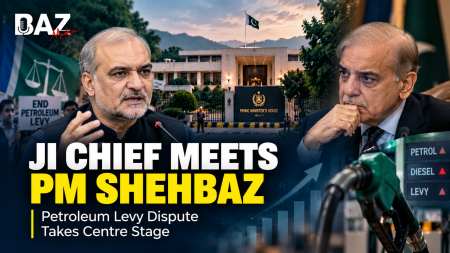
Jamaat-e-Islami’s leadership seeks relief from fuel taxation as negotiations with the federal government take place under the threat of another Islamabad protest march.
Jamaat-e-Islami (JI) chief Hafiz Naeemur Rehman arrived at the Prime Minister’s House on Tuesday for talks with Prime Minister Shehbaz Sharif, as pressure grows on the federal government to address Pakistan’s petroleum levy and rising fuel costs.
The visit marks a significant development in an ongoing dispute between JI and the government over taxes on petrol and diesel.
According to the party, the meeting is intended to discuss its demand for the complete removal of the petroleum levy, a measure JI argues would provide financial relief to households, businesses and transport operators. The talks come after months of demonstrations, postponed protest marches and attempts to establish a negotiating framework.
Hafiz Naeemur Rehman Arrives at PM House With JI Delegation
Hafiz Naeemur Rehman was accompanied by senior Jamaat-e-Islami representatives, including Deputy Emir Liaquat Baloch, Deputy Secretary General Syed Farasat Shah and Islamabad Emir Nasrullah Randhawa.
The party confirmed the delegation’s arrival through its official social media account. The discussions represent an opportunity for both sides to address the petroleum levy dispute directly at the highest political level.
However, no final agreement or policy change had been confirmed in the initial reporting.
Why Is Jamaat-e-Islami Demanding an End to the Petroleum Levy?
Jamaat-e-Islami has been campaigning against the petroleum levy for more than two months, arguing that fuel taxation has intensified financial pressure on the public.
The dispute has gained prominence as international energy prices have been affected by conflict in the Middle East. JI maintains that reducing or eliminating the levy could ease transport costs and provide relief to businesses and consumers.
Petrol and diesel prices influence a wide range of economic activities, from public transport and agricultural production to industrial operations and the distribution of everyday goods. As a result, changes in fuel taxation can have implications beyond motorists, potentially affecting household expenses and business costs.
However, eliminating the levy would also have consequences for government revenue, making the issue a broader fiscal policy challenge.
JI’s Protest Movement and Earlier Negotiations
The October 27 meeting follows an extended period of political pressure.
On August 16, Jamaat-e-Islami announced plans for demonstrations in Pakistan’s provincial capitals and called for a nationwide strike in September.
The government and JI subsequently agreed to establish committees to explore possible measures for reducing the petroleum levy. Despite those discussions, disagreements remained unresolved.
On September 20, the party began a protest march towards Islamabad, warning that the movement could intensify if the government failed to respond to its demands.
Two days later, Hafiz Naeemur Rehman announced that the march would be postponed following a request from Prime Minister Shehbaz Sharif and assurances of further discussions.
JI later complained that promised high-level engagement had not progressed as expected. The latest meeting therefore comes after several attempts to resolve the dispute through negotiations.
JI Warns of Another Islamabad March in November
Political pressure increased on October 26 when Hafiz Naeemur Rehman warned that Jamaat-e-Islami could organize another march towards Islamabad in mid-November if the federal government failed to abolish the petroleum levy or provide meaningful relief.
The warning placed renewed urgency on negotiations.
JI has indicated that it intends to maintain pressure through public demonstrations while remaining open to discussions with government representatives. Whether the latest meeting changes those plans will depend on any commitments made by the federal government and the party’s response.
How Could Petroleum Levy Changes Affect Pakistan’s Economy?
The petroleum levy debate highlights a difficult balance between public affordability and government finances.
Lower fuel-related taxes could reduce costs for some consumers and businesses, depending on how changes are reflected in retail prices.
Transport operators, farmers and manufacturers are among the sectors particularly sensitive to diesel and petrol prices.
At the same time, petroleum levies provide revenue for the federal government. A reduction or abolition would therefore require policymakers to consider how any revenue shortfall could be managed. The economic implications extend to inflation, public spending and Pakistan’s wider fiscal commitments.
For this reason, the outcome of negotiations could matter not only politically but also for economic policy.
What Happens Next After the PM Shehbaz–JI Meeting?
Attention now turns to whether the talks produce an agreement on the petroleum levy, a timetable for further negotiations or an alternative public relief package.
Three issues remain central:
- Whether the government agrees to reduce or abolish the petroleum levy.
- Whether JI considers any proposed measures sufficient to suspend further protests.
- How the government balances fuel-price relief with its fiscal responsibilities.
Until official statements confirm the meeting’s outcome, no reduction in the levy should be treated as approved.
Final Analysis: A Test of Negotiation and Public Relief
The meeting between Hafiz Naeemur Rehman and Prime Minister Shehbaz Sharif comes at a politically sensitive time, with rising fuel costs contributing to public concern about affordability.
For Jamaat-e-Islami, the talks are an opportunity to secure progress on a central demand of its protest campaign.
For the federal government, they offer a chance to address political pressure while managing difficult economic trade-offs.
The key question is whether negotiations will deliver measurable relief for the public or lead to another phase of nationwide protests. The next official announcements will determine whether the October 27 meeting becomes a turning point in the petroleum levy dispute.