
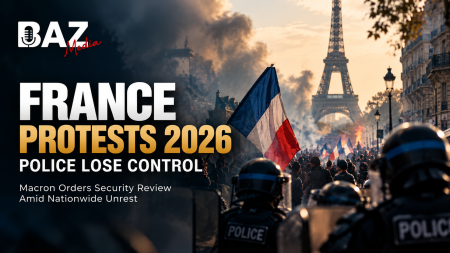
PARIS, FRANCE: France is facing renewed political and security pressure after nationwide demonstrations over rising living costs, education conditions and public services descended into violence across several major cities.
Interior Minister Laurent Nuñez acknowledged that police had lost control in parts of the country during the weekend unrest, raising questions about the government’s ability to anticipate and manage large-scale demonstrations. President Emmanuel Macron subsequently rejected the minister’s offer to resign and ordered a review of security planning and intelligence failures.
The developments have intensified debate over public safety, economic pressures and the government’s response to growing public dissatisfaction.
Why Are People Protesting in France in 2026?
The latest wave of demonstrations reflects frustration over several economic and social issues affecting French households.
Rising living expenses, concerns about wages and dissatisfaction with public services have contributed to public anger. Education has become another major source of tension. Students have been protesting overcrowded classrooms, teacher shortages and what they describe as inadequate investment in the country’s education system.
The October 17 demonstrations brought together students, trade unions and other groups demanding improvements in living conditions and public services. Authorities estimated that approximately 550,000 people participated nationwide, while protest organisers reported higher attendance. Although many demonstrators protested peacefully, violence broke out in several locations as groups engaged in vandalism, looting and confrontations with security forces.
French Police Face Criticism Over Protest Violence
France deployed approximately 60,000 police officers and other security personnel during Saturday’s demonstrations. Despite this significant deployment, authorities struggled to contain violent incidents in multiple cities.
Interior Minister Laurent Nuñez acknowledged shortcomings in the government’s preparation and deployment strategy. He indicated that the security response had not adequately anticipated the scale of violence and that additional measures were necessary to prevent similar incidents. His admission has brought renewed attention to police intelligence, operational planning and crowd-control procedures. The situation also raises questions about how authorities can protect peaceful demonstrations while responding to individuals involved in criminal activity.
Macron Rejects Interior Minister’s Resignation
Following the unrest, Laurent Nuñez offered to step down from his position as interior minister.
President Emmanuel Macron declined the resignation, choosing instead to retain the minister while demanding changes to the government’s security response. The French presidency instructed Nuñez to examine failures in intelligence gathering and operational planning. Macron also called for new policing methods to address looting, barricades and attacks on public property. The decision places responsibility for implementing security improvements on the existing leadership. It also comes at a politically sensitive time, with France facing economic difficulties and approaching its next presidential election.
Paris, Lyon and Marseille Among Cities Affected
The protests affected several major French cities, with incidents of violence reported in Paris, Lyon, Marseille, Bordeaux and Limoges. In Paris, businesses experienced broken windows, vandalism and looting.
The authorities also reported damage around Place de la République, a prominent public gathering location.
In Lyon, a fire damaged the city’s tourism office. Marseille experienced attacks on commercial premises and public buildings, while a major fire severely damaged the historic city hall in Limoges.
Local officials have demanded answers about the adequacy of security arrangements and the protection provided to businesses and residents.
The mayors of Paris, Marseille and Lyon have called for discussions with the national government over the scale of the destruction.
Thousands Arrested as Injuries Raise Concerns
The weekend demonstrations resulted in thousands of arrests and significant injuries.
Reports published on October 19 indicated that more than 2,300 people had been taken into custody, with some reports placing the broader arrest total above 2,400.
Nearly 1,000 police officers and gendarmes were reported injured.
Injuries among protesters have also attracted attention, particularly incidents involving police crowd-control weapons.
Investigations into serious injuries have renewed debate about the proportionality and safety of policing methods during demonstrations. Human rights concerns and public safety responsibilities are likely to remain important parts of the discussion surrounding the government’s response.
Economic Impact of the France Protests
The unrest has created additional challenges for businesses already operating under economic pressure.
Shops, restaurants and other commercial establishments in affected areas have faced damage, temporary closures and disruption to normal operations. Business representatives have warned that the financial consequences could be substantial. The disturbances also come as France attempts to address public debt, government spending and concerns about economic growth.
Political uncertainty and widespread disruption can affect investor confidence, particularly when they coincide with difficult budget negotiations. For the French government, restoring normal commercial activity while addressing the underlying causes of public frustration presents a significant challenge.
A Growing Debate Over Public Services and Government Accountability
The protests have highlighted a wider debate about the quality and accessibility of essential services in France.
For students, concerns about educational resources and classroom conditions have become central demands. For workers and households, purchasing power and the rising cost of everyday necessities remain major issues.
Government officials have condemned attacks on public buildings, police officers and businesses, while protest participants have continued to highlight their social and economic grievances.
The distinction between peaceful protest and criminal violence is central to the debate.
Authorities face the challenge of protecting the right to demonstrate while preventing destruction and ensuring accountability for unlawful acts.
What Happens Next in France?
The government’s immediate priorities include restoring public order, investigating incidents of violence and assessing failures in security preparation.
Macron has asked the interior ministry to develop improvements in operational coordination and intelligence. Local authorities are also assessing the damage to businesses and public infrastructure.
Meanwhile, labour organisations have called for further demonstrations and strikes, including action planned for November 5.
The coming weeks will test whether the government can address economic and education-related grievances while maintaining public confidence in its security response.
Conclusion
The October 2026 protests have exposed significant tensions within French society, bringing economic frustration, education concerns and policing failures into national focus.
Interior Minister Laurent Nuñez’s admission that authorities lost control in some cities marks an important moment in the government’s response. President Emmanuel Macron’s decision to reject his resignation places renewed emphasis on accountability, security reform and the prevention of further violence.
As France works to recover from the unrest, the broader questions surrounding living standards, public services and the right to peaceful protest remain unresolved.