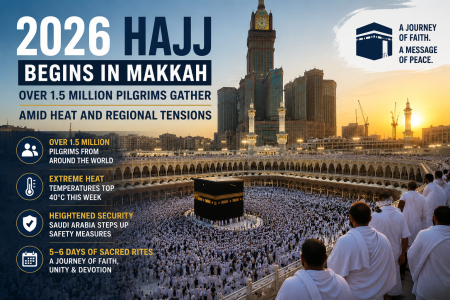
The 2026 Hajj pilgrimage has officially begun in the Holy city of Makkah, drawing more than 1.5 million Muslims from around the world. As one of the largest annual religious gatherings on Earth, Hajj continues to hold deep spiritual significance for the global Muslim community.
This year’s pilgrimage is unfolding under extraordinary circumstances. Alongside intense summer heat and heightened security measures, the event is also shaped by ongoing geopolitical instability across the Middle East. Despite these challenges, pilgrims continue to arrive with devotion, unity, and hope for peace.
The sacred journey of Hajj remains a powerful symbol of faith, discipline, and equality bringing millions together in one of the most spiritually significant moments of their lives.
What is Hajj? (Spiritual Significance Explained)
Hajj is the annual Islamic pilgrimage to Makkah and is one of the Five Pillars of Islam. Every Muslim who is physically and financially able is required to perform Hajj at least once in their lifetime.
During Hajj, pilgrims perform a series of sacred rituals including:
- Tawaf (circling the Kaaba seven times)
- Sa’i (walking between Safa and Marwah)
- Standing at Arafat (the most important ritual)
- Symbolic stoning of the devil in Mina
These acts represent unity, humility, and submission to God.
Hajj is not just a journey it is a complete spiritual transformation that millions prepare for years in advance.
2026 Hajj Overview: Key Highlights
The 2026 Hajj season has already set global attention due to its scale and conditions.
1. Over 1.5 Million Pilgrims Arrived
More than 1.5 million pilgrims have reached Saudi Arabia, including a significant number of international visitors. The increase in foreign pilgrims compared to 2025 highlights improved travel facilitation and post-pandemic recovery in global mobility.
2. Mina Tent City Fully Occupied
Pilgrims are being accommodated in Mina, a massive tent city designed to host millions during the most intense days of Hajj. The area becomes one of the world’s largest temporary settlements.
3. Extreme Heat Conditions
Temperatures in Makkah are expected to exceed 40°C, creating serious challenges for elderly pilgrims and those with health conditions. Saudi authorities have implemented cooling systems, shaded pathways, and hydration stations.
4. Heightened Security Measures
Due to ongoing regional tensions, Saudi Arabia has increased surveillance, crowd control systems, and emergency response readiness to ensure pilgrim safety.
5. Standard 5-6 Day Ritual Duration
Hajj rituals typically span five to six days, depending on individual pilgrimage plans and schedules.
Why 2026 Hajj is Globally Significant
This year’s pilgrimage stands out not only for its size but also for its geopolitical backdrop.
Middle East Tensions and Global Attention
The pilgrimage is taking place during a period of regional instability. Issues such as diplomatic friction, security concerns, and intermittent conflicts in parts of the Middle East have added a layer of uncertainty.
Despite this, Hajj continues uninterrupted, reflecting its protected religious status and international importance.
Peace Expectations Among Pilgrims
Many pilgrims have expressed hopes that the spiritual gathering will serve as a reminder of unity and peace across nations, regardless of political divides.
Key Challenges Faced During Hajj 2026
1. Heat Stress and Health Risks
One of the biggest challenges this year is extreme weather conditions. Heat exhaustion, dehydration, and fatigue remain major risks.
Authorities have deployed:
- Medical emergency tents
- Mobile clinics
- Ambulance units across pilgrimage routes
2. Crowd Management
Managing over a million people in confined sacred areas requires advanced crowd control systems, especially during peak rituals like Arafat and Tawaf.
3. Travel and Accommodation Pressure
With high international participation, logistics including transport, accommodation, and timing coordination remain critical.
Impact of Technology on Hajj 2026
Modern technology plays a major role in managing the pilgrimage:
- Smart crowd monitoring systems
- AI-based security surveillance
- Digital health tracking for pilgrims
- Mobile apps for navigation and guidance
- Real-time emergency alerts
Why Hajj Remains One of the World’s Most Powerful Spiritual Gatherings
Despite modern challenges, Hajj continues to be a deeply unifying global event. Pilgrims from diverse cultures, languages, and backgrounds gather with a shared purpose worship and spiritual renewal.
The simplicity of white garments, the repetition of prayers, and the collective movement of millions symbolize equality and unity before God.
Conclusion
The 2026 Hajj in Makkah stands as a powerful reminder of faith, resilience, and unity. With over 1.5 million pilgrims participating amid heat, global tensions, and logistical challenges, the pilgrimage remains one of the most remarkable human gatherings in the world.As the rites continue over the coming days, the world watches not just a religious event but a moment of shared humanity, devotion, and hope for peace.