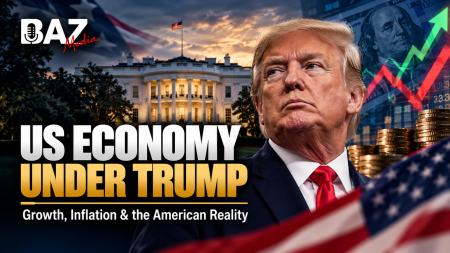
America’s economy continues to expand ahead of the 2026 midterm elections, but higher consumer prices, slower hiring and increasing borrowing costs are raising questions about how much of that growth is reaching ordinary households.
WASHINGTON | October 20, 2026 – The United States economy is sending mixed signals as President Donald Trump approaches the congressional midterm elections with an optimistic message about the country’s financial performance.
The administration has highlighted economic growth, rising household incomes and relatively low unemployment as evidence that its policies are delivering results.
However, a closer examination of economic ind icators reveals a more complicated picture.
While the US economy continues to outperform several other advanced economies, inflation has accelerated, employment growth has weakened and federal borrowing remains elevated. At the same time, substantial investment in artificial intelligence is supporting economic activity, raising questions about how sustainable the current expansion would be without continued technology-sector spending. For American voters, the central issue is whether national economic growth is translating into meaningful improvements in everyday living standards.
US GDP Growth Remains Resilient Despite Trade Uncertainty
The American economy has demonstrated considerable resilience despite concerns surrounding the Trump administration’s trade policies.
According to the latest figures from the US Bureau of Economic Analysis, gross domestic product (GDP) has been expanding at an annualized rate of approximately 2.2%. This performance places the United States ahead of other G7 economies over the same reporting period. The result is particularly significant given the uncertainty that followed the administration’s announcement of extensive import tariffs in April 2025.
At the time, economists warned that higher trade barriers could discourage investment, disrupt supply chains and reduce consumer spending. The International Monetary Fund subsequently lowered its economic growth expectations.
However, the administration later reduced or modified several proposed tariffs, limiting some of the disruption initially anticipated. The economy’s continued expansion suggests that American businesses and consumers have remained more resilient than early forecasts indicated.
Nevertheless, economic growth alone does not provide a complete picture of financial conditions across the country.
Artificial Intelligence Investment Is Becoming a Major Economic Driver
One of the most important developments supporting US economic growth is the rapid expansion of artificial intelligence infrastructure.
Technology companies are investing heavily in data centers, computing facilities and other infrastructure needed to support advanced AI systems.
According to data compiled by Our World in Data, monthly US business spending on data-center construction reached approximately $5 billion in August 2026. That figure represents nearly twice the monthly spending level recorded when Trump returned to office in January 2025. This investment has supported construction activity, infrastructure development and demand for specialized equipment. It has also helped strengthen economic performance at a time when other sectors face uncertainty.
However, the concentration of investment in artificial intelligence introduces an important risk. If technology companies reduce capital spending because of weaker demand, financing constraints or disappointing commercial returns, one of the economy’s major growth drivers could lose momentum. For policymakers and investors, the challenge is determining whether AI-related investment can produce lasting productivity gains rather than a temporary surge in infrastructure spending.
US Inflation Rises as Tariffs and Energy Costs Pressure Consumers
Inflation remains one of the clearest challenges facing American households.
According to US Bureau of Labor Statistics figures cited in the latest reporting, the annual inflation rate has reached 3.7%. Although this is considerably below the approximately 9% inflation peak recorded in 2022, it exceeds the roughly 3% rate at the beginning of Trump’s second term. The increase has been influenced by several factors, including import tariffs and higher energy prices. Tariffs can increase the cost of imported products and components used by American businesses.
Companies may absorb part of these costs through reduced profit margins, but some additional expenses can be passed on to consumers.
Research published by economists at the Federal Reserve Bank of New York has examined how tariff-related costs move through supply chains and affect consumer prices. Energy prices have added another layer of pressure. Disruption to Middle Eastern oil supplies associated with the US-Israel conflict involving Iran has contributed to higher fuel costs. US diesel prices reportedly reached $6.52 per gallon in September 2026.
Because diesel is widely used in transportation, agriculture and manufacturing, higher prices can influence the cost of producing and delivering everyday goods.
Are Groceries and Everyday Expenses Becoming More Affordable?
The inflation figures highlight a distinction between slowing price increases and actual reductions in prices. Even when inflation moderates, consumers may continue paying substantially more than they did several years earlier. Recent price data show differing trends across essential food categories. Products such as beef and coffee have become more expensive since Trump returned to office, while egg prices have declined. Businesses are also facing higher transportation and production expenses associated with energy costs. These increases can eventually reach supermarket shelves.
For households managing fixed budgets, the combined cost of groceries, utilities, healthcare and housing is often more important than headline GDP growth. This explains why positive national economic indicators do not necessarily translate into stronger consumer confidence.
Household Incomes Are Rising, but Financial Benefits Are Uneven
There has been measurable progress in American household incomes.
According to the US Census Bureau, inflation-adjusted median household income increased by 2.6% in 2025, reaching approximately $87,460.
That represented a record level in the reported series. However, income growth does not capture every policy-related cost affecting households.
An analysis by the Institute on Taxation and Economic Policy (ITEP) considered the combined effects of tax changes, higher consumer prices and the expiration of additional health-insurance subsidies.
Its estimates suggest that the financial consequences differ significantly across income groups.
Middle-income households were projected to be approximately $1,700 worse off in 2026 than they would have been under the study’s comparison scenario. The lowest-income fifth of households were estimated to face an average negative impact of around $750. By contrast, the wealthiest 1% were projected to benefit by approximately $12,560 on average, largely because of tax reductions. These figures represent modeled policy impacts, not direct measurements of changes in every household’s income. They nevertheless illustrate an important economic question: whether the benefits of growth and tax policy are distributed broadly or concentrated among higher-income groups.
US Job Creation Slows Despite Low Unemployment
Employment is another area where the administration’s economic message faces scrutiny. Trump has argued that tariffs would encourage companies to relocate manufacturing operations to the United States, generating additional domestic employment.
However, the pace of overall job creation has slowed.
Employment data cited in the latest analysis indicate that the US economy has added an average of approximately 34,000 jobs per month since the beginning of Trump’s second term. That compares with roughly 122,000 jobs per month during the final year of Joe Biden’s presidency. Manufacturing employment has also shown limited improvement. Approximately 12.6 million Americans were employed in manufacturing in September 2026, slightly below the level recorded when Trump returned to the White House. Despite slower hiring, the national unemployment rate remains relatively low at 4.2%.
This apparent contradiction reflects changes in both labor demand and labor supply.
The administration’s immigration restrictions and deportation policies have reduced growth in the available workforce, according to economic research from the Federal Reserve Bank of Dallas. When fewer workers enter the labor market, the economy may require fewer new jobs each month to maintain a stable unemployment rate. As a result, a low unemployment rate does not necessarily indicate strong hiring across every industry.
Trump’s Tax Cuts and the Growing US Budget Deficit
Federal borrowing presents another challenge for the American economy.
According to figures from the Congressional Budget Office, the federal budget deficit reached approximately $2 trillion during the fiscal year ending in September 2026.
That represents roughly 6% of US GDP. A deficit occurs when federal spending exceeds government revenue, requiring the Treasury to borrow money to cover the difference. Tax reductions, government expenditure and debt-servicing costs can all influence the size of the shortfall. The International Monetary Fund projects that the US fiscal deficit could exceed 8% of GDP by 2030. Large deficits can support economic activity in the short term by allowing government spending to remain above tax revenues.
However, sustained borrowing also increases the national debt and the cost of servicing it.
The IMF has warned that America’s fiscal trajectory creates longer-term financial vulnerabilities. For the administration, the challenge is balancing economic stimulus and tax policy with the need to maintain confidence in public finances.
Rising US Bond Yields Could Make Mortgages More Expensive
Government borrowing costs are increasingly relevant to American households.
The yield on the benchmark 10-year US Treasury bond has climbed above 5%, according to the market figures cited in the latest reporting. Treasury yields are influenced by several factors, including inflation expectations, monetary policy, investor demand and concerns about future government borrowing.
When longer-term yields rise, financing conditions can become more expensive throughout the economy. Mortgage rates, business loans and other forms of credit may face upward pressure. This can make homeownership more difficult for prospective buyers and increase financing costs for companies considering expansion. Higher borrowing costs can also discourage investment and weaken consumer spending.
Consequently, rising bond yields create an additional risk for an economy that is already dealing with inflation and slower employment growth.
How Does the US Economy Compare With Other G7 Countries?
The United States continues to demonstrate stronger economic growth than several other major advanced economies. Its technology sector, consumer market and investment activity remain important competitive advantages.
However, international comparisons require more than examining GDP growth rates. Inflation, productivity, employment conditions, public debt and household purchasing power also influence economic performance.
A country can record relatively strong growth while many residents continue experiencing financial pressure. The US economy therefore presents two contrasting realities: resilience at the national level and affordability challenges at the household level.
What Could Shape the US Economy After the 2026 Midterm Elections?
Several developments could determine the direction of the American economy over the coming months.
The first is inflation. If energy prices remain elevated or tariff-related costs continue reaching consumers, inflation may prove difficult to reduce.
The second is employment. A prolonged slowdown in hiring could weaken household confidence and consumer spending, even if unemployment remains relatively stable.
The third is artificial intelligence investment. Continued infrastructure spending could support economic expansion, while a slowdown could expose weaknesses in other sectors.
Finally, government borrowing and financial-market interest rates will remain important indicators of long-term economic stability. These factors are likely to influence political debate as voters evaluate the administration’s economic record.
Final Analysis: Is Trump’s Economic Strategy Working?
The evidence does not support a simple conclusion that the American economy is either booming across the board or facing an immediate collapse.
GDP continues to grow, unemployment remains relatively low and AI-related investment is providing substantial support. At the same time, inflation has increased, job creation has slowed and government borrowing has become more expensive. Household income figures show improvement, but the effects of tax changes and rising costs vary considerably across income groups.
The central question is no longer whether the US economy is growing. It is whether that growth is improving financial security for a broad range of Americans.
As the 2026 midterm elections approach, that distinction may become one of the most important measures by which voters judge President Trump’s economic performance.