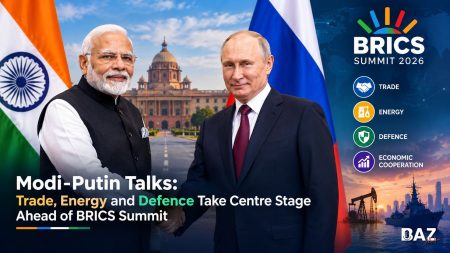
Indian Prime Minister Narendra Modi and Russian President Vladimir Putin held high-level bilateral talks in New Delhi on Friday, September 11, 2026, ahead of the BRICS Summit 2026. The meeting comes at a crucial time for global diplomacy, with the Ukraine war, the Iran conflict, energy security and the changing international economic order shaping discussions among major emerging economies.
The Modi Putin meeting 2026 is expected to focus heavily on trade, energy, defence and economic cooperation, while both countries look to strengthen their long-standing strategic partnership.
Modi Putin Talks Focus on Expanding Bilateral Trade
One of the major priorities during the Modi Putin bilateral talks is expected to be the expansion of India-Russia trade.
India and Russia have set their sights on increasing bilateral trade to $100 billion by 2030. Achieving this ambitious target will require both countries to address India’s trade imbalance with Russia while creating greater market access for Indian exporters.
The two sides are also expected to explore opportunities in manufacturing, steel, fertilisers, critical minerals and other sectors that could increase two-way economic activity.
Alternative payment mechanisms and greater use of national currencies could also feature prominently in the discussions as India and Russia seek ways to make bilateral trade more resilient to international financial pressures.
The push for stronger economic connectivity reflects the broader transformation of India Russia relations, with both countries looking beyond traditional areas of cooperation.
Energy Security Remains a Key Priority
Energy is another major component of the Putin India visit 2026.
Russia remains an important energy partner for India, particularly in crude oil. Discussions between Modi and Putin are expected to cover oil supplies, energy security and potential expansion of cooperation in civil nuclear energy.
Civil nuclear cooperation could become an increasingly important part of the relationship, with discussions potentially involving additional reactors and support for the nuclear fuel cycle.
For India, maintaining reliable and affordable energy supplies remains strategically important as the country continues to expand its economy and industrial capacity.
The talks therefore come at a time when global energy markets remain sensitive to geopolitical tensions, making India Russia energy cooperation 2026 an important area to watch.
Defence Cooperation Also on the Agenda
Defence remains one of the traditional pillars of the India-Russia strategic relationship.
During the Modi Putin meeting in New Delhi, potential defence discussions are expected to include upgrades to BrahMos missile systems, the delivery of remaining S-400 air-defence systems and Russia’s possible offer of Su-57 fighter aircraft.
India and Russia have maintained decades of defence cooperation, although New Delhi has increasingly sought to diversify its defence partnerships and strengthen domestic defence manufacturing.
Future cooperation could therefore increasingly focus on technology transfer, joint production and manufacturing in India rather than simply purchasing finished military equipment.
The potential development and upgrading of defence platforms could reinforce the strategic dimension of Russia India defence cooperation while supporting India’s broader push for greater defence self-reliance.
Economic Connectivity Beyond Oil and Defence
The relationship between India and Russia is also expanding into sectors beyond traditional trade and defence.
The two countries may explore cooperation in critical minerals, fertilisers, manufacturing, steel, railways and tunnelling. These sectors could create new opportunities for investment and long-term industrial cooperation.
Critical minerals are particularly significant because countries worldwide are competing to secure supplies of resources essential for electric vehicles, advanced electronics, renewable energy technologies and modern defence systems.
Improved transportation and economic connectivity could also help address some of the logistical challenges affecting India-Russia trade.
Modi Putin Meeting Comes Ahead of BRICS Summit 2026
The timing of the Modi Putin meeting 2026 is particularly significant because India is hosting the BRICS gathering from September 11 to 13.
Chinese President Xi Jinping and Iranian President Masoud Pezeshkian are also expected to attend, placing the Modi-Putin talks within a much broader geopolitical environment.
The BRICS Summit 2026 is taking place against the backdrop of the Ukraine war and the conflict involving Iran, while BRICS members continue discussions about strengthening economic cooperation and reducing dependence on traditional global financial systems.
Putin’s participation is also politically significant. According to Indian reporting, this marks his first in-person participation at a BRICS summit outside Russia since the beginning of the Ukraine war in 2022.
Why the Modi Putin Meeting Matters
The latest Modi Putin talks demonstrate that India continues to view Russia as an important strategic partner despite major changes in global geopolitics.
For Russia, maintaining strong relations with India provides access to one of the world’s fastest-growing major economies. For India, Russia remains an important partner in energy, defence, nuclear cooperation and several strategic industries.
At the same time, New Delhi has continued to maintain relationships with the United States, Europe, the Middle East and other major powers. This reflects India’s broader foreign-policy approach of maintaining strategic autonomy while pursuing its national economic and security interests.
The outcome of the meeting could therefore provide important signals about the future direction of India Russia relations, particularly in trade, energy and defence.
What Comes Next for India-Russia Relations?
The success of the proposed $100 billion India-Russia trade target by 2030 will depend on whether both countries can overcome payment, logistics and market-access challenges.
Energy cooperation is likely to remain central, while defence ties may increasingly shift toward joint production and advanced technologies. Meanwhile, cooperation in critical minerals, infrastructure and manufacturing could provide new foundations for the relationship.
As the BRICS Summit 2026 unfolds, the Modi-Putin meeting could prove to be one of the most closely watched bilateral engagements, offering insight into how India and Russia intend to navigate an increasingly complex global landscape.
For now, the meeting highlights a clear message: India-Russia ties are evolving beyond their traditional foundations, with trade, energy, technology and strategic cooperation increasingly shaping the partnership.