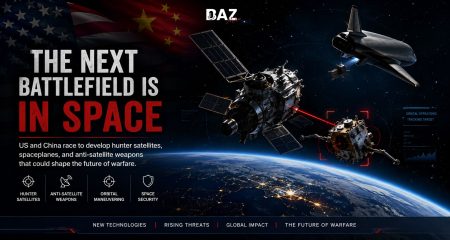
The US-China space race is entering a more dangerous phase. What was once largely a competition over exploration, communications and satellite technology is increasingly becoming a contest over military capabilities in orbit.
Both the United States and China are developing increasingly sophisticated military satellites, spaceplanes and orbital systems capable of manoeuvring close to other spacecraft. Some of these technologies are designed for legitimate purposes such as inspection, servicing and satellite maintenance. However, the same capabilities could potentially be adapted for offensive missions.
This has renewed concerns about the future of space warfare and whether a major conflict on Earth could eventually extend into orbit.
A Chinese Spaceplane Raises New Questions
In June, a secretive Chinese unmanned spaceplane released a small satellite hundreds of miles above Earth. The deployment attracted attention because it occurred in an orbital region containing numerous commercial and military spacecraft.
According to space-tracking company LeoLabs, the newly released object performed a manoeuvre around another Chinese satellite before returning toward the spaceplane.
The exact purpose of the mission remains unclear. There is no public confirmation that the satellite was designed as a weapon. Nevertheless, the manoeuvre demonstrated an important capability: the ability of spacecraft to conduct sophisticated proximity operations in orbit.
Such operations are becoming increasingly important because satellites no longer have to remain in fixed or predictable positions. Modern spacecraft can change their orbits, approach other satellites and potentially inspect, interact with or interfere with them.
That capability is at the heart of concerns surrounding the emerging US-China space arms race.
What Are Hunter Satellites?
One of the most closely watched developments is the emergence of so-called hunter satellites.
A hunter satellite is essentially a manoeuvrable spacecraft capable of approaching another object in orbit. Depending on its design and mission, it could potentially inspect, service, move or capture another spacecraft.
In peaceful applications, similar technologies could be used to repair satellites, refuel them or remove space debris.
The concern is that the same technology could potentially be modified for military purposes.
A spacecraft capable of approaching another satellite could, in theory, interfere with its operations, damage sensitive components or alter its orbit.
This makes hunter satellites particularly significant in discussions about future space warfare.
China’s Growing Military Space Capabilities
China has invested heavily in its space program and is developing a broad range of military and dual-use technologies.
Researchers linked to China’s military have studied systems capable of conducting satellite servicing, extending spacecraft fuel supplies and performing complex orbital manoeuvres.
China also possesses other technologies relevant to anti-satellite warfare, including ground-based systems designed to interfere with space-based communications and surveillance.
The country has previously demonstrated the ability to conduct complex orbital operations, increasing international attention on its military space program.
US officials have repeatedly warned that China’s ability to threaten satellites is developing rapidly.
For military planners, the concern is straightforward: modern armed forces depend heavily on satellites for communications, navigation, intelligence, surveillance and targeting.
Disrupting those systems could significantly affect military operations on Earth.
How the United States Is Responding
The United States is also expanding its military space capabilities as it attempts to protect its satellites and prepare for potential attacks.
The US Space Force has been developing systems designed to detect, track and respond to threats in orbit. These include manoeuvrable spacecraft, electromagnetic warfare capabilities and other technologies intended to protect American space assets.
The United States also maintains and develops a range of capabilities associated with anti-satellite weapons, including electronic jamming, directed-energy systems and missile-based technologies.
The objective is not simply to build weapons. Increasingly, military planners want satellites to be capable of moving quickly, communicating securely and surviving in an environment where they may be deliberately targeted.
This represents a major shift in military thinking.
Why Space Warfare Matters
Satellites are critical infrastructure for modern society and modern militaries.
They support GPS and navigation, weather forecasting, telecommunications, financial systems, internet connectivity, intelligence gathering and military communications.
That means a conflict involving satellites could have consequences far beyond space.
If an adversary disables a military satellite, for example, the impact could potentially extend to command systems, battlefield communications or intelligence operations on Earth.
There is also another major concern: space debris.
Destroying satellites with kinetic weapons can create thousands of fragments travelling at extremely high speeds. Those fragments can damage or destroy other spacecraft, potentially creating a chain reaction in heavily populated orbital regions.
This is one reason why the militarization of space presents risks even to countries that are not directly involved in a conflict.
Is Space Becoming the Next Battlefield?
The answer is increasingly complicated.
Space has already been an important part of military operations for decades. However, the growing ability of spacecraft to manoeuvre around one another is changing the strategic environment.
The distinction between a satellite designed for peaceful servicing and one capable of offensive action can be difficult to establish.
A spacecraft that can approach another satellite may be conducting an inspection today but could potentially be used for interference tomorrow.
This creates a serious challenge for international security.
The emerging US-China space arms race is therefore not simply about who can launch more satellites. It is about who can control, protect and potentially disrupt critical systems in orbit.
The Future of Warfare May Extend Beyond Earth
The competition between Washington and Beijing suggests that the next generation of military technology will increasingly involve space.
Hunter satellites, manoeuvrable spacecraft, spaceplanes, electronic warfare systems and anti-satellite weapons could all become important components of future military strategies.
Yet the biggest question is not whether countries can develop these technologies. They increasingly can.
The bigger question is how these capabilities will be regulated and whether nations can establish rules that prevent dangerous misunderstandings or an uncontrolled escalation in orbit.
For now, the June Chinese spaceplane mission and the wider development of military space systems offer a glimpse into a future where satellites are no longer merely observers and communication platforms.
They may become strategic assets that must be defended and, in a conflict, potentially targeted.
As the US-China space race accelerates, the battlefield of the future may not be limited to land, sea, air or cyberspace.