
World’s Most Powerful Solar Telescope Captures the Highest-Resolution Image of the Sun Ever
Scientists have achieved a historic breakthrough in solar astronomy after the Daniel K. Inouye Solar Telescope, the world’s most powerful solar telescope, captured the highest-resolution images of the Sun’s visible surface ever recorded.
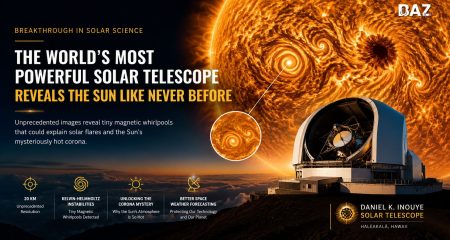
The stunning observations provide an unprecedented look at the Sun’s magnetic landscape, revealing microscopic whirlpools and magnetic structures that scientists believe play a crucial role in heating the Sun’s atmosphere and triggering powerful solar eruptions.
This remarkable discovery could reshape our understanding of the Sun while significantly improving future space weather forecasting, helping protect satellites, power grids, communication systems, and astronauts from solar storms.
A Historic Milestone in Solar Observation
Located atop Haleakalā volcano in Hawaii, the Daniel K. Inouye Solar Telescope is equipped with a massive 4-meter primary mirror, making it the most advanced solar observatory ever constructed.
Unlike previous telescopes, Inouye can observe the Sun at an astonishing level of detail, allowing scientists to detect structures as small as 20 kilometers (12 miles) across on the solar surface.
These latest observations focused on a highly magnetically active region surrounding a sunspot, where researchers witnessed features never directly observed before.
The images represent a major leap forward in solar physics, providing scientists with valuable insight into how magnetic energy behaves at the smallest scales.
Tiny Magnetic Whirlpools Finally Observed
Among the telescope’s biggest discoveries were Kelvin-Helmholtz Instabilities (KHI) tiny whirlpool-like vortices that form where magnetic structures interact with moving plasma.
For decades, computer models predicted that these microscopic vortices should exist on the Sun, but technology had never been powerful enough to capture them directly.
Now, thanks to the extraordinary resolution of the Inouye Telescope, scientists have finally observed these whirlpool structures in remarkable detail.
Even more surprising, researchers found that these vortices appear almost everywhere in the observed region, suggesting they are a common feature of the Sun rather than a rare phenomenon.
This discovery opens an entirely new chapter in understanding how energy moves throughout the Sun.
Solving the Mystery of the Sun’s Super-Hot Corona
One of astronomy’s greatest mysteries has puzzled scientists for decades:
Why is the Sun’s corona millions of degrees hotter than its visible surface?
The visible surface of the Sun has a temperature of approximately 5,500°C, while the outer atmosphere, known as the corona, can exceed one million degrees Celsius.
This seemingly impossible temperature difference has challenged physicists for generations.
Researchers now believe these newly observed magnetic whirlpools may act as tiny engines that stir solar plasma, transfer magnetic energy, and generate heat throughout the corona.
If confirmed by future studies, Kelvin-Helmholtz Instabilities could become one of the missing pieces needed to explain the long-standing mystery of coronal heating.
Understanding Solar Flares and Space Weather
The Sun constantly releases enormous amounts of magnetic energy.
Sometimes this energy erupts suddenly as solar flares or coronal mass ejections (CMEs) massive explosions capable of sending billions of tons of charged particles into space.
When directed toward Earth, these solar storms can:
- Disrupt satellite operations
- Damage power grids
- Interrupt GPS navigation
- Affect radio communications
- Increase radiation exposure for astronauts
- Create spectacular auroras near Earth’s poles
By understanding how tiny magnetic structures behave before larger eruptions occur, scientists hope to improve predictions of dangerous space weather events.
Earlier warnings could give governments, airlines, satellite operators, and utility companies valuable time to prepare for incoming solar storms.
Why the Inouye Telescope Is So Powerful
The Daniel K. Inouye Solar Telescope is unlike any previous solar observatory.
Its enormous 4-meter mirror collects approximately seven times more sunlight than earlier solar telescopes, enabling researchers to observe incredibly fine magnetic structures that were previously invisible.
Advanced adaptive optics systems compensate for atmospheric turbulence, while cutting-edge scientific instruments measure magnetic fields, plasma motion, and temperature changes across the solar surface with exceptional precision.
Together, these technologies provide the clearest window ever into the dynamic processes shaping our nearest star.
A New Era for Solar Science
These groundbreaking observations represent far more than beautiful images.
They offer scientists an opportunity to test decades of theoretical models, refine computer simulations, and deepen our understanding of how stars generate, transport, and release energy.
Future observations from the Inouye Solar Telescope are expected to uncover additional hidden processes occurring on the Sun’s surface, bringing researchers closer to solving some of astrophysics’ biggest mysteries.
As technology continues advancing, humanity’s ability to observe our nearest star will only improve, opening the door to discoveries that could enhance both scientific knowledge and the protection of Earth’s technological infrastructure.
Final Thoughts
The world’s most powerful solar telescope has delivered an extraordinary glimpse into the hidden mechanics of our closest star. By capturing the highest-resolution images ever taken of the Sun’s visible surface, the Daniel K. Inouye Solar Telescope has revealed tiny magnetic whirlpools that may explain why the corona is so incredibly hot and how solar flares begin.
Beyond advancing our understanding of the Sun, these discoveries could transform space weather forecasting, helping safeguard satellites, communications, navigation systems, and electrical infrastructure from the impacts of powerful solar storms. As researchers continue exploring the Sun with unprecedented clarity, we are entering a new era of solar science that promises to unlock some of astronomy’s greatest mysteries.