Ancient Disaster May Have Shaped Neptune’s Moons, James Webb Telescope Reveals
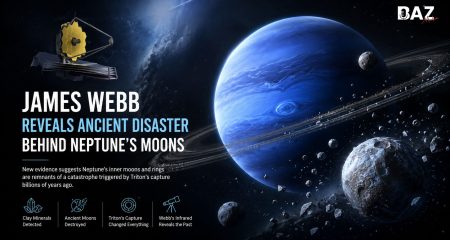
The James Webb Space Telescope (JWST) continues to transform our understanding of the solar system, and its latest observations have uncovered compelling evidence that Neptune’s inner moons and rings are the remains of an ancient cosmic catastrophe. Scientists believe this dramatic event occurred billions of years ago after Neptune captured its largest moon, Triton, triggering massive collisions that reshaped the planet’s entire satellite system.
Using Webb’s advanced infrared instruments, researchers detected unusual clay-like minerals on several of Neptune’s small inner moons an unexpected discovery that could finally explain why Neptune’s moon system looks so different from those surrounding the other giant planets.
This remarkable finding offers a new glimpse into the violent history of the outer solar system.
James Webb Space Telescope Reveals Hidden Clues
Unlike previous space telescopes, the James Webb Space Telescope can observe celestial objects in infrared wavelengths with exceptional sensitivity. This allows scientists to study the chemical composition of distant worlds in unprecedented detail.
During recent observations, Webb examined several of Neptune’s inner moons, including:
- Proteus
- Larissa
- Galatea
Instead of finding ordinary icy surfaces, researchers identified clay-rich minerals that are rarely expected on such small moons.
These minerals suggest that the surfaces visible today may actually be fragments from the interiors of much larger ancient moons that were destroyed long ago.
The discovery provides one of the strongest pieces of evidence yet that Neptune experienced an enormous collision-driven restructuring early in its history.
Triton’s Capture May Have Changed Everything
The leading explanation centers on Triton, Neptune’s largest moon.
Unlike most large moons in the solar system, Triton orbits Neptune in the opposite direction of the planet’s rotation a retrograde orbit. This unusual motion has long suggested that Triton did not originally form around Neptune.
Scientists believe Triton was once a Kuiper Belt object, a distant icy body orbiting beyond Neptune. Billions of years ago, it wandered too close to Neptune and became trapped by the planet’s gravity.
This dramatic capture likely had catastrophic consequences.
As Triton’s orbit gradually evolved, its enormous gravitational influence may have destabilized Neptune’s original family of moons. Many of these moons would have collided with one another, breaking apart into countless fragments.
Over millions of years, those fragments eventually merged again to form the smaller inner moons and ring system visible today.
Clay Minerals Tell an Ancient Story
One of the most exciting parts of the discovery is the identification of clay-like materials on Neptune’s moons.
Normally, astronomers expect small icy moons to contain relatively simple surface compositions. Clay minerals, however, usually form deeper inside larger bodies where heat and geological activity have altered the original material.
Finding these minerals on moons like Proteus, Larissa, and Galatea suggests their surfaces may expose material that once belonged to the interiors of ancient satellites.
In other words, today’s moons could actually be surviving fragments of much larger worlds destroyed in a massive ancient collision.
This evidence strongly supports the theory that Neptune’s satellite system was rebuilt after a catastrophic event.
Why the James Webb Space Telescope Matters
The James Webb Space Telescope represents one of humanity’s most advanced astronomical observatories.
Its infrared capabilities allow scientists to detect minerals, ices, and organic compounds that earlier telescopes simply could not identify.
For Neptune, Webb provides:
- High-resolution infrared spectroscopy
- Detailed chemical mapping
- Improved understanding of moon surfaces
- Better analysis of planetary rings
- New evidence of ancient planetary evolution
Without Webb’s advanced instruments, identifying these unusual clay minerals would have been extremely difficult.
This demonstrates why the telescope is revolutionizing planetary science throughout our solar system.
Understanding Neptune’s Strange Moon System
Neptune has always puzzled astronomers.
Unlike Jupiter and Saturn, whose largest moons appear to have formed alongside their planets, Neptune’s satellite system seems unusually chaotic.
Several characteristics have remained difficult to explain:
- Triton’s retrograde orbit
- Small irregular inner moons
- Complex ring structures
- Evidence of repeated gravitational disruption
The new Webb observations offer a coherent explanation for these mysteries.
If Triton’s capture destroyed Neptune’s original moons, then the planet’s current satellites are essentially second-generation moons formed from ancient debris.
That scenario explains why Neptune’s moon system differs so dramatically from those of the other gas giants.
What This Means for the Solar System
The discovery extends far beyond Neptune itself.
Planetary scientists increasingly believe that the early solar system experienced frequent collisions, migrations, and gravitational interactions that dramatically reshaped planets and moons.
Neptune now appears to be another important example of this dynamic history.
The findings support broader theories that:
- Giant planets migrated during the early solar system.
- Moon systems can be completely rebuilt after catastrophic events.
- Planetary rings may form from destroyed satellites.
- Ancient collisions leave chemical signatures detectable billions of years later.
These insights help researchers reconstruct how our solar system evolved into the structure we observe today.
Future Research with James Webb
Scientists plan to continue using the James Webb Space Telescope to investigate Neptune, Triton, and other distant worlds.
Future observations may reveal:
- Additional minerals on Neptune’s moons
- More evidence supporting Triton’s capture
- Better understanding of Neptune’s ring evolution
- Hidden geological features on icy satellites
- New clues about the formation of the outer solar system
Each new observation helps refine models of planetary evolution and may uncover even more evidence of ancient cosmic events.
Conclusion
The latest observations from the James Webb Space Telescope provide compelling evidence that Neptune’s inner moons and rings are the remnants of a catastrophic event that occurred billions of years ago. By identifying unusual clay minerals on moons such as Proteus, Larissa, and Galatea, scientists have strengthened the theory that Neptune’s moon system was dramatically reshaped after the capture of Triton.
This discovery not only explains Neptune’s unusual satellite system but also highlights the violent history of the early solar system. As Webb continues exploring the outer planets, researchers expect even more groundbreaking discoveries that will deepen our understanding of planetary formation, moon evolution, and the dynamic processes that shaped our cosmic neighborhood.