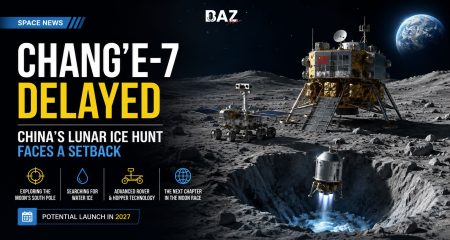
China has postponed the launch of Chang’e-7, one of its most ambitious lunar exploration missions, after officials determined that the spacecraft did not meet the required launch conditions during the planned 2026 window. No new launch date has been officially announced, although reports suggest the mission could now move into 2027.
The delay comes at a crucial moment in the global Moon race, as China and the United States increasingly focus on the lunar south pole and its potentially valuable water-ice deposits.
Chang’e-7: China’s Mission to the Lunar South Pole
The Chang’e-7 mission is designed to explore one of the most scientifically challenging areas of the Moon: its south pole.
Unlike many previous lunar missions that focused on relatively accessible regions, Chang’e-7 will investigate permanently shadowed craters. These areas receive little or no direct sunlight and may contain water ice preserved for billions of years.
The mission will use several spacecraft and exploration systems, including an orbiter, lander, rover and a unique rocket-powered flying vehicle known as a hopper.
The orbiter will help map and study the lunar south-pole region, while the lander will conduct scientific experiments on the surface. A rover equipped with instruments such as radar and spectroscopy equipment will investigate the lunar terrain and subsurface environment.
Perhaps the most innovative component is the hopper, which is designed to travel into extremely cold and permanently shadowed craters that conventional solar-powered vehicles may struggle to explore.
Why Is Chang’e-7 Searching for Water Ice?
The search for water on the Moon is one of the central objectives of modern lunar exploration.
Scientists have strong evidence that water ice exists in permanently shadowed regions near the lunar poles. Confirming its location, quantity and accessibility could have major implications for future human missions.
Lunar water could potentially be processed into several useful resources. It could provide drinking water for astronauts, oxygen for life support and, potentially, hydrogen and oxygen for rocket propellant.
This concept is known as in-situ resource utilization (ISRU). Instead of transporting every resource from Earth, future lunar missions could use materials already available on the Moon.
That could make long-duration lunar exploration significantly more practical.
Why the Lunar South Pole Matters
The lunar south pole has become a major target for space agencies because of its unusual environment.
Some crater interiors remain permanently shadowed, creating extremely cold conditions where volatile materials such as water ice may survive for exceptionally long periods.
At the same time, nearby elevated areas can receive sunlight for extended periods, potentially providing a source of solar power.
This combination of water resources, sunlight and strategically useful terrain makes the lunar south pole particularly attractive for future bases and scientific stations.
China’s Chang’e-7 mission is therefore about more than simply collecting scientific data. Its findings could help establish the knowledge and technology required for China’s longer-term lunar exploration plans.
Chang’e-7 Delay and the US-China Moon Race
The postponement could also affect the growing US-China space race.
The United States, through its Artemis programme and associated commercial lunar initiatives, is also targeting the lunar south pole. NASA and private-sector partners are developing missions intended to study the Moon’s surface, resources and environment.
A delay into 2027 could give American missions additional time to reach and investigate lunar polar regions before Chang’e-7 completes its objectives.
However, the postponement should not automatically be viewed as a major setback for China.
China has steadily developed its lunar exploration capabilities through the Chang’e programme. Previous missions have demonstrated increasingly sophisticated technologies, including lunar orbiting, landing, roving and sample return.
Taking additional time to improve reliability could ultimately increase the probability of Chang’e-7 achieving its scientific objectives.
Why the Launch Was Postponed
Chinese officials have emphasized the importance of ensuring safety, reliability and mission success before launching the spacecraft.
Some reports have associated the postponement with unfavorable weather conditions near China’s Wenchang Spacecraft Launch Site. However, a specific cause has not been officially confirmed by Chinese authorities.
Launch windows for lunar missions can be highly demanding because spacecraft trajectories, lighting conditions and surface operations must be carefully coordinated.
For Chang’e-7, these considerations are particularly important because its mission involves operating around the lunar south pole, where sunlight and shadows create unusual challenges for spacecraft and robotic vehicles.
What Happens If Chang’e-7 Finds Lunar Water?
A successful Chang’e-7 mission could provide valuable information about the distribution and characteristics of lunar water ice.
Finding accessible deposits would be a major scientific achievement, but the bigger question would be whether that water can actually be extracted and processed economically.
Future lunar infrastructure could potentially use local resources to produce water, oxygen and rocket fuel. This could reduce the amount of material that must be launched from Earth and support increasingly ambitious missions.
In the long term, lunar resources could become an important part of a permanent human presence beyond Earth.
A New Era of Lunar Exploration
The Chang’e-7 delay highlights an important reality of modern space exploration: reaching the Moon is no longer the only objective.
The next stage is about exploring difficult environments, identifying resources and developing technologies that could support sustained activity on the lunar surface.
China’s lunar programme, NASA’s Artemis initiative and commercial space companies are all contributing to this new phase of exploration.
If Chang’e-7 launches successfully in 2027, its investigation of the lunar south pole could become one of the most important robotic lunar missions of the decade.
The race for the Moon is increasingly becoming a race to understand and potentially use what the Moon already has.