
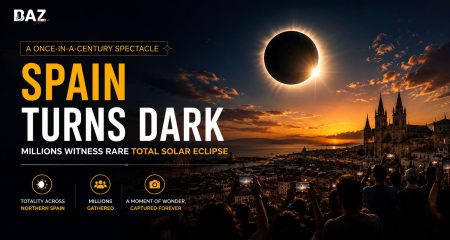
Millions of people across northern Spain gathered on Wednesday, August 12, 2026, to witness one of the most spectacular astronomical events in decades: a rare total solar eclipse that briefly transformed daylight into darkness.
The 2026 total solar eclipse in Spain was particularly historic because it marked the first total solar eclipse visible from mainland Spain in more than a century. As the Moon moved directly between the Earth and the Sun, its shadow swept across Spain from the Atlantic coast toward the Mediterranean, creating breathtaking moments for spectators across the country. Spain’s National Geographic Institute confirmed that the eclipse crossed the Iberian Peninsula from west to east, passing through numerous cities and regions.
2026 Total Solar Eclipse: What Happened in Spain?
The total solar eclipse on August 12, 2026, crossed a large section of northern Spain and the Balearic Islands. The path of totality passed through up to 13 autonomous communities and numerous provincial capitals, including A Coruña, Oviedo, León, Bilbao, Zaragoza, Valencia and Palma.
During totality, the Moon completely covered the Sun’s bright surface, allowing viewers to briefly see the Sun’s outer atmosphere, known as the corona. In several locations, totality lasted for around one to two minutes, although the exact duration depended on the viewing location.
The eclipse occurred unusually close to sunset. According to Spain’s National Geographic Institute, the Sun was already relatively low above the horizon during totality, making unobstructed western views especially important. In A Coruña, for example, totality lasted approximately 76 seconds, while some other locations experienced more than 100 seconds of darkness.
Where Was the Solar Eclipse Visible?
The path of totality in Spain stretched across much of the northern half of the country. Galicia was among the first areas to experience totality before the Moon’s shadow moved eastward across Spain.
Major cities and areas along or near the path included:
- A Coruña
- Oviedo
- León
- Bilbao
- Zaragoza
- Valencia
- Palma
- Several towns across northern and eastern Spain
Madrid and Barcelona were outside the main path of totality but experienced an exceptionally deep partial solar eclipse, with the vast majority of the Sun covered at maximum eclipse.
The combination of totality, sunset conditions and the low position of the Sun created an especially dramatic visual spectacle.
Millions Gather for a Once-in-a-Lifetime Event
The Spain solar eclipse 2026 attracted enormous crowds, including local residents, astronomers, photographers and international astro-tourists. Rural communities along the eclipse route became major viewing destinations as visitors searched for locations with clear skies and unobstructed horizons.
Reports says that Spain prepared for millions of visitors, with authorities implementing extensive police and safety measures around popular observation areas.
As darkness arrived, spectators in parks, plazas, viewing areas and open countryside reacted with cheers and applause. Many observers described the experience as surreal as daylight faded, temperatures changed and the solar corona appeared around the dark silhouette of the Moon.
The event also highlighted the growing popularity of astrotourism, with lesser-known Spanish destinations benefiting from visitors who traveled specifically to experience the eclipse.
Why Was the 2026 Eclipse So Special?
A total solar eclipse occurs when the Moon passes directly between Earth and the Sun and appears large enough in the sky to completely block the Sun’s visible disk.
However, total eclipses are relatively rare from any particular location. For mainland Spain, the August 12 event was especially significant because the country had not experienced a total solar eclipse of this kind for more than 100 years. Spain’s astronomical authorities described it as the first total solar eclipse visible from the Iberian Peninsula in over a century.
The timing also made the August 2026 solar eclipse unusual. Because the eclipse occurred during the evening and close to sunset, the Sun appeared low on the western horizon. This produced dramatic lighting conditions and made the event particularly attractive for photographers.
Safety and Wildfire Concerns
The huge influx of visitors also created challenges. Spanish authorities faced concerns about traffic, emergency access and wildfire risks, particularly in dry rural areas during the summer.
Authorities introduced restrictions in some locations and advised visitors to follow local instructions. Reports before the event highlighted concerns that the large number of vehicles and visitors could increase pressure on rural infrastructure and create additional wildfire risks.
For anyone viewing a solar eclipse, eye safety is also essential. Outside the brief period of totality, viewers must use proper certified solar viewing protection when looking directly toward the Sun.
Spain’s Eclipse Journey Continues
The spectacular 2026 total solar eclipse in Spain is not the end of the country’s remarkable eclipse sequence.
Spain is also positioned to experience another total solar eclipse on August 2, 2027, with totality crossing parts of southern Spain, including areas around Cádiz and Málaga. An annular solar eclipse will then occur on January 26, 2028. Spain’s National Geographic Institute describes these events as part of an extraordinary sequence of major solar eclipses visible from the country.
The August 12, 2026 eclipse, however, will remain a landmark moment for millions who watched the Moon’s shadow cross Spain and experienced daylight turning into darkness.
For astronomy enthusiasts, photographers and travelers, it was more than just an astronomical event it was a rare reminder of the extraordinary precision of the Earth-Moon-Sun system and the fleeting beauty of our planet’s place in space.