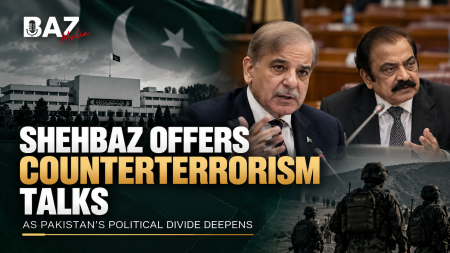
Pakistan’s federal government has renewed its call for a unified national security strategy, urging opposition parties to cooperate as political tensions and terrorism concerns intensify in Khyber Pakhtunkhwa.
ISLAMABAD | October 20, 2026 Prime Minister Shehbaz Sharif is prepared to engage opposition parties in discussions over Pakistan’s counterterrorism strategy, according to his adviser on political affairs, Rana Sanaullah.
The announcement signals another attempt by the federal government to establish political agreement on national security at a time when relations between the ruling coalition and Pakistan Tehreek-e-Insaf (PTI) remain deeply strained.
Speaking during a Senate session on Tuesday, Sanaullah emphasized that combating terrorism required cooperation across political divisions. He called on opposition parties to prioritize security discussions rather than allowing unrelated political disagreements to prevent dialogue. The renewed invitation follows the federal government’s controversial decision to impose emergency measures and governor’s rule in Khyber Pakhtunkhwa (KP), escalating tensions over the province’s security administration.
Government Seeks National Consensus on Counterterrorism
The federal government’s latest proposal centers on developing a coordinated response to terrorism involving political parties, security institutions and relevant authorities.
Sanaullah indicated that Prime Minister Shehbaz Sharif remained willing to bring political stakeholders together to discuss how Pakistan’s counterterrorism operations could receive broader national support. The government’s position reflects concerns that security challenges cannot be addressed effectively without coordination between federal institutions and provincial administrations.
However, reaching a political agreement may prove difficult because the ruling coalition and opposition continue to disagree over both the security situation and the government’s recent decisions.
Why Khyber Pakhtunkhwa Is at the Center of the Dispute
Khyber Pakhtunkhwa has emerged as a major flashpoint in Pakistan’s national security debate.
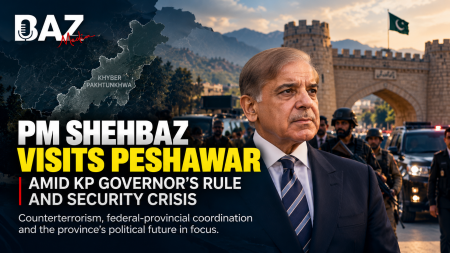
On October 11, the federal government imposed emergency measures and governor’s rule in the province, arguing that the PTI-led provincial administration had failed to cooperate adequately with counterterrorism efforts. The move received parliamentary endorsement but faced opposition protests and criticism. Federal officials maintain that effective counterterrorism operations require close coordination between provincial authorities, the Pakistan Army, law enforcement agencies and intelligence institutions.
PTI, however, has disputed the federal government’s characterization of its role.
The party has previously argued that it was excluded from important security decisions affecting the province and has called for a reassessment of the existing counterterrorism approach. These conflicting positions have complicated attempts to develop a common national security framework.
Rana Sanaullah Criticizes Opposition’s Approach
During his Senate remarks, Rana Sanaullah questioned the opposition’s willingness to participate in discussions with the federal leadership. He specifically criticized National Assembly opposition leader Mahmood Khan Achakzai over his reported reluctance to engage with the prime minister through parliamentary channels.
Sanaullah also accused the former PTI-led provincial government of failing to participate consistently in security coordination meetings. These allegations form part of the broader dispute between the government and opposition over responsibility for Pakistan’s security challenges. The opposition’s position remains significant because any lasting national consensus would require meaningful participation from parties outside the ruling coalition.
Previous Government-PTI Negotiations Failed
The latest offer follows an unsuccessful round of talks between government representatives and PTI earlier in October. Both sides initially explored the possibility of establishing a political committee to address outstanding differences.
However, discussions ultimately collapsed amid disagreements over counterterrorism policy and the responsibilities of the provincial administration.
Government representatives have maintained that opposition cooperation on security matters is essential. PTI representatives, meanwhile, have raised concerns about the decision-making process and the need for a more inclusive approach to national security. The breakdown illustrates how Pakistan’s broader political confrontation has increasingly become intertwined with questions of security policy.
Tariq Fazal Chaudhry Calls for Political Unity
Federal Minister for Parliamentary Affairs Tariq Fazal Chaudhry has also renewed the government’s invitation to opposition parties. He argued that political differences should not obstruct efforts to protect the country from terrorism.
Chaudhry maintained that cooperation between the federal government and provincial authorities was particularly important in Khyber Pakhtunkhwa. He also linked the province’s security challenges to concerns about cross-border infiltration from Afghanistan.
According to the minister, the provincial administration is now cooperating with federal institutions, and the government expects this coordination to support ongoing security operations.
He rejected suggestions that the emergency measures were primarily motivated by a struggle for political control, presenting them instead as a response to security concerns. Those explanations remain contested by opposition figures.
Could KP Governor’s Rule Be Reversed?
The future of governor’s rule in Khyber Pakhtunkhwa has become an important part of the political discussion.
On October 18, Pakistan Peoples Party Chairman Bilawal Bhutto-Zardari suggested that the emergency arrangements could be reconsidered if opposition parties participated in developing an agreed counterterrorism strategy. His comments indicate that the ruling coalition may view political cooperation as a possible route toward resolving the province’s administrative crisis.
Nevertheless, no formal agreement between the federal government and opposition has been announced.
Any change to the province’s current arrangements would depend on further political decisions and the evolving security situation.
Why Political Consensus Matters for Pakistan’s Security
Counterterrorism requires more than military or police operations.
It also depends on effective intelligence sharing, coordination between government institutions, public confidence and policies capable of addressing long-term security risks.
Disagreements between federal and provincial authorities can complicate operational planning and weaken public trust in security decisions. At the same time, meaningful political consensus cannot be achieved through invitations alone.
It requires a framework in which participating parties can raise concerns, review policy options and understand how decisions will be implemented. For Pakistan, the challenge is to create cooperation on national security without allowing political competition to determine the effectiveness of counterterrorism efforts.
What Happens Next?
The government’s renewed invitation has opened another opportunity for dialogue, but it remains unclear whether opposition parties will accept the proposal. The coming days could determine whether both sides move toward a shared counterterrorism framework or continue their political confrontation.
Developments in Khyber Pakhtunkhwa, the future of governor’s rule and the government’s relationship with PTI will remain central to the discussion. The larger question is whether Pakistan’s political leadership can separate immediate national security priorities from its ongoing struggle for political influence.
A sustainable response to terrorism will likely require both operational coordination and a level of political cooperation that has so far proved difficult to achieve.