
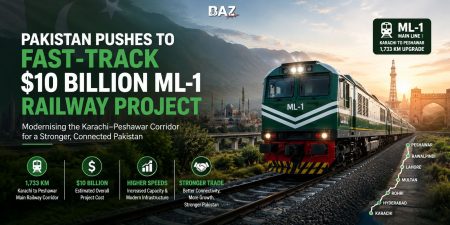
Pakistan is pushing to accelerate one of its most ambitious infrastructure projects as Prime Minister Shehbaz Sharif called for the early groundbreaking of the Main Line-1 (ML-1) railway project during a meeting with Asian Development Bank (ADB) Vice President Yingming Yang.
The proposed ML-1 railway upgrade is designed to modernise Pakistan’s main railway corridor between Karachi and Peshawar, improve freight transportation, increase railway capacity and strengthen the country’s connectivity with regional trade routes.
With an estimated overall cost of around $10 billion, the ML-1 project could become a major transformation for Pakistan Railways if financing, reforms and implementation move forward as planned.
What Is the ML-1 Railway Project?
The ML-1 railway project Pakistan is a planned upgrade of the country’s primary railway corridor, stretching approximately 1,733 kilometres from Karachi to Peshawar.
The route passes through several of Pakistan’s most important commercial and population centres, including Hyderabad, Rohri, Multan, Lahore and Rawalpindi.
Rather than constructing an entirely new railway network, the project focuses on upgrading existing infrastructure. The planned improvements include modern signalling systems, improved tracks, higher operating speeds, increased freight capacity and better railway operations.
The Karachi to Peshawar ML-1 upgrade is therefore viewed as an important component of Pakistan’s long-term railway modernization strategy.
Why Is Pakistan Prioritising ML-1?
Pakistan’s railway network plays an important role in moving passengers and freight across the country. However, ageing infrastructure, limited capacity and operational challenges have restricted the sector’s ability to compete effectively with road transportation.
The government believes that upgrading ML-1 can help address these challenges.
A modern railway corridor could provide Pakistan with a more efficient system for transporting large volumes of goods between ports, industrial centres and markets.
This is particularly important for freight transportation in Pakistan, where lower logistics costs can improve the competitiveness of Pakistani businesses and exporters.
The project could also strengthen connectivity between Karachi’s major ports and markets in Punjab and Khyber Pakhtunkhwa, potentially creating a more efficient domestic trade corridor.
Karachi-Rohri Section Gets Immediate Focus
The first major focus of the project is the approximately 480-kilometre Karachi-Rohri section.
The government is working with the Asian Development Bank on financing arrangements for this section, which has an estimated cost of roughly $2.5 billion.
Proposed ADB financing is around $1.1 billion, consisting of approximately $1 billion in ordinary capital resources and $100 million in concessional financing. Other development partners and lenders are expected to contribute toward the remaining financing requirements.
Within this section, the 183-kilometre Nawabshah-Rohri portion has been identified as a priority for implementation.
The government is seeking faster approval of financing so that the foundation stone can be laid during the current fiscal year, with physical construction targeted for early 2027.
If the proposed schedule remains on track, the Karachi-Rohri upgrade could be completed within approximately three years.
ML-1 Project Financing and ADB Support
Financing has been one of the biggest challenges surrounding the ML-1 project.
Pakistan has already secured significant ADB financing for the Karachi-Rohri segment and is seeking additional financial support for the remaining sections extending from Rohri toward Peshawar.
The government is also continuing discussions with Chinese banks and other development partners to secure financing for the wider project.
The use of a multitranche financing facility could allow the massive railway programme to be implemented in stages rather than requiring the entire investment to be arranged at once.
This approach could make the project more manageable from a financing and implementation perspective.
However, securing funds is only one part of the challenge. The project will also require effective procurement, project management and long-term maintenance.
How ML-1 Could Transform Pakistan’s Freight Network
One of the biggest potential benefits of the ML-1 railway upgrade is its impact on freight transportation.
A modernised Karachi-Peshawar railway corridor could provide businesses with a faster and more reliable alternative for transporting bulk goods over long distances.
Improved railway capacity could also help reduce pressure on Pakistan’s road network.
For exporters and manufacturers, more efficient logistics could translate into lower transportation costs and improved supply-chain reliability.
The project could therefore have implications beyond Pakistan Railways, potentially supporting Pakistan’s exports, trade connectivity and industrial growth.
A stronger railway connection between Karachi’s ports and inland commercial centres could also enhance Pakistan’s role in regional trade.
ML-1 and Regional Trade Connectivity
The strategic importance of ML-1 extends beyond domestic transportation.
Karachi serves as a major gateway for Pakistan’s international trade, while cities along the ML-1 route contain major industrial, agricultural and commercial activity.
Improving the railway corridor could make it easier to connect ports with inland markets and logistics hubs.
For Pakistan, this could strengthen the country’s broader regional connectivity infrastructure and support efforts to improve trade links with neighbouring countries and regional markets.
However, achieving these benefits will depend on more than upgrading tracks.
Railway Reforms Remain Critical
While the government is pushing for an early start, development experts and the ADB have highlighted the importance of broader Pakistan Railways reforms.
Modern infrastructure alone cannot guarantee a successful railway system.
Pakistan Railways will need stronger governance, improved operational efficiency, better maintenance systems and sustainable financial management.
Without these reforms, there is a risk that newly upgraded infrastructure could face the same operational and maintenance problems that have affected the existing network.
This makes institutional reform a critical component of the ML-1 railway project Pakistan strategy.
What Happens Next?
The immediate priority is to accelerate financing approval for the Karachi-Rohri section and prepare for the project’s initial construction phase.
The government wants the foundation stone to be laid within the current fiscal year, with physical work expected to begin in early 2027.
At the same time, Pakistan will need to secure financing for the remaining ML-1 sections and coordinate with international development partners.
If successfully implemented, the Karachi to Peshawar ML-1 railway upgrade could become one of Pakistan’s most significant infrastructure investments, transforming freight transportation and strengthening national connectivity.
But the project’s ultimate success will depend on three key factors: timely financing, efficient implementation and meaningful Pakistan Railways reforms.
For Pakistan’s economy, ML-1 is not simply a railway upgrade. It represents a potential long-term investment in trade, logistics, infrastructure and regional connectivity.
Conclusion
The push for an early groundbreaking signals renewed momentum for Pakistan’s long-discussed ML-1 railway project.
With the Karachi-Rohri section receiving immediate attention and construction targeted for 2027, the project is entering an important phase.
If financing and implementation remain on schedule, ML-1 could help modernise Pakistan Railways, improve freight movement, reduce logistics bottlenecks and strengthen connections between Karachi’s ports and major economic centres.
The challenge now is turning the ambitious plan into a functioning railway system and ensuring that infrastructure investment is matched by the reforms needed to keep it running efficiently for decades to come.