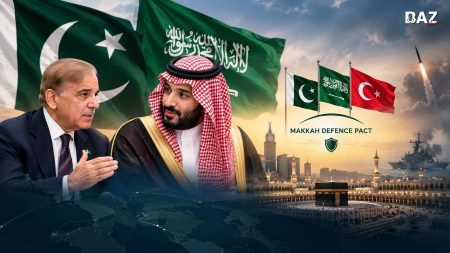
Pakistan Prime Minister Shehbaz Sharif has assured Saudi Crown Prince Mohammed bin Salman that Islamabad will continue diplomatic efforts to de-escalate rising regional tensions while reaffirming Pakistan’s “complete solidarity” with Saudi Arabia following recent Houthi attacks.
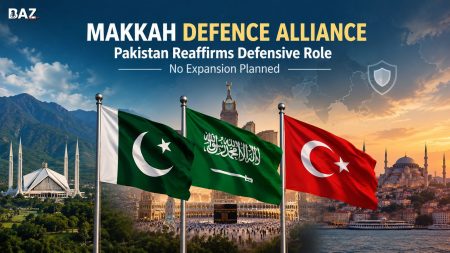
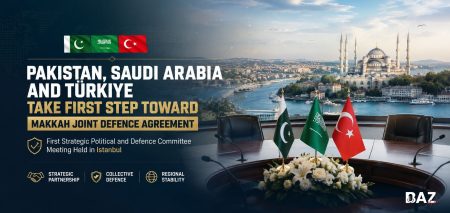
The development comes at a sensitive time for the Middle East, as the newly established Pakistan-Saudi Arabia-Türkiye Makkah Joint Defence Agreement faces its first major test. While Pakistan has reaffirmed its security commitment to Saudi Arabia, Islamabad is also emphasizing diplomacy and avoiding direct military escalation.
Pakistan Vows to Support Saudi Arabia
During a phone conversation with Saudi Crown Prince Mohammed bin Salman, Prime Minister Shehbaz Sharif strongly condemned recent Houthi attacks targeting Saudi Arabia.
Sharif expressed Pakistan’s solidarity with the Saudi leadership and people, particularly over attacks against the Kingdom’s civilian and economic infrastructure. He warned that continued attacks could threaten regional stability and potentially disrupt global energy supplies.
Pakistan has longstanding strategic, economic and diplomatic ties with Saudi Arabia, making Riyadh an important partner for Islamabad. The latest conversation further highlighted Pakistan’s intention to stand by Saudi Arabia while simultaneously encouraging dialogue and regional de-escalation.
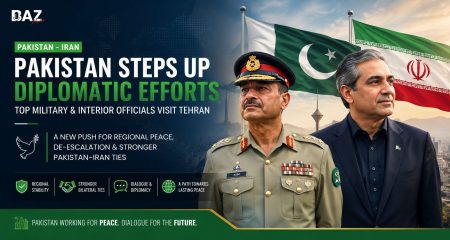
The prime minister also said that he, Chief of Army Staff Field Marshal Syed Asim Munir, and Deputy Prime Minister and Foreign Minister Ishaq Dar would continue working to promote peace and reduce tensions in the region.
Saudi Arabia Welcomes Pakistan’s Diplomatic Efforts
According to reports, Crown Prince Mohammed bin Salman appreciated Pakistan’s support and Islamabad’s efforts to promote regional peace and stability.
The two leaders also agreed to remain in close contact and meet in the near future, underscoring the importance of continued high-level communication between Pakistan and Saudi Arabia.
The conversation comes as tensions involving Saudi Arabia, the Houthis and the wider regional security environment continue to create concerns about the potential for a broader conflict.
For Pakistan, maintaining communication with Saudi Arabia is particularly important because of the country’s newly strengthened defence relationship with Riyadh.
Makkah Defence Pact Faces Its First Major Test
The latest developments have placed the Makkah Joint Defence Agreement under intense scrutiny.
The defence pact between Pakistan, Saudi Arabia and Türkiye establishes a framework for collective security cooperation. One of its key provisions states that an armed attack against one member is to be treated as an attack against all three.
However, Pakistan has clarified that this provision should not automatically be interpreted as a commitment to launch offensive military operations.
Pakistan’s Foreign Office has described the agreement as defensive in nature and stated that military action against the Houthis is not currently under discussion.
This distinction is significant.
The agreement gives Saudi Arabia a stronger security partnership with Pakistan and Türkiye, but Islamabad is simultaneously attempting to prevent the agreement from becoming a mechanism for expanding the conflict.
Why Pakistan Is Choosing Diplomacy
Pakistan’s position reflects a complicated regional balancing act.
On one side, Islamabad has deep strategic and defence relations with Saudi Arabia. The Kingdom is an important economic partner and has historically maintained close security ties with Pakistan.
On the other side, Pakistan shares important regional interests with countries across the broader Middle East and has repeatedly supported diplomatic solutions to regional conflicts.
The Houthi issue is particularly sensitive because the movement has longstanding ties with Iran, making any direct Pakistani military involvement potentially more complicated.
Islamabad therefore appears to be pursuing a dual-track approach: reaffirming its security commitment to Saudi Arabia while using diplomacy to prevent further escalation.
This strategy could allow Pakistan to maintain its relationship with Riyadh without being directly pulled into another prolonged regional conflict.
Houthi Attacks and Global Energy Security
The significance of the latest tensions extends beyond Saudi Arabia and the Middle East.
Saudi Arabia remains one of the world’s most important energy producers, meaning attacks against its oil, transportation or economic infrastructure can have consequences for international markets.
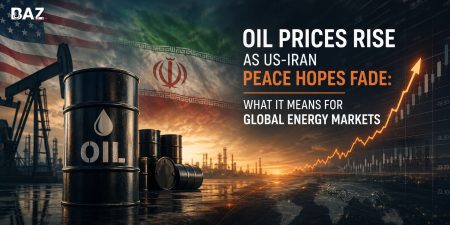
Any prolonged disruption to regional energy infrastructure or shipping routes could contribute to uncertainty in global oil supplies and energy prices.
Pakistan, which is heavily dependent on imported energy, has a direct economic interest in maintaining stability across the region.
For Islamabad, therefore, regional de-escalation is not simply a diplomatic objective. It also has important implications for Pakistan’s energy security, inflation and economic stability.
Pakistan’s Difficult Regional Balancing Act
The latest phone call demonstrates the challenge facing Pakistan’s foreign policy.
Islamabad wants to remain a reliable defence partner for Saudi Arabia while also presenting itself as a country capable of supporting dialogue and regional peace.
The Makkah defence pact strengthens Pakistan’s strategic relationship with Saudi Arabia and Türkiye, but its first major test could determine how the agreement is interpreted in future crises.
Pakistan’s emphasis on the defensive character of the pact suggests that Islamabad wants to distinguish collective security commitments from automatic participation in offensive military operations.
At the same time, continued diplomatic engagement could give Pakistan an opportunity to play a constructive role in reducing tensions.
What Happens Next?
The coming weeks could be important for Pakistan, Saudi Arabia and the wider region.
The immediate priority for Islamabad is likely to remain regional de-escalation, while maintaining close coordination with Riyadh.
Future meetings between Prime Minister Shehbaz Sharif and Crown Prince Mohammed bin Salman could provide an opportunity to discuss the defence pact, regional security and diplomatic initiatives in greater detail.
For Pakistan, the challenge will be to demonstrate that its commitment to Saudi Arabia can coexist with its objective of avoiding further military escalation.
The latest developments show that the Pakistan-Saudi Arabia relationship is entering a new phase one where defence cooperation, diplomacy and regional stability are increasingly interconnected.
As tensions continue, Islamabad’s ability to balance its strategic commitments with its diplomatic ambitions will be closely watched across the region.