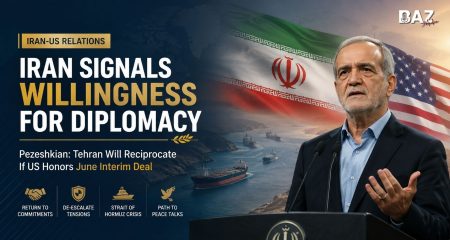
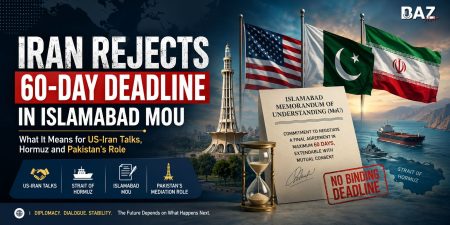
Iran has rejected claims that a binding 60-day deadline exists under the Islamabad Memorandum of Understanding (MoU) with the United States, arguing that Washington violated the agreement soon after it was signed. The statement comes as the reported 60-day period approaches its expected expiry on August 17, putting renewed attention on the fragile US-Iran diplomatic process, the Strait of Hormuz and Pakistan’s role as a mediator.
The dispute over the US-Iran MoU highlights a deeper disagreement between Washington and Tehran over whether the agreement remains operational, whether negotiations were ever formally launched and what conditions would be required for diplomacy to resume.
Iran Rejects the 60-Day Deadline
Iranian Foreign Ministry spokesperson Esmaeil Baqaei has disputed the characterization of the Islamabad agreement as having a strict “60-day deadline.” According to Tehran, the memorandum contains no provision explicitly titled a “60-day deadline,” and Iran does not formulate its foreign policy according to ultimatums or externally imposed time limits.
Baqaei argued that the United States committed what Tehran described as “gross and widespread” violations of the June 18 memorandum within weeks of its signing. As a result, Iranian officials maintain that serious negotiations never actually began and that the 60-day period therefore became irrelevant.
This position is significant because it challenges the interpretation that the US-Iran ceasefire agreement simply expires after 60 days unless both countries agree to extend it.
What Did the Islamabad MoU Actually Say?
Reports on the text of the Islamabad MoU between Iran and the United States indicate that both sides committed to negotiating a final agreement within a maximum period of 60 days, with the possibility of extending that period through mutual consent.
The reported framework also included commitments related to military operations, the Strait of Hormuz, maritime navigation and sanctions.
Under the reported arrangement, Iran was expected to take steps concerning mines in the Strait of Hormuz and facilitate maritime passage, while the United States was expected to lift its naval blockade and begin measures toward sanctions relief.
This distinction is important. While the document reportedly referenced a 60-day period for reaching a final agreement, Tehran argues that this should not be interpreted as a conventional 60-day ceasefire deadline.
Iranian Foreign Minister Abbas Araghchi and other officials have emphasized that the purpose of the memorandum was to help end the conflict rather than establish a temporary ceasefire that automatically required renewal after 60 days.
Why Is August 17 Important?
The reported 60-day period is expected to expire around August 17, 2026, making the timing of Iran’s latest statement particularly important.
However, Tehran’s interpretation means that the approaching date may not necessarily trigger a formal extension process.
Iran’s argument is straightforward: if Washington violated the agreement before meaningful negotiations began, then the timeline cannot be treated as a functioning diplomatic countdown.
The United States, meanwhile, could view the situation differently, potentially arguing that the commitments and timeline remain relevant regardless of Iran’s interpretation.
This creates another obstacle for US-Iran negotiations, particularly as disagreements over sanctions, nuclear issues and the Strait of Hormuz remain unresolved.
Strait of Hormuz Adds Pressure
The Strait of Hormuz is central to the dispute because it is one of the world’s most strategically important maritime routes. Any prolonged confrontation surrounding the waterway could have major consequences for global energy markets, shipping and international trade.
Iranian officials have repeatedly emphasized Tehran’s control over decisions regarding access to the strait. The issue has therefore become closely connected to the wider US-Iran confrontation.
For global markets, uncertainty surrounding Hormuz can create concerns over oil supplies, shipping costs and energy prices. Even without a complete closure, heightened military or diplomatic tensions around the waterway can increase geopolitical risk.
Pakistan’s Role in the US-Iran MoU
The dispute also puts the spotlight on Pakistan’s diplomatic role.
The Islamabad MoU is significant because Pakistan has positioned itself as a potential bridge between Washington and Tehran. Islamabad’s involvement demonstrates how Pakistan’s regional diplomatic importance has expanded amid growing tensions in the Middle East.
For Pakistan, successful mediation could strengthen its position as a regional diplomatic actor. It could also support Islamabad’s broader efforts to maintain constructive relationships with both the United States and Iran.
However, the latest disagreement illustrates the difficulty of mediation. If Washington and Tehran cannot agree on the basic interpretation of an agreement, Pakistan faces a challenging task in bringing both sides back to the negotiating table.
What Happens Next?
The future of the US-Iran peace process will likely depend less on the calendar and more on whether both governments are willing to restore trust.
Three issues are particularly important:
- Agreement on the MoU’s status: Washington and Tehran need to establish whether the Islamabad memorandum remains operational.
- Sanctions and nuclear negotiations: Iran is likely to seek meaningful guarantees and sanctions relief, while Washington may demand verifiable commitments on Iran’s nuclear program.
- Hormuz and military tensions: Maintaining maritime security and preventing further escalation will be essential for creating an environment for diplomacy.
The disagreement over the 60-day period therefore represents more than a technical dispute. It reflects the much larger problem of US-Iran relations: both sides continue to disagree over commitments, sequencing and responsibility for the breakdown in diplomacy.
Conclusion
Iran’s rejection of a binding 60-day deadline has added another layer of uncertainty to the Islamabad MoU. Tehran insists that the timeline became moot after alleged US violations, while reports about the agreement indicate that both sides had initially committed to pursuing a final deal within a maximum of 60 days, subject to mutual extension.
With the reported deadline approaching on August 17, attention will now turn to whether Pakistan can help revive diplomacy and whether Washington and Tehran can overcome their competing interpretations.
For Pakistan, the developments represent both a diplomatic opportunity and a major challenge. The success of the Islamabad initiative could reinforce its emerging role as a mediator in Middle Eastern affairs, while failure could further expose the limits of diplomacy between two deeply divided powers.