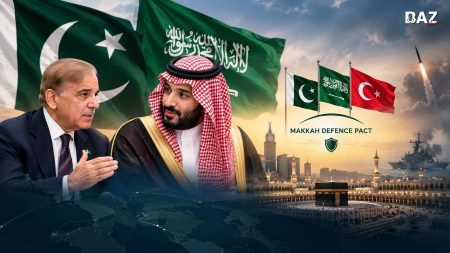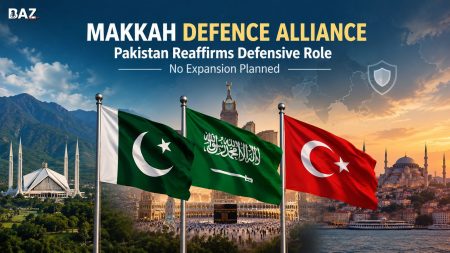
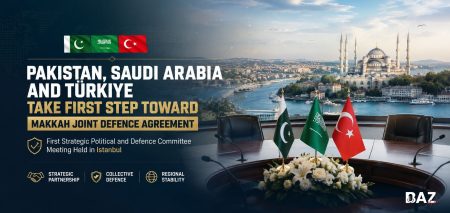
Pakistan, Saudi Arabia and Turkiye have taken a significant step toward strengthening trilateral security cooperation after senior political and military leaders from the three countries convened in Istanbul for the first meeting of the Strategic Political and Defence Committee established under the Makkah Joint Defence Agreement.
The meeting marks the first major institutional step toward translating the trilateral defence pact from a political commitment into a practical framework for strategic coordination, military cooperation and collective security.
The development could have far-reaching implications for regional security, particularly at a time when the Middle East continues to face geopolitical uncertainty, conflict and growing concerns about long-term security arrangements.
Pakistan, Saudi Arabia and Turkiye Meet in Istanbul
The Istanbul meeting brought together some of the most senior diplomatic, defence and military officials from Pakistan, Saudi Arabia and Turkiye.
Pakistan was represented by Deputy Prime Minister and Foreign Minister Ishaq Dar, Defence Minister Khawaja Asif, and Chief of Defence Forces Field Marshal Asim Munir.
Saudi Arabia’s delegation included Foreign Minister Prince Faisal bin Farhan, Defence Minister Prince Khalid bin Salman, and Chief of General Staff Gen. Fayyadh bin Hamed Al-Ruwaili.
Turkiye hosted the meeting with Foreign Minister Hakan Fidan, Defence Minister Yaşar Güler, and Chief of General Staff Gen. Selçuk Bayraktaroğlu participating in the discussions.
The presence of both civilian leadership and senior military commanders highlights the strategic importance being attached to the Pakistan-Saudi Arabia-Turkiye defence partnership.
What Is the Makkah Joint Defence Agreement?
The Makkah Joint Defence Agreement, signed in Mecca on August 7, represents a new framework for security cooperation between Pakistan, Saudi Arabia and Turkiye.
At its core, the agreement focuses on the principle of collective defence. According to the framework, an armed attack against one participating country could be treated as an attack against all three nations.
However, the Makkah agreement is specifically designed around the strategic priorities, defence interests and regional security concerns of Pakistan, Saudi Arabia and Turkiye.
The agreement could potentially strengthen cooperation in areas such as:
- Military coordination
- Strategic planning
- Intelligence cooperation
- Joint defence initiatives
- Security consultations
- Defence technology
- Military training and exercises
- Regional crisis response
The first committee meeting in Istanbul is therefore seen as an important step in developing the operational structure required to implement these objectives.
Strategic Political and Defence Committee Takes the Pact Forward
The newly established Strategic Political and Defence Committee is expected to play a central role in implementing the Makkah Joint Defence Agreement.
The committee brings together the foreign ministers, defence ministers and top military commanders of all three countries. Its primary purpose is to provide strategic direction and coordinate activities carried out under the defence framework.
While the signing of an agreement represents a political commitment, institutional mechanisms are necessary to ensure that cooperation can be translated into real-world policies and coordinated action.
The Istanbul meeting therefore represents the beginning of that process.
By creating a formal mechanism for consultation, Pakistan, Saudi Arabia and Turkiye can work toward developing common approaches to emerging regional threats and security challenges.
Why the Istanbul Meeting Is Important for Regional Security
The first meeting of the Makkah defence committee comes at a particularly sensitive time for the Middle East and the wider Muslim world.
Regional tensions, ongoing conflicts and uncertainty surrounding major global powers have encouraged countries to explore stronger and more independent security arrangements.
The Pakistan-Saudi Arabia-Turkiye strategic partnership reflects a growing interest in regional cooperation among major Muslim-majority nations with significant military and geopolitical influence.
Saudi Arabia remains one of the most influential states in the Gulf, while Turkiye has developed into a major regional military and diplomatic power. Pakistan, meanwhile, possesses one of the world’s largest armed forces and holds considerable strategic importance due to its geographic location and military capabilities.
Together, the three countries could create a powerful platform for dialogue and defence cooperation.
Pakistan’s Growing Role in Regional Defence
For Pakistan, the Makkah Joint Defence Agreement could represent an important development in its evolving foreign and security policy.
Pakistan has historically maintained close defence and strategic ties with Saudi Arabia, while its military and diplomatic cooperation with Turkiye has also expanded significantly over recent years.
The trilateral agreement brings these relationships together within a broader strategic framework.
Pakistan’s involvement could strengthen its position as an important player in regional security discussions, particularly concerning the Middle East, the Gulf and the broader Islamic world.
The agreement may also open new opportunities for Pakistan’s defence industry, military training institutions and strategic cooperation initiatives.
At the same time, Islamabad will likely seek to maintain a careful diplomatic balance, ensuring that deeper security partnerships do not negatively affect its relationships with other regional and global powers.
Can the Makkah Defence Pact Reshape the Region?
The long-term impact of the Makkah Joint Defence Agreement will depend on how effectively Pakistan, Saudi Arabia and Turkiye can translate political commitments into practical cooperation.
The Istanbul meeting is an important first step, but the future success of the pact will depend on several factors, including the development of clear operational mechanisms, regular strategic consultations and agreement on how collective defence commitments would function during an actual security crisis.
If successfully implemented, the agreement could become one of the most significant new defence cooperation frameworks involving Muslim-majority countries in recent decades.
It could also encourage greater regional self-reliance in security matters and create new opportunities for diplomatic and military coordination.
The Road Ahead
The first Strategic Political and Defence Committee meeting in Istanbul signals that Pakistan, Saudi Arabia and Turkiye are moving beyond symbolic declarations and toward institutional cooperation.
The Makkah Joint Defence Agreement has the potential to reshape discussions surrounding collective security, military cooperation and regional strategic partnerships.
While many questions remain regarding its operational structure and long-term implementation, the Istanbul meeting represents a clear indication that the three countries are serious about developing a stronger trilateral security framework.
As regional geopolitical challenges continue to evolve, the partnership between Pakistan, Saudi Arabia and Turkiye could become an increasingly important factor in shaping the future of Middle Eastern and regional security.
The Istanbul meeting may only be the beginning, but it has already placed the Makkah Joint Defence Agreement at the center of an emerging conversation about collective defence, strategic independence and the future of regional cooperation.