
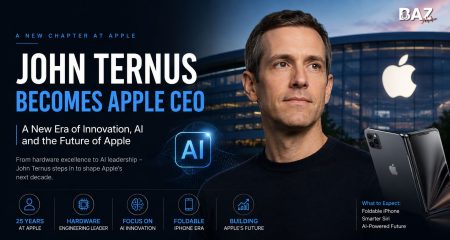
John Ternus Becomes Apple CEO, Marking a New Era for the Tech Giant
Apple has entered a new chapter with John Ternus officially becoming the company’s chief executive officer on September 1, 2026. Ternus succeeds Tim Cook, who led Apple for 15 years after taking over from Steve Jobs.
The leadership transition comes at a critical moment for Apple. While the company continues to dominate the premium smartphone market and maintain one of the world’s strongest technology ecosystems, it faces increasing pressure in artificial intelligence (AI).
Ternus now takes charge as Apple prepares for a potentially transformative period involving AI-powered products, foldable devices and the next generation of Apple services.
Who Is John Ternus?
John Ternus is a longtime Apple executive and hardware engineering expert. He has spent approximately 25 years at Apple, gradually rising through the company’s engineering ranks.
In 2021, Ternus became Apple’s senior vice president of Hardware Engineering. In that role, he was closely involved in the development of major Apple products, including the iPhone, iPad and Mac.
Unlike Tim Cook, who became one of the world’s most recognizable corporate leaders, Ternus has generally maintained a lower public profile.
His background is particularly important because he is fundamentally a hardware-focused engineer. That experience could shape Apple’s next stage as the company attempts to combine advanced artificial intelligence with its hardware ecosystem.
For businesses and consumers searching for “who is John Ternus, Apple’s new CEO,” his engineering background is one of the most significant aspects of his leadership profile.
Apple Faces a Growing AI Challenge
One of the biggest challenges awaiting John Ternus as Apple CEO is artificial intelligence.
Apple remains one of the world’s most valuable technology companies, but its progress in generative AI has attracted criticism from investors, analysts and technology observers.
Competitors such as Google, Microsoft and major Chinese technology companies have moved aggressively into generative AI, AI assistants and AI-powered consumer applications.
Apple has also been developing its own AI capabilities, but the company has faced questions over the speed and execution of its AI strategy.
This creates a major opportunity for Ternus.
His hardware expertise could help Apple differentiate itself by making AI a deeper part of the company’s devices rather than simply competing on standalone AI software.
The challenge will be turning Apple’s enormous hardware ecosystem into an advantage in the AI race.
Foldable iPhone Could Become Ternus’s First Major Test
Ternus is taking over Apple just as the company enters a potentially important product cycle.
Apple’s September 9 product event is widely expected to showcase major new products, including speculation surrounding the company’s first foldable iPhone and an upgraded AI-powered Siri.
A foldable iPhone would represent one of Apple’s most significant hardware expansions in years.
Foldable smartphones have already been introduced by competitors, particularly Samsung and several Chinese manufacturers. Apple’s entry could therefore intensify competition in the premium smartphone market.
For Ternus, successfully launching a new product category could immediately establish his leadership credentials.
It would also reinforce the perception that Apple’s new CEO intends to build on the company’s traditional strength: integrating hardware, software and services into a seamless ecosystem.
Tim Cook Leaves Behind a Powerful Apple
Ternus inherits a company in a remarkably strong financial and market position.
During Tim Cook’s 15-year tenure, Apple expanded its global ecosystem, strengthened its services business and continued to grow the iPhone into one of the world’s most influential consumer products.
However, Apple’s next decade could look very different.
The technology industry is increasingly being shaped by AI, cloud computing, custom silicon, wearable technology and new device categories.
Ternus therefore faces the difficult task of protecting Apple’s existing strengths while identifying its next major growth engine.
The question is no longer simply whether Apple can sell more iPhones. It is whether Apple can remain at the forefront of the AI-powered technology industry.
What Will Be John Ternus’s Priorities?
Several priorities are likely to dominate Ternus’s early leadership.
1. Strengthening Apple’s AI Strategy
Apple needs to demonstrate that it can compete effectively in generative and on-device AI. Improving Siri and integrating AI throughout Apple’s ecosystem will likely be crucial.
2. Launching New Hardware
The potential foldable iPhone could become a defining product for the new administration. Apple’s approach to foldable technology will be closely watched by competitors and consumers.
3. Protecting Apple’s Ecosystem
Apple’s biggest competitive advantage remains its tightly integrated ecosystem of hardware, software and services. Maintaining that advantage will be essential.
4. Managing Global Supply Chains
Apple also faces geopolitical and supply-chain challenges, particularly its long-standing manufacturing relationship with China. Diversification and supply-chain resilience will remain important strategic issues.
5. Maintaining Innovation
Perhaps the biggest challenge will be convincing consumers and investors that Apple can continue producing products that create entirely new markets rather than simply improving existing ones.
John Ternus’s Compensation Reflects Apple’s Expectations
Ternus’s compensation package also highlights the scale of expectations surrounding Apple’s new CEO.
His reported base salary is $3 million annually, alongside a prorated restricted stock award for 2026 and a much larger target annual equity award beginning in fiscal 2027.
A significant portion of executive compensation is tied to shareholder performance, meaning Ternus will be under pressure not only to innovate but also to deliver long-term financial value.
What Does John Ternus Mean for Apple’s Future?
The appointment of John Ternus as Apple CEO represents more than a change in leadership. It marks Apple’s first CEO transition since Tim Cook succeeded Steve Jobs.
Ternus inherits an extraordinarily powerful brand, a massive global customer base and an ecosystem that remains difficult for competitors to replicate.
But he also inherits a technology industry undergoing rapid transformation.
AI may define Apple’s next decade just as the iPhone defined much of the company’s previous era.
If Ternus can successfully combine Apple’s hardware expertise with competitive AI technology, foldable devices and new services, he could establish a new chapter in Apple’s history.
The coming months will provide an early indication of his strategy. With a major product event immediately ahead, the technology industry will be watching closely to see whether John Ternus can lead Apple into its next era of innovation.