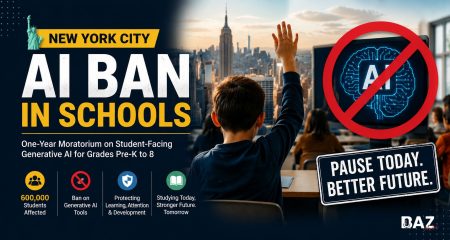
New York City has announced a one-year moratorium on student-facing generative AI in public elementary and middle schools, putting the use of AI tools under renewed scrutiny across the education system. The policy affects roughly 600,000 students from pre-K and 2-K through 8th grade and comes just days before the new school year begins on September 10.
Mayor Zohran Mamdani and Schools Chancellor Kamar Samuels announced the policy as part of a broader effort to examine how artificial intelligence is affecting children’s learning, attention, development and classroom experiences.
The decision makes New York City’s AI ban in schools one of the most significant restrictions on student-facing generative AI in the United States.
What Is New York City’s AI Ban in Schools?
Under the new policy, public school students through 8th grade will generally be prohibited from using generative AI tools designed for direct student interaction.
The restrictions cover several types of AI-powered educational technology, including AI tutors, instructional software, companion chatbots and other generative AI applications used by students.
New York City schools currently use dozens of AI-related educational tools. Around 40 existing AI education tools are expected to be blocked or removed from school software as the moratorium takes effect.
However, the policy is not intended to eliminate artificial intelligence from the education system completely.
High school students in 9th grade and above will still have access to a limited number of vetted AI tools under supervision. These students will also receive twice-yearly AI critical-thinking modules covering topics such as AI bias, ethics and the potential impact of artificial intelligence on future careers.
Why Is NYC Restricting Generative AI for Students?
The main purpose of the New York City generative AI moratorium is to give educators and policymakers time to understand the technology before expanding its use among younger students.
Generative AI has rapidly entered classrooms through tools that can answer questions, generate essays, explain concepts, create images and provide personalized tutoring. While these capabilities can support education, concerns have also emerged about their impact on learning and child development.
New York City officials want to study questions surrounding student attention, learning outcomes, independent thinking and the developmental effects of AI.
The city has emphasized that the policy is temporary rather than a permanent rejection of artificial intelligence in schools.
A new Technology in Schools Coalition will examine available evidence and make recommendations about how AI and other technologies should be used in future school years.
What About Teachers Using AI?
Interestingly, the policy does not completely prohibit AI use inside schools.
Teachers will still be able to use artificial intelligence for certain professional and administrative purposes, including lesson planning, scheduling and operational tasks, provided those uses meet applicable safety and privacy requirements.
This creates an important distinction between AI for teachers and AI directly interacting with students.
The approach suggests that NYC is not necessarily against artificial intelligence itself. Instead, the city is taking a more cautious approach to student-facing AI technology, particularly for younger children.
Are There Exceptions to the AI Ban?
Yes. The policy includes exceptions where AI or other technology may provide important educational support.
Certain assistive technologies for students with disabilities, tools supporting multilingual learners and specific career-readiness programs may continue to be permitted.
These exceptions recognize that technology can provide significant benefits when it addresses specific educational needs.
The challenge for policymakers is therefore not simply deciding whether schools should use AI, but determining when, where and how AI should be used in education.
NYC Also Introduces Screen-Time Limits
The AI moratorium comes alongside broader efforts to reduce excessive classroom screen use.
Under the new approach, schools will not use 1:1 student devices through 2nd grade. For older students, recommended daily classroom device-use limits include approximately 30 minutes for grades 3-5 and 45 minutes for grades 6-8.
The move reflects growing concerns about the relationship between digital technology, classroom attention and traditional learning experiences.
By limiting both generative AI and device exposure, New York City is placing greater emphasis on human-centered learning and direct interaction between students and teachers.
What Does This Mean for the Future of AI in Education?
New York City’s decision could become an important test case for education systems considering how quickly they should adopt artificial intelligence.
Supporters of the AI ban in elementary and middle schools argue that younger students should have opportunities to develop writing, reasoning, problem-solving and communication skills without becoming overly dependent on automated systems.
Critics, however, warn that restricting AI too much could leave students behind as artificial intelligence becomes increasingly important in higher education and the workplace.
This creates a difficult policy question: Should schools protect children from the risks of AI, or teach them how to use it responsibly from an early age?
The answer may ultimately require a balance between both approaches.
Why NYC’s AI Policy Matters Beyond New York
The New York City AI education policy could influence how other school districts approach generative AI.
As schools across the United States experiment with AI tutors, automated feedback, personalized learning systems and classroom assistants, policymakers are facing similar concerns about privacy, academic integrity, screen time and student development.
NYC’s one-year moratorium provides an opportunity to gather evidence before making long-term decisions.
Rather than treating AI as either entirely beneficial or entirely harmful, the city’s experiment could help determine what responsible AI adoption in schools actually looks like.
The Bottom Line
New York City’s one-year restriction on student-facing generative AI marks a major moment in the debate over AI in education.
For roughly 600,000 younger students, the immediate focus will shift away from AI-powered classroom tools and toward more traditional learning methods. Meanwhile, teachers and older students will continue to have limited opportunities to use AI under specific guidelines.
The bigger question is what happens after the one-year moratorium.
If the policy demonstrates that younger students benefit from reduced AI and screen exposure, other school systems may follow. If evidence instead shows that carefully supervised AI improves learning, NYC could eventually move toward a more targeted adoption model.
Either way, New York City’s AI ban in schools could become an important experiment in determining how artificial intelligence and education should coexist.