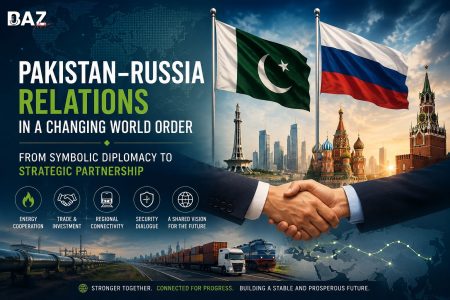
Pakistan-Russia Relations in a Changing World Order: A Partnership Beyond Symbolism
For decades, Pakistan-Russia relations were constrained by Cold War rivalries, regional conflicts, and differing strategic priorities. However, today’s geopolitical landscape tells a different story. As global power dynamics shift and traditional alliances evolve, Islamabad and Moscow are gradually redefining their relationship through practical cooperation rather than diplomatic symbolism.
The ongoing competition between major powers, particularly the United States and China, has accelerated the emergence of a more fragmented and multipolar international system. In this environment, countries like Pakistan and Russia are increasingly pursuing flexible, interest-based partnerships focused on economic growth, energy security, regional stability, and connectivity.
While challenges remain, the growing engagement between the two nations reflects a broader transformation in global diplomacy.
A Changing Global Order Is Creating New Opportunities
The international system is experiencing one of its most significant transitions since the end of the Cold War. Conflicts in Europe, tensions in the Indo-Pacific, disruptions to global supply chains, and economic sanctions have reshaped how countries approach foreign policy.
Rather than relying solely on traditional alliances, many middle powers are diversifying their partnerships to protect national interests.
For Pakistan, this means expanding diplomatic and economic engagement beyond its longstanding partners. For Russia, strengthening ties with countries across South Asia provides additional strategic and economic opportunities in an increasingly polarized world.
This evolving environment has created space for Pakistan-Russia strategic cooperation to grow in areas that were previously overlooked.
Energy Cooperation Is Becoming a Key Pillar
Energy security remains one of Pakistan’s most pressing economic challenges. Rising fuel prices, electricity shortages, and increasing industrial demand have pushed Islamabad to seek diversified energy sources.
Russia, as one of the world’s largest energy producers, represents a potential long-term partner in:
- Oil imports
- Natural gas supplies
- LNG cooperation
- Energy infrastructure
- Pipeline development
- Refinery modernization
Several bilateral discussions have already explored opportunities for expanding energy cooperation, demonstrating that both governments recognize the mutual benefits of closer collaboration.
If implemented effectively, energy partnerships could significantly strengthen Pakistan’s economic resilience while opening new markets for Russian exports.
Trade Still Has Significant Room to Grow
Despite improving diplomatic relations, one major reality remains unchanged: bilateral trade is still relatively limited.
Current trade volumes fall well below their actual potential considering the size of both economies.
Key obstacles include:
- Limited banking channels
- Payment restrictions
- Transportation challenges
- Logistics costs
- Regulatory barriers
- Sanctions-related complications
Experts argue that without practical financial mechanisms and improved transport connectivity, ambitious diplomatic statements may not translate into meaningful economic outcomes.
Creating sustainable trade infrastructure will be essential if Pakistan and Russia hope to build a long-term strategic economic partnership.
Regional Connectivity Could Transform the Relationship
One of the most promising aspects of Pakistan-Russia cooperation lies in regional connectivity.
Pakistan’s strategic geographic location provides access to the Arabian Sea while connecting South Asia, Central Asia, the Middle East, and Western China.
Russia, meanwhile, continues expanding its engagement across Eurasia.
This creates opportunities for collaboration through:
- Regional transport corridors
- Cross-border logistics
- Trade routes
- Infrastructure investment
- Transit cooperation
- Supply chain diversification
If regional connectivity projects advance successfully, Pakistan could strengthen its position as a commercial gateway linking multiple regions while supporting broader Eurasian integration.
Security Cooperation Is Also Expanding
Security remains another area where bilateral engagement has gradually increased.
Over recent years, Pakistan and Russia have expanded dialogue on:
- Counterterrorism
- Regional stability
- Afghanistan
- Military exchanges
- Defense consultations
- Security cooperation
Although defense cooperation remains measured compared to Russia’s traditional regional partnerships, continued engagement reflects growing strategic trust between the two countries.
Both nations also share an interest in preventing instability from spreading across neighboring regions, making security collaboration increasingly relevant.
Challenges Cannot Be Ignored
While diplomatic momentum is encouraging, significant obstacles continue to limit the pace of progress.
These include:
Banking Limitations
Financial sanctions and payment restrictions complicate commercial transactions between businesses.
Transportation Infrastructure
Efficient trade requires stronger logistics networks, shipping routes, and regional transport corridors.
Political Commitment
Long-term cooperation depends on consistent policy implementation rather than periodic diplomatic engagement.
Global Geopolitical Pressures
Pakistan continues balancing relationships with China, the United States, Gulf countries, and other strategic partners. Similarly, Russia must carefully manage its own international priorities.
Successfully navigating these competing interests will require pragmatic diplomacy from both governments.
Why This Relationship Matters for Pakistan
For Pakistan, improving relations with Russia is about more than diplomacy.
It represents an opportunity to:
- Diversify foreign partnerships
- Improve energy security
- Expand export markets
- Strengthen regional trade
- Increase foreign investment
- Enhance geopolitical flexibility
Rather than replacing existing alliances, Pakistan appears to be pursuing a broader foreign policy approach that emphasizes economic opportunity and strategic balance.
This reflects a wider trend among many emerging economies adapting to an increasingly multipolar world.
Looking Ahead
Pakistan-Russia relations have entered a new phase where practical cooperation is becoming more important than historical differences.
While political dialogue has expanded considerably, the next stage will depend on measurable progress in trade, energy, infrastructure, finance, and connectivity.
If both countries successfully overcome existing structural barriers, their partnership could evolve into one of the more significant regional relationships shaping Eurasian geopolitics over the coming decade.
However, without sustained implementation, improved financial mechanisms, and stronger commercial engagement, the relationship risks remaining largely symbolic.
The coming years will determine whether Pakistan and Russia can convert diplomatic goodwill into lasting economic and strategic cooperation.
Final Thoughts
The evolution of Pakistan-Russia relations reflects the realities of an international system that is becoming increasingly interconnected, competitive, and multipolar. As geopolitical alignments continue to shift, both nations have an opportunity to build a partnership grounded in shared interests rather than historical constraints.
The success of this relationship will ultimately depend not on high-level meetings or diplomatic rhetoric, but on concrete achievements in trade, energy, regional connectivity, and economic cooperation. If these ambitions are realized, Pakistan and Russia could emerge as important partners in shaping the future of Eurasian integration and regional stability.