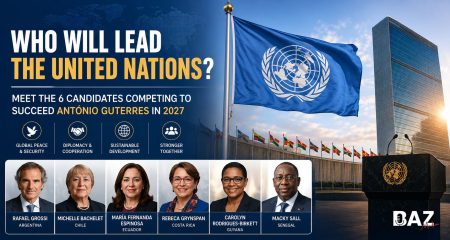
The race to become the next UN Secretary-General has officially begun, with six prominent global leaders emerging as candidates to succeed António Guterres, whose second five-year term concludes on December 31, 2026. The successful candidate will assume office on January 1, 2027, at a time when the United Nations faces one of the most challenging periods in its history.
From ongoing wars and geopolitical rivalries to humanitarian emergencies and financial instability, the next leader of the United Nations will inherit an organization under immense pressure. The upcoming UN Secretary-General election 2026 is therefore attracting worldwide attention from governments, diplomats, and policy experts alike.
Why the Next UN Secretary-General Matters
The Secretary-General serves as the chief administrative officer and public face of the United Nations. Beyond managing the organization’s operations, the role involves mediating international conflicts, coordinating humanitarian responses, promoting sustainable development, and advocating for peace.
The incoming Secretary-General will confront several urgent global challenges, including:
- Multiple armed conflicts across different regions
- Rising geopolitical competition among major powers
- Climate change and environmental crises
- Humanitarian emergencies affecting millions
- A growing financial and budget crisis within the United Nations
- Increasing demands for institutional reform
Strong leadership will be essential to maintaining the UN’s credibility and effectiveness during this critical period.
Meet the Six Candidates
Rafael Grossi (Argentina)
Currently serving as the Director General of the International Atomic Energy Agency (IAEA), Rafael Grossi has earned international recognition for overseeing nuclear safety, non-proliferation efforts, and diplomacy during several global security crises.
His experience negotiating with countries over sensitive nuclear issues has positioned him as one of the leading contenders. Supporters believe his crisis-management skills could prove valuable in navigating today’s increasingly complex geopolitical environment.
Michelle Bachelet (Chile)
Michelle Bachelet brings one of the most distinguished political careers among the candidates. She served two terms as President of Chile and later became the United Nations High Commissioner for Human Rights.
Known for advocating democracy, human rights, gender equality, and social inclusion, Bachelet’s extensive UN experience makes her a strong candidate. Many observers also note that electing her would mark another milestone for women’s leadership in global governance.
María Fernanda Espinosa (Ecuador)
María Fernanda Espinosa has held several senior diplomatic positions, including Ecuador’s Foreign Minister and President of the UN General Assembly.
Her background includes negotiations on climate policy, sustainable development, migration, and international cooperation. Espinosa has consistently emphasized multilateral dialogue and strengthening the UN’s ability to address global challenges collectively.
Rebeca Grynspan (Costa Rica)
Currently leading the United Nations Conference on Trade and Development (UNCTAD), Rebeca Grynspan previously served as Vice President of Costa Rica.
Her expertise lies in international development, global trade, economic policy, and sustainable growth. As many developing nations face mounting debt and economic uncertainty, Grynspan’s financial and development experience could become a major advantage during the selection process.
Carolyn Rodrigues-Birkett (Guyana)
Guyana’s Permanent Representative to the United Nations, Carolyn Rodrigues-Birkett, has built an impressive diplomatic career representing her country at the highest international level.
Her work within the UN system provides firsthand knowledge of multilateral negotiations, consensus-building, and institutional governance. She represents the growing influence of smaller nations within international diplomacy.
Macky Sall (Senegal)
Former Senegalese President Macky Sall enters the race with extensive executive leadership experience after serving over a decade as head of state.
Throughout his presidency, Sall played active roles in regional diplomacy, African development initiatives, and international cooperation. His supporters argue that his practical government experience could help the UN better coordinate responses to today’s global crises.
Why Latin America Could Shape the Outcome
An important aspect of this election is the UN’s long-standing tradition of informal regional rotation. Although not officially mandated, different global regions typically take turns producing the Secretary-General.
Many diplomats believe that Latin America and the Caribbean are due for the position, which explains why several candidates including Rafael Grossi, Michelle Bachelet, María Fernanda Espinosa, and Rebeca Grynspan come from the region.
If this informal tradition continues, Latin America may hold a significant advantage during the selection process.
Major Challenges Await the Next Secretary-General
Regardless of who ultimately wins, the next Secretary-General will inherit an increasingly difficult global landscape.
Key priorities will likely include:
- Restoring trust in multilateral diplomacy
- Managing conflicts in multiple regions simultaneously
- Addressing the UN’s ongoing budget shortfall
- Accelerating action on climate change
- Reforming UN institutions for greater efficiency
- Strengthening peacekeeping and humanitarian operations
- Building consensus among increasingly divided major powers
Balancing these competing priorities while maintaining the organization’s neutrality will be one of the greatest tests of the next UN leader
How the UN Secretary-General Is Chosen
The selection process begins with consultations among UN member states. The UN Security Council evaluates candidates through informal rounds of voting before recommending one nominee to the UN General Assembly.
The General Assembly then formally appoints the Secretary-General, who serves a five-year term beginning on January 1, 2027.
Because the Security Council’s permanent members hold veto power, political negotiations often play a decisive role alongside candidates’ qualifications and diplomatic credentials.
Final Thoughts
The competition to become the next UN Secretary-General is more than a leadership contest it represents a defining moment for the future of global governance.
Each of the six candidates offers unique strengths, from nuclear diplomacy and human rights advocacy to economic development and international negotiations. As the United Nations navigates escalating conflicts, financial pressures, and growing demands for reform, the next Secretary-General will face enormous expectations from the international community.
With the world watching closely, the selection process over the coming months could shape international diplomacy, peace efforts, and multilateral cooperation well into the next decade.