
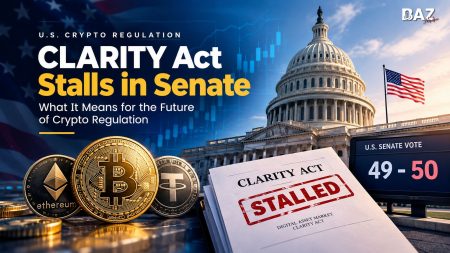
The United States Senate has stalled one of the most significant attempts to establish a comprehensive federal cryptocurrency regulatory framework, after the Digital Asset Market Clarity Act, commonly known as the CLARITY Act, failed to advance in a key procedural vote on September 15, 2026.
The Senate vote ended 49-50, falling well short of the 60 votes required to overcome the procedural hurdle and move the legislation toward formal consideration. The vote was not a final vote on whether the bill would become law, but its failure has put the future of major US crypto regulation efforts under renewed uncertainty.
What Is the CLARITY Act?
The CLARITY Act is a proposed US cryptocurrency market-structure law designed to establish clearer federal rules for the rapidly expanding digital asset market.
The legislation seeks to define how different cryptocurrencies and digital assets are regulated and establish clearer responsibilities for the Securities and Exchange Commission (SEC) and the Commodity Futures Trading Commission (CFTC).
Supporters of the bill have argued that clearer rules could reduce regulatory uncertainty for crypto companies, investors and developers operating in the United States.
The legislation also addresses areas including digital-asset exchanges, brokers, decentralized finance and anti-money-laundering requirements. The latest version included provisions concerning DeFi registration, digital-asset activities by credit unions and protections for certain blockchain developers.
Senate CLARITY Act Vote: What Happened?
The Senate’s September 15 procedural vote produced a 49-50 result, meaning the measure did not receive the 60 votes needed to proceed.
All Democratic senators voted against advancing the legislation, while four Republicans Susan Collins, Josh Hawley, Jerry Moran and Thom Tillis also voted no. The vote therefore reflected disagreements across both parties rather than a completely unified Republican position.
Importantly, the vote was a procedural vote rather than final passage. However, because the legislation failed to clear this stage, its path through Congress has become considerably more difficult.
Senator Thom Tillis subsequently indicated that the matter could still be reconsidered, leaving open a procedural route for additional negotiations.
Why Did the Crypto Bill Fail?
Several unresolved issues contributed to the Senate deadlock.
1. Ethics and Trump’s Crypto Interests
One of the central disagreements involved ethics rules for public officials, particularly provisions concerning President Donald Trump’s involvement in cryptocurrency-related businesses.
Democratic lawmakers argued that the proposed safeguards did not go far enough to address potential conflicts involving officials who could benefit financially from digital assets.
Senate Democrats had sought stronger restrictions and enforcement mechanisms. Senator Adam Schiff, for example, said the legislation needed stronger and enforceable ethics provisions alongside rules addressing consumer protection and illicit finance.
Republican negotiators had introduced changes before the vote. According to Senator Cynthia Lummis’s office, the final draft incorporated substantial portions of an ethics proposal developed by Senators Thom Tillis and Ruben Gallego and gave state attorneys general a role in enforcement.
The two sides nevertheless failed to reach a final compromise.
2. Banking and Stablecoin Concerns
Another major disagreement involved stablecoins and the banking system.
Lawmakers and financial institutions have debated whether stablecoin-related rewards could encourage customers to move deposits away from traditional banks.
The final Senate draft included provisions giving the Treasury Secretary additional authority to respond to potential deposit-flight risks associated with payment stablecoins. Supporters described this as a measure intended to protect community banks and businesses that rely on traditional lending.
However, banking-related concerns remained part of the broader negotiations surrounding the bill.
3. Regulatory Oversight
The CLARITY Act also attempted to resolve one of the longest-running questions in US cryptocurrency regulation: which federal agency should oversee different digital assets.
The proposed framework would divide significant regulatory responsibilities between the SEC and CFTC, providing clearer definitions and jurisdiction over different types of digital assets.
For cryptocurrency businesses, exchanges and investors, the objective was to replace a fragmented regulatory environment with clearer statutory rules.
What Would the CLARITY Act Have Changed?
If enacted, the legislation would have created a broad federal framework covering significant parts of the digital-asset industry.
Among the major areas addressed were:
- Cryptocurrency classification
- SEC and CFTC regulatory jurisdiction
- Digital-asset exchanges and brokers
- Anti-money-laundering requirements
- Decentralized finance
- Blockchain developers
- Stablecoin-related banking risks
- Consumer and market protections
The bill’s supporters have argued that regulatory clarity could make it easier for legitimate cryptocurrency businesses to operate while establishing clearer protections and responsibilities.
The legislation was also viewed by the crypto industry as an important step toward establishing long-term US digital asset regulation.
What Does the Senate Vote Mean for Crypto Regulation?
The immediate consequence is that the United States remains without the comprehensive market-structure law envisioned by the CLARITY Act.
The US cryptocurrency market will therefore continue operating under existing laws and regulations while federal agencies pursue their respective approaches to digital assets.
The SEC and CFTC can continue developing and enforcing regulatory policies within their existing authority, but a comprehensive framework created directly by Congress would provide a different level of statutory certainty.
Former CFTC Chairman J. Christopher Giancarlo said regulators can continue advancing cryptocurrency rules despite the Senate setback.
Impact on Bitcoin and Crypto Markets
The Senate vote also had an immediate effect on cryptocurrency markets.
Bitcoin declined during the trading session as investors reacted to the legislation’s failure, while crypto-related companies also experienced pressure. Reuters reported declines across major crypto assets and related companies following the vote.
The market reaction highlights how closely investors have been watching US cryptocurrency legislation.
However, the Senate vote does not change the underlying technology or eliminate existing cryptocurrency markets. Instead, it increases uncertainty around when and how Congress might establish a comprehensive federal framework.
What Happens Next?
The future of the CLARITY Act remains uncertain.
Senate lawmakers could continue negotiations and potentially reconsider the legislation, particularly because some senators who opposed the procedural vote have indicated that discussions could continue.
At the same time, the approaching election calendar and unresolved disagreements over ethics, banking protections and regulatory authority could make another bipartisan agreement difficult.
For cryptocurrency companies, investors and blockchain developers, the central question remains whether Congress can eventually establish clear federal rules for the digital-asset industry.
For now, the CLARITY Act Senate vote has demonstrated how difficult it remains to build bipartisan agreement around US cryptocurrency regulation.
Conclusion
The failure of the Digital Asset Market Clarity Act to advance in the Senate marks a major setback for efforts to establish comprehensive US crypto regulation.
The 49-50 procedural vote did not permanently eliminate the legislation, but it stopped the bill from moving forward at a critical stage. Disagreements over ethics rules, banking concerns, stablecoins and SEC-CFTC regulatory authority remain central to the debate.
The next phase will depend on whether lawmakers can find common ground on these issues. Until then, the US cryptocurrency industry will continue operating within an evolving regulatory environment while investors watch for further congressional and regulatory developments.