Senate Passes Resolution Challenging Trump’s Iran War Authority
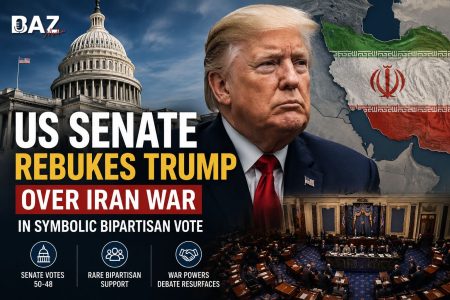
In a significant political development, the United States Senate has passed a largely symbolic bipartisan resolution rebuking President Donald Trump over military actions involving Iran. The measure, approved in a narrow 50-48 vote, urges an end to U.S. military hostilities against Iran unless Congress formally authorizes the use of force.
Although the resolution does not carry the force of law and does not require presidential approval, it represents a rare instance of bipartisan opposition to the White House on matters of war powers and foreign policy. The vote comes at a critical moment as diplomatic discussions with Tehran continue and concerns over regional stability remain high.
Why the Senate Vote Matters
The resolution serves as a powerful political statement regarding congressional authority over military engagement. Under the U.S. Constitution, Congress holds the power to declare war, while the president serves as commander-in-chief of the armed forces.
Lawmakers supporting the measure argue that any prolonged military action against Iran should require explicit congressional authorization. The vote reflects growing concerns among both Democrats and some Republicans about executive authority in matters of war.
Four Republican senators joined Democrats in supporting the resolution, highlighting unusual bipartisan agreement on limiting presidential military powers.
Understanding the War Powers Debate
The debate surrounding war powers has existed for decades in American politics. Successive administrations from both parties have often engaged in military operations without formal declarations of war from Congress.
Supporters of the resolution argue that military escalation with Iran could draw the United States into a broader regional conflict without adequate legislative oversight. They believe congressional approval is essential before expanding military engagements that could have significant consequences for U.S. troops, allies, and global stability.
Critics, however, contend that presidents require flexibility to respond rapidly to security threats and protect national interests abroad.
The Senate vote reflects this ongoing tension between executive authority and congressional oversight, a constitutional issue that continues to shape U.S. foreign policy.
Impact on US-Iran Relations
The symbolic rebuke arrives during a sensitive period in U.S.-Iran relations. While tensions between Washington and Tehran have fluctuated over the years, recent diplomatic efforts have aimed to reduce the risk of direct confrontation.
Political analysts suggest that the Senate’s action could strengthen arguments favoring diplomacy over military escalation. Even though the resolution lacks legal enforcement mechanisms, it sends a message that a significant portion of Congress prefers negotiations and de-escalation.
What This Means for the Middle East
The Middle East remains one of the world’s most strategically important and volatile regions. Any increase in tensions between the United States and Iran can have widespread implications for energy markets, regional security, and international diplomacy.
Countries throughout the region closely monitor developments in Washington and Tehran because military conflict could affect trade routes, oil prices, and geopolitical alliances.
The Senate’s bipartisan vote may reassure some regional stakeholders that political leaders in Washington are seeking greater oversight before committing to broader military action.
Pakistan’s Perspective on the Senate Resolution
For Pakistan and neighboring countries, the significance of the vote extends beyond U.S. domestic politics. Regional governments have consistently emphasized the importance of diplomatic engagement and peaceful conflict resolution.
A reduction in U.S.Iran tensions could contribute to greater regional stability, benefiting trade, security cooperation, and economic development across South Asia and the Middle East.
While the Senate resolution alone is unlikely to alter military policy immediately, it demonstrates growing political support for diplomatic pathways and conflict prevention.
Political Significance of the Bipartisan Vote
Perhaps the most notable aspect of the resolution is the bipartisan nature of the vote. In an era of intense political polarization, support from members of both major parties is relatively uncommon.
The decision underscores concerns among lawmakers about congressional oversight and military accountability. Political observers view the vote as an important indicator of congressional sentiment regarding future military actions involving Iran.
Even if the White House maintains its current approach, the resolution establishes a public record of legislative opposition and may influence future policy debates.
Conclusion
The U.S. Senate’s symbolic rebuke of President Donald Trump over the Iran conflict represents more than a procedural vote. It highlights an ongoing constitutional debate over war powers, demonstrates bipartisan concern regarding military escalation, and signals congressional support for greater oversight of foreign policy decisions.
Although the resolution does not legally compel changes in military operations, its political significance is substantial. As diplomatic discussions with Iran continue, the Senate’s action may contribute to broader efforts aimed at reducing tensions and promoting stability in the region.
The coming months will determine whether this bipartisan message translates into meaningful policy shifts or remains a symbolic milestone in the continuing debate over America’s role in global conflicts.