
Pakistan-Kyrgyzstan Trade Relations Enter a New Phase with Ambitious Economic Goals
Pakistan and Kyrgyzstan are taking significant steps to transform their long-standing diplomatic friendship into a stronger economic partnership. During the latest high-level meeting between President Asif Ali Zardari and President Sadyr Zhaparov, both leaders reaffirmed their commitment to expanding bilateral trade, investment, and regional connectivity.
Although political relations between the two countries have remained positive for decades, economic cooperation has not kept pace. The renewed focus reflects a broader strategy to unlock trade opportunities, improve transport links, and strengthen private-sector collaboration across multiple industries.
With Central Asia becoming increasingly important in regional commerce, Pakistan and Kyrgyzstan now see each other as strategic partners capable of creating new opportunities for businesses and investors alike.
Pakistan and Kyrgyzstan Strengthen Economic Cooperation
One of the strongest messages from the presidential meeting was the shared commitment to deeper economic engagement.
Rather than limiting cooperation to diplomatic exchanges, both governments are focusing on practical initiatives that encourage businesses to trade and invest across borders.
Recent discussions have emphasized:
- Expanding bilateral trade
- Increasing investment opportunities
- Improving transport connectivity
- Reviving the Pakistan-Kyrgyz Joint Business Council
- Organizing business forums and B2B meetings
- Encouraging cooperation between private-sector companies
These initiatives indicate that both countries want measurable economic outcomes rather than symbolic agreements.
Bilateral Trade Still Has Massive Growth Potential
Despite strong political relations, trade between Pakistan and Kyrgyzstan remains relatively small.
Officials from both countries acknowledge that current trade volumes are well below their true potential.
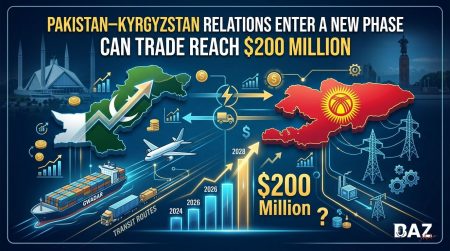
To address this gap, leaders have announced an ambitious objective of increasing bilateral trade to $200 million within the next two years. Earlier discussions had proposed a $100 million target, making the new goal a significant upgrade in expectations.
Achieving this target will require:
- Greater export diversification
- Easier customs procedures
- Better logistics infrastructure
- Increased private-sector participation
- Improved financial and banking cooperation
While the target is ambitious, it reflects growing confidence that stronger institutional cooperation can unlock new commercial opportunities.
Why Pakistan Sees Kyrgyzstan as a Strategic Partner
Kyrgyzstan occupies an important position within Central Asia, making it a valuable partner for Pakistan’s regional economic strategy.
Pakistan has long sought to expand its presence in Central Asian markets through stronger transport and trade corridors. Improved relations with Kyrgyzstan support that objective by opening opportunities for:
- Regional trade expansion
- Cross-border investment
- Energy cooperation
- Transit commerce
- Technology partnerships
Greater connectivity with Central Asian economies also helps Pakistan diversify its export destinations while reducing dependence on traditional markets.
Why Kyrgyzstan Benefits from Pakistan
As a landlocked country, Kyrgyzstan continuously seeks reliable access to international shipping routes.
Pakistan offers an important solution through its access to the Arabian Sea.
Using Pakistani ports could provide Kyrgyz businesses with:
- Faster access to South Asian markets
- Improved international shipping routes
- Lower transportation costs
- Better export competitiveness
- Greater access to Middle Eastern and global markets
This strategic advantage explains why discussions frequently include logistics, transit trade, and port cooperation alongside traditional trade agreements.
Key Sectors Driving Pakistan-Kyrgyzstan Partnership
The growing partnership extends beyond merchandise trade.
Recent agreements and Memorandums of Understanding (MOUs) cover several sectors expected to drive long-term economic cooperation.
Energy
Energy collaboration remains a major priority, particularly as both countries explore opportunities for regional energy integration.
Agriculture
Agricultural cooperation can help improve food trade while encouraging knowledge exchange and modern farming practices.
Information Technology
Pakistan’s rapidly expanding IT industry creates opportunities for software exports, digital services, and technology partnerships with Kyrgyz businesses.
Banking and Finance
Efficient banking channels are essential for facilitating cross-border transactions and reducing barriers for exporters and investors.
Mining
Both countries possess valuable mineral resources, creating opportunities for joint exploration and investment.
Logistics and Transport
Improved transport infrastructure remains one of the most important factors for increasing bilateral trade.
Connectivity Will Determine Future Success
Political goodwill alone cannot generate trade growth.
Experts believe the real challenge lies in implementing practical measures that allow businesses to move goods efficiently.
Several critical issues still require attention:
- Modern transport corridors
- Reliable customs systems
- Digital trade facilitation
- Cross-border banking services
- Freight connectivity
- Private-sector investment
Without progress in these areas, ambitious trade targets may remain difficult to achieve.
The Role of the Private Sector
Government agreements provide the foundation, but businesses ultimately determine whether trade expands.
Business forums, trade exhibitions, and B2B networking events are expected to encourage companies from both countries to explore new partnerships.
Industries likely to benefit include:
- Textile exports
- Pharmaceuticals
- Food products
- Information technology
- Construction materials
- Agriculture
- Logistics services
A more active private sector could significantly accelerate bilateral trade over the coming years.
Conclusion
Pakistan and Kyrgyzstan appear committed to building an economic partnership that matches their long-standing political relationship.
The renewed focus on trade, investment, connectivity, and regional integration demonstrates a shared vision for sustainable economic growth.
However, reaching the proposed $200 million trade target will require more than diplomatic meetings. Efficient transport links, stronger banking cooperation, active business engagement, and timely implementation of signed agreements will ultimately determine success.
If both governments successfully translate their commitments into practical action, Pakistan and Kyrgyzstan could emerge as increasingly important economic partners, strengthening trade across South Asia and Central Asia while creating new opportunities for businesses, investors, and regional development.