
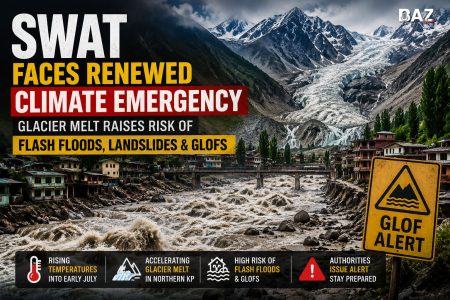
Swat Faces Renewed Climate Emergency as Glacier Melt Accelerates Flood Risk
Swat Valley is once again confronting a growing climate emergency as soaring temperatures across northern Pakistan rapidly accelerate glacier and snow melt. The resulting increase in water flow has significantly raised the risk of Glacial Lake Outburst Floods (GLOFs), flash floods, landslides, and sudden downstream inundation.
Authorities have already issued precautionary alerts across several districts of Khyber Pakhtunkhwa, warning residents, travelers, and local administrations to remain vigilant as temperatures continue climbing into early July. Experts believe this is another clear reminder that climate change is transforming seasonal weather patterns into increasingly dangerous natural disasters.
Why Swat Is at Greater Risk Than Ever
Swat Valley lies within Pakistan’s mountainous northern region, where glaciers and seasonal snowfields play a critical role in feeding rivers. During normal summers, gradual melting supplies freshwater downstream. However, prolonged heatwaves are now accelerating the melting process beyond safe levels.
As temperatures rise, glacial lakes expand rapidly behind unstable ice or moraine barriers. When these natural dams fail, massive volumes of water rush downstream within minutes, creating Glacial Lake Outburst Floods (GLOFs). These floods can destroy bridges, roads, homes, farmland, and communication infrastructure while giving communities little time to react.
Unlike traditional monsoon flooding, glacier-related floods often occur suddenly and with tremendous force, making them especially dangerous for mountain communities.
Government Issues Fresh GLOF Alert
Pakistan’s disaster management authorities have warned that the combination of extreme temperatures and melting glaciers could trigger dangerous flood events across northern Khyber Pakhtunkhwa.
The Pakistan Meteorological Department forecasts continued high temperatures through the first week of July, while the National Disaster Management Authority has highlighted elevated glacier-melt risks between June 27 and July 3.
Following these warnings, the Provincial Disaster Management Authority instructed district administrations in Swat, Upper Chitral, Lower Chitral, Upper Dir, Upper Kohistan, Lower Kohistan, and Mansehra to remain on high alert and activate precautionary measures.
Emergency services have also been advised to monitor vulnerable river channels, low-lying settlements, and transportation routes that could be affected by sudden flooding.
Climate Change Is Changing Pakistan’s Flood Pattern
The latest emergency is not simply the result of seasonal weather it reflects a much larger climate trend.
Pakistan is home to one of the world’s largest concentrations of glaciers outside the polar regions. Rising global temperatures are causing these glaciers to melt faster each year, increasing the number of unstable glacial lakes.
Scientists warn that climate change is producing a dangerous combination of:
- More frequent heatwaves
- Accelerated glacier retreat
- Earlier snowmelt
- Stronger monsoon systems
- Increased landslide activity
- More frequent flash floods
This combination significantly raises disaster risks across northern Pakistan, particularly in valleys like Swat that depend heavily on mountain ecosystems.
Why Swat Remains Highly Vulnerable
Swat’s geography makes it particularly susceptible to climate-related disasters.
Steep mountains funnel enormous volumes of water into narrow valleys, allowing floodwaters to travel rapidly toward populated areas. Villages located along rivers, streams, and drainage channels often have very little warning before floodwaters arrive.
Heavy rainfall further worsens the situation by combining with glacier melt, overwhelming rivers and increasing erosion. Landslides triggered by saturated slopes can also block rivers temporarily before collapsing and releasing destructive surges downstream.
The recurrence of multiple glacier-melt alerts within the same month demonstrates that these hazards are becoming increasingly frequent rather than isolated incidents.
Risks for Residents and Tourists
The ongoing climate emergency poses risks not only to local communities but also to thousands of tourists visiting Swat during the summer season.
People should exercise extra caution around:
- Riverbanks
- Suspension bridges
- Mountain streams
- Water crossings
- Narrow valleys
- Landslide-prone roads
- Glacial trekking routes
Even clear weather can quickly become hazardous when upstream glacier melt suddenly increases river flow.
The Need for Stronger Climate Preparedness
While emergency alerts remain essential, experts emphasize that long-term preparedness is equally important.
Improving early warning systems, expanding weather monitoring networks, strengthening evacuation planning, protecting critical infrastructure, and educating local communities can significantly reduce disaster impacts.
Climate adaptation must now become a central part of Pakistan’s national development strategy. Investments in resilient infrastructure, improved disaster response capabilities, and scientific monitoring of glacier systems will become increasingly important as global temperatures continue rising.
The recurring emergencies in Swat illustrate that future flood management cannot rely solely on monsoon forecasting. Glacier monitoring and climate adaptation must become permanent priorities.
Conclusion
Swat’s latest climate emergency serves as another warning that climate change is reshaping Pakistan’s natural landscape. What was once considered seasonal glacier melting is increasingly evolving into a year-round disaster management challenge.
As temperatures continue rising and glaciers become more unstable, authorities, local communities, and policymakers must work together to strengthen preparedness, improve resilience, and protect vulnerable populations.
The lessons from Swat extend far beyond one valley they highlight the urgent need for comprehensive climate action across Pakistan’s northern mountain regions before future disasters become even more destructive.