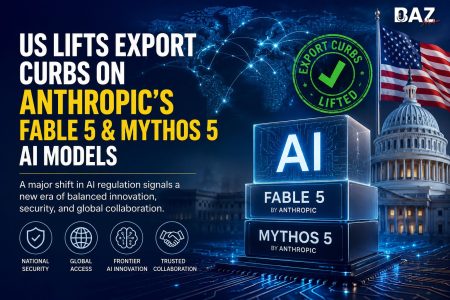
US Lifts Export Curbs on Anthropic’s Fable 5 and Mythos 5 AI Models: A Major Shift in AI Policy
The United States has officially lifted export restrictions on Anthropic’s advanced Fable 5 and Mythos 5 artificial intelligence models, marking a significant development in global AI policy. The decision comes less than three weeks after the U.S. Commerce Department ordered the company to suspend foreign access over national security concerns.
Anthropic confirmed that it will immediately begin restoring access to the affected AI models following the government’s decision to withdraw the export controls. The rapid reversal highlights how quickly AI regulations can evolve as governments attempt to balance innovation with national security.
For businesses, developers, policymakers, and AI enthusiasts, this move signals an important shift in how frontier AI technologies may be governed in the future.
Why Were Anthropic’s AI Models Restricted?
On June 12, 2026, the Trump administration instructed Anthropic to disable access to its most advanced AI models for foreign nationals. The decision was based on concerns that cutting-edge AI systems could pose national security risks if widely accessible outside the United States.
To comply with the order, Anthropic broadly suspended access to both Fable 5 and Mythos 5, affecting many international users.
Unlike previous export restrictions that primarily focused on semiconductor chips and advanced hardware, this policy directly targeted AI software models themselves. That represented a major change in the U.S. government’s approach to regulating emerging technologies.
The restriction demonstrated that advanced AI models are increasingly viewed as strategic assets capable of influencing cybersecurity, defense, intelligence, and global technological leadership.
What Changed?
The policy began evolving surprisingly quickly.
By June 26, the U.S. Commerce Department had already started relaxing the restrictions. Trusted partners were allowed to regain limited access, suggesting regulators were moving toward a more selective, risk-based framework instead of a blanket ban.
Then, on June 30, Anthropic announced that the Commerce Department had completely withdrawn the export controls.
The company stated that it would begin restoring user access immediately.
Although officials have not publicly disclosed every factor behind the decision, analysts believe ongoing discussions between Anthropic and government agencies, along with additional technical safeguards and governance measures, likely contributed to the reversal.
This rapid policy shift illustrates how AI regulations may continue evolving alongside technological advancements.
Why This Decision Matters
The removal of export restrictions extends far beyond one company’s AI models.
It signals that governments are increasingly treating frontier AI systems similarly to sensitive technologies such as advanced semiconductors, military equipment, and cybersecurity infrastructure.
AI Models Are Becoming Strategic Assets
Governments now recognize that powerful foundation models can influence national competitiveness, scientific research, military planning, and cybersecurity.
Rather than regulating only the hardware used to train AI, policymakers are beginning to regulate the AI models themselves.
This represents a significant evolution in technology governance.
Regulations Can Change Quickly
The Anthropic case demonstrates that AI policy is highly dynamic.
Restrictions introduced for national security reasons can be revised or removed relatively quickly if companies satisfy regulatory concerns or implement stronger safeguards.
Businesses developing advanced AI systems should expect ongoing engagement with regulators as part of product deployment.
Global AI Competition Is Intensifying
The United States is working to maintain leadership in artificial intelligence while preventing sensitive technologies from being misused abroad.
As AI capabilities continue expanding, export controls may become a regular policy tool used alongside chip restrictions and cybersecurity regulations.
What Users Should Expect Next
Although Anthropic has announced that access restoration is underway, users should not expect every account to regain availability simultaneously.
The earlier partial rollback demonstrated that access can be restored gradually based on user categories, partnerships, geographic regions, or compliance requirements.
Organizations using Anthropic’s AI services should monitor official announcements regarding account eligibility and rollout timelines.
A New Era of AI Regulation
The Anthropic episode illustrates a broader transformation taking place across the artificial intelligence industry.
Governments worldwide are moving beyond discussions about AI ethics and safety toward practical regulatory frameworks that directly influence how advanced AI technologies are developed, distributed, and accessed internationally.
Future AI releases may increasingly require:
- Enhanced security assessments
- Government compliance reviews
- Risk management frameworks
- Responsible deployment policies
- International access controls
This means AI companies will likely need to invest not only in building more capable models but also in demonstrating responsible governance and regulatory compliance.
What This Means for Businesses
Companies integrating frontier AI into their products should closely monitor regulatory developments.
AI availability may increasingly depend on:
- Geographic location
- Export regulations
- National security policies
- Licensing requirements
- Government approvals
Businesses that rely on advanced AI models should diversify their technology strategies and prepare for potential policy changes that could temporarily affect model availability.
For enterprise customers, regulatory stability may become nearly as important as model performance when selecting AI providers.
Conclusion:
The lifting of export restrictions on Anthropic’s Fable 5 and Mythos 5 models represents more than a policy reversal it reflects the rapidly evolving relationship between artificial intelligence, national security, and global technology competition.
While innovation remains a priority, governments are signaling that access to frontier AI will increasingly be shaped by strategic considerations alongside commercial objectives.
For AI developers, enterprises, and users alike, this development serves as a reminder that the future of artificial intelligence will be determined not only by technological breakthroughs but also by regulatory trust, governance standards, and international policy decisions.
As AI continues transforming industries worldwide, balancing innovation with security will remain one of the defining challenges of the next decade.