
Researchers Unlock New Insights Into the Universe’s Most Mysterious Objects
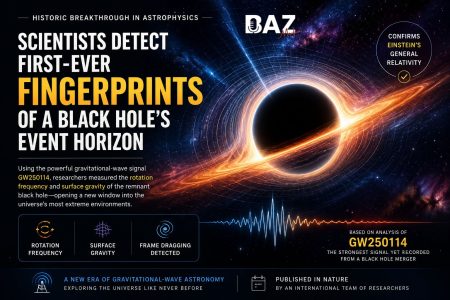
In a groundbreaking discovery that could reshape our understanding of the cosmos, scientists have reported the first observational detection of “fingerprints” from a black hole’s event horizon. By analyzing an exceptionally powerful gravitational-wave signal known as GW250114, researchers were able to probe the region closest to a black hole’s boundary and directly measure key properties of the newly formed black hole.
The achievement marks a significant milestone in astrophysics, offering a new method to study black holes and test Albert Einstein’s theory of general relativity under the most extreme conditions ever observed.
What Is a Black Hole’s Event Horizon?
The event horizon is often described as the “point of no return” surrounding a black hole. Once matter, light, or radiation crosses this boundary, it can no longer escape the black hole’s immense gravitational pull.
For decades, scientists have been able to observe the effects of black holes indirectly. However, obtaining direct observational information about the event horizon itself has remained one of astronomy’s greatest challenges.
How Scientists Measured the Event Horizon’s Fingerprints
The discovery was made by examining GW250114, the strongest gravitational-wave signal detected from a binary black hole merger.
Gravitational waves are ripples in spacetime generated by massive cosmic events, such as two black holes colliding. When these black holes merge, they produce an enormous burst of energy that travels across the universe.
Researchers focused on the final moments of the signal following the merger. This late-stage portion of the gravitational-wave data contains information originating from extremely close to the newly formed black hole’s event horizon.
By isolating these “direct waves,” scientists extracted signatures linked to the horizon region and measured two fundamental properties:
Rotation Frequency
The team determined how fast the newly formed black hole spins. Rotation frequency is a crucial characteristic because spinning black holes can influence the surrounding spacetime through a phenomenon known as frame dragging.
Surface Gravity
Scientists also measured the black hole’s surface gravity, a quantity related to how strongly gravity behaves near the event horizon. Surface gravity plays an important role in theoretical concepts such as black hole thermodynamics and Hawking radiation.
These measurements provide an unprecedented look at the physical conditions near a black hole’s boundary.
Confirmation of Einstein’s General Relativity
One of the most exciting aspects of this research is that the findings strongly support Einstein’s theory of general relativity.
General relativity predicts how black holes should behave, including their rotation, gravitational effects, and influence on surrounding spacetime. The newly observed event-horizon signatures closely match theoretical expectations.
Researchers also identified evidence of frame dragging, where a rapidly spinning black hole twists nearby spacetime around itself. This phenomenon has been predicted for over a century but remains challenging to observe directly.
The successful detection further strengthens confidence in current models of black hole physics.
Why This Discovery Matters
The ability to study a black hole’s event horizon through gravitational waves represents a major advancement in astronomy.
Until now, scientists primarily relied on two approaches:
- Observing electromagnetic radiation emitted near black holes.
- Studying post-merger ringdown signals produced after black hole collisions.
This new method provides a third and potentially more powerful tool.
A New Window Into Extreme Gravity
Black holes create the strongest gravitational fields known in the universe. Studying the event horizon allows researchers to test the laws of physics under conditions impossible to recreate on Earth.
The discovery opens the door to:
- More precise tests of gravity.
- Better understanding of black hole formation.
- Insights into spacetime behavior near singularities.
- Future investigations into quantum gravity theories
Complementing Event Horizon Telescope Images
The famous images captured by the Event Horizon Telescope provided visual evidence of supermassive black holes by observing their shadows.
However, gravitational waves offer something different.
While telescope images reveal what black holes look like from a distance, gravitational-wave observations provide dynamic information about what happens during and immediately after black hole mergers.
Together, these techniques create a more complete picture of black hole physics.
The GW250114 Signal: A Record-Breaking Observation
GW250114 is considered one of the most significant gravitational-wave detections to date.
The signal was recorded by the Laser Interferometer Gravitational-Wave Observatory (LIGO) and partner detectors. Its exceptional strength allowed researchers to isolate details that would normally remain hidden within background noise.
This high-quality data made it possible to identify subtle signatures associated with the event horizon and extract meaningful measurements.
As gravitational-wave observatories become more sensitive, scientists expect many similar discoveries in the coming years.
Published in Nature by International Researchers
The study was published in the prestigious journal Nature and involved researchers from several leading institutions, including:
- Australian National University (ANU)
- OzGrav
- Canadian research institutions
- United States collaborators
- European research teams
The international effort highlights the growing importance of gravitational-wave astronomy as one of the fastest-evolving fields in modern science.
What Comes Next?
The detection of event-horizon fingerprints is only the beginning.
Future gravitational-wave observatories and upgraded detectors could allow scientists to:
- Study black holes with greater precision.
- Search for deviations from Einstein’s predictions.
- Investigate the connection between gravity and quantum mechanics.
- Explore previously inaccessible regions of spacetime.
Researchers believe this technique may ultimately help answer some of the universe’s deepest mysteries.
Final Thoughts
The first observational detection of a black hole’s event-horizon fingerprints represents a historic achievement in astrophysics. By analyzing the powerful GW250114 gravitational-wave signal, scientists have successfully measured properties originating from the region closest to a black hole’s boundary.
This breakthrough not only confirms key predictions of general relativity but also opens an entirely new pathway for exploring the universe’s most extreme environments. As gravitational-wave technology continues to advance, humanity may soon uncover even deeper secrets hidden within the fabric of spacetime itself.