
A Crucial Financial Blueprint for Pakistan
Pakistan is preparing for a significant economic moment as Finance Minister Muhammad Aurangzeb is set to present the federal budget for FY2026-27 in the National Assembly
This budget arrives at a time when Pakistan is navigating fiscal pressures, inflation management, and structural economic reforms. The new financial plan is expected to reshape taxation, public spending, and economic priorities for the upcoming year.
Overview of Pakistan Budget FY2026-27
The federal budget for FY2026-27 introduces a combination of tax reforms, expenditure cuts, and structural economic adjustments aimed at stabilizing fiscal performance and expanding the tax base.
The National Economic Council has set the total federal budget at approximately Rs3.3 trillion, reflecting both revenue constraints and reform-oriented planning.
Key Highlights of Pakistan Budget 2026-27
Major New Tax Policies Introduced
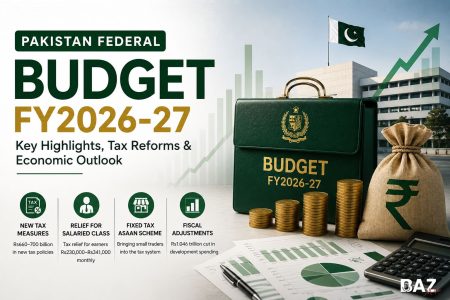
One of the most impactful elements of the budget is the introduction of Rs 660-700 billion in new tax measures. These reforms are expected to widen the tax net and improve revenue collection efficiency.
Key expectations include:
- Expansion of tax compliance systems
- Strengthening digital tax tracking
- Reduction in tax evasion loopholes
- Increased documentation of the informal economy
Relief for Salaried Class in Pakistan
A major highlight of the budget is targeted relief for salaried individuals. Workers earning between:
- Rs230,000 to Rs341,000 monthly will receive tax relief
- Middle-to-upper income groups earning Rs300,000-Rs500,000 may see reduced tax liabilities
This move is expected to ease financial pressure on Pakistan’s urban working population and improve disposable income levels.
For many households, this represents one of the most significant salaried class tax relief Pakistan budget 2026-27 updates in recent years.
Stability for Lower Income Groups
Individuals earning between Rs100,000 and Rs183,000 per month are expected to see minimal or no tax changes. This stability aims to protect lower middle-income households from additional financial burden amid inflationary pressures.
Fixed Tax Asaan Scheme for Small Businesses
A major structural reform in the budget is the introduction of the Fixed Tax Asaan Scheme, aimed at integrating small traders and shopkeepers into the formal tax system.
This scheme targets businesses with annual revenues up to Rs200 million, encouraging:
- Simplified tax filing
- Reduced compliance complexity
- Increased participation in the documented economy
Integration of Informal Economy
Prime Minister Shehbaz Sharif has emphasized the government’s commitment to bringing the informal economy into the formal tax structure.
The strategy includes:
- Improved business registration systems
- Incentives for documentation
- Stronger enforcement of tax compliance
This long-term reform aims to increase transparency and reduce dependency on indirect taxation.
Fiscal Adjustments and Economic Challenges
Addressing Revenue Shortfall
Pakistan is facing an estimated Rs800 billion revenue shortfall. To manage this gap, the government plans to reduce development and operational expenditures across multiple sectors.
Reduction in Development Spending
One of the most significant fiscal decisions includes a reduction of Rs1.046 trillion in development spending.
Key impacts:
- Punjab’s development program cut by nearly 49%
- Balochistan’s development allocation remains stable at Rs308 billion
- Federal and provincial adjustments to maintain fiscal balance
These cuts highlight the government’s prioritization of macroeconomic stability over expansionary development spending.
3. Provincial Budget Stability
Despite cuts in development programs, provincial shares from the divisible pool remain unchanged compared to the current fiscal year. This ensures some level of fiscal predictability for regional governments.
Economic Impact of Budget FY2026-27
The Pakistan federal budget 2026-27 is expected to have mixed economic effects:
Positive Impacts:
- Increased tax compliance and documentation
- Relief for middle-income salaried groups
- Long-term stabilization of fiscal deficit
Challenges:
- Reduced development spending may slow infrastructure growth
- Short-term inflationary pressure may persist
- Compliance burden may increase for businesses
Economists suggest that while the budget is reform-oriented, its success will depend on execution and enforcement.
Role of Media Coverage and Public Awareness
The budget has sparked widespread public and economic interest due to its potential impact on salaries, taxes, and development spending.
Media coverage plays a key role in:
- Explaining fiscal policies to the public
- Increasing transparency in government planning
- Shaping investor confidence
Conclusion: A Reform-Focused but Tight Budget
The Pakistan federal budget FY2026-27 reflects a balancing act between economic reform and fiscal constraint. While salaried individuals receive targeted relief, broader structural changes in taxation and spending indicate a shift toward long-term financial stabilization.
With new tax policies, informal economy integration, and expenditure controls, the government is signaling a strong push toward economic discipline and documentation-driven growth.