Introduction
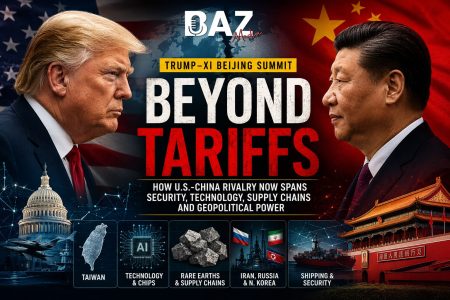
The much-anticipated summit in Beijing between Donald Trump and Xi Jinping was never realistically expected to produce a historic breakthrough. Despite the grand ceremony, diplomatic symbolism, and carefully managed optics, the meeting ultimately highlighted a far more important reality: the rivalry between the United States and China is no longer centered only on tariffs or trade deficits.
Today, the dispute stretches across security, technology, supply chains, military influence, and geopolitical alliances. That broader strategic competition explains why the summit produced cautious stabilization rather than a transformational agreement.
According to reports, both leaders attempted to project calm and cooperation, but the underlying disagreements remained deeply unresolved. China reportedly emphasized Taiwan as the most sensitive issue in the relationship, while American statements focused more heavily on economic coordination and market stability. The contrast revealed how differently both governments now define the core challenges in bilateral relations.
A Summit Built More on Optics Than Outcomes
The Beijing summit succeeded in reducing immediate tensions, but it stopped short of delivering major policy breakthroughs. Observers described the talks as producing limited tactical progress, including a fragile trade truce, business-friendly gestures, and commitments to maintain dialogue. However, there was little evidence of a deeper strategic settlement.
This matters because the summit was less about solving disputes and more about preventing further escalation. Both Washington and Beijing understand the economic and geopolitical costs of uncontrolled confrontation, particularly at a time when global markets remain sensitive to supply-chain instability, inflation, and regional conflicts.
Yet neither side appeared willing to make the kinds of concessions necessary for a genuine reset. The United States continues to view China as its primary long-term strategic competitor, while China increasingly sees American containment policies as a direct threat to its rise.
As a result, the summit functioned primarily as crisis management rather than conflict resolution.
Why Tariffs Are No Longer the Main Story
For years, U.S.-China tensions were largely framed through the lens of tariffs and trade imbalances. While those issues still matter, they are now only one layer of a much larger strategic rivalry.
The more serious disputes involve:
Taiwan and military signaling in the Indo-Pacific
Restrictions on advanced semiconductors and artificial intelligence technology
Control over rare earth minerals and critical supply chains
China’s relationships with Russia, Iran, and North Korea
Cybersecurity and digital infrastructure competition
Naval influence and shipping security in key trade routes
These issues are fundamentally harder to resolve because they relate directly to national security and long-term global influence.
For example, the United States has continued tightening restrictions on advanced chip exports and AI technologies to China, aiming to slow Beijing’s access to cutting-edge systems with military and strategic applications. China, meanwhile, has increasingly used rare earth controls and supply-chain leverage as economic tools of pressure.
This dynamic demonstrates that the competition is no longer about balancing trade numbers. It is about technological dominance, strategic independence, and geopolitical power.
Taiwan Remains the Most Dangerous Flashpoint
One of the clearest signs of continuing mistrust came from discussions surrounding Taiwan. Chinese officials reportedly warned that mishandling the Taiwan issue could lead to confrontation or even conflict.
That warning reflects how central Taiwan has become to Beijing’s strategic priorities. China considers Taiwan a core sovereignty issue, while the United States continues to strengthen informal security and political ties with the island.
This creates a dangerous environment where diplomacy and military signaling increasingly overlap. Even when both governments seek stability, neither side wants to appear weak on issues tied to national prestige or regional influence.
The Beijing summit therefore exposed an uncomfortable truth: the most dangerous aspects of the U.S.-China relationship are precisely the issues that cannot easily be solved through economic negotiations.
Technology and Supply Chains Are the New Battleground
Another major theme behind the summit was the growing battle over technology and industrial control.
Artificial intelligence, semiconductor manufacturing, quantum computing, and critical minerals are now viewed as strategic assets rather than ordinary commercial sectors. Both countries are racing to secure technological leadership because future economic and military power will depend heavily on these industries.
Washington’s export restrictions on advanced chips and China’s response through rare earth leverage reveal how deeply interconnected economic policy and national security have become.
At the same time, multinational companies are increasingly caught in the middle. Businesses that once relied on stable globalization now face pressure to diversify supply chains, relocate manufacturing, and prepare for geopolitical disruptions.
This shift is transforming the global economy itself. Countries across Asia, Europe, and the Middle East are now adjusting their foreign policies and trade strategies based on the growing divide between Washington and Beijing.
What the Summit Actually Achieved
Although the summit did not produce a landmark agreement, it would still be inaccurate to call it a failure.
The meeting achieved three important short-term goals:
It reduced the immediate risk of escalation.
It reopened communication channels between both governments.
It reassured markets that neither side currently wants a direct crisis.
Those outcomes matter because even limited stability can prevent economic shocks and military miscalculations.
However, the summit also reinforced the idea that the U.S.-China rivalry is now structural rather than temporary. The disagreements are rooted in competing visions of global power, technological leadership, and regional influence.
That means future summits will likely focus on managing tensions instead of resolving them entirely.
Conclusion
The Beijing summit may have slowed the deterioration in U.S.-China relations, but it did not fundamentally change their direction.
The era when Washington and Beijing could settle disputes mainly through tariff negotiations appears to be over. Today’s rivalry is broader, deeper, and far more strategic. Issues like Taiwan, artificial intelligence, rare earths, military positioning, and geopolitical alliances now define the relationship far more than trade balances alone.
In that sense, the summit was not a breakthrough moment. It was a reminder that the world’s two largest powers are entering a prolonged era of competition where diplomacy is increasingly about preventing conflict rather than building trust.
The meeting in Beijing showed that both sides still want stability but stability alone is no longer the same thing as partnership.