Pakistan Condemns Houthi Threats Against Saudi Arabia and Red Sea Shipping
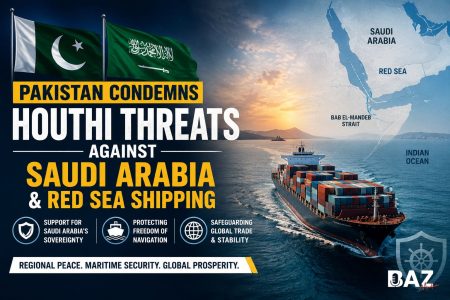
Pakistan has strongly condemned the latest Houthi threats against Saudi Arabia and commercial vessels operating in the Red Sea, reaffirming its unwavering support for Saudi Arabia’s sovereignty, territorial integrity, and regional security. The statement from Pakistan’s Foreign Office also highlighted growing concerns over threats to international shipping, freedom of navigation, and the stability of one of the world’s busiest maritime trade routes.
The latest diplomatic response demonstrates Islamabad’s continued commitment to supporting regional peace while emphasizing the importance of protecting international commerce from escalating security risks.
Pakistan Reaffirms Support for Saudi Arabia
In its official statement, Pakistan described the Houthi threats as a serious concern for regional peace and international maritime security.
The Foreign Office stated that such actions threaten regional stability, undermine freedom of navigation, and pose risks to commercial shipping operating through the Red Sea. Pakistan also reiterated its longstanding support for Saudi Arabia’s security and sovereignty, emphasizing that any threats against the Kingdom are unacceptable.
This position aligns with Pakistan’s consistent foreign policy of maintaining strong diplomatic and strategic ties with Saudi Arabia, one of its closest allies in the Middle East.
Why the Red Sea Matters to the World
The Red Sea is one of the world’s most strategically important waterways.
Every year, thousands of cargo ships carrying oil, natural gas, consumer goods, food supplies, and industrial products pass through the region via the Bab el-Mandeb Strait and the Suez Canal.
Any disruption in this maritime corridor can have immediate consequences for global trade, including:
- Rising shipping costs
- Delays in international supply chains
- Increased insurance premiums for cargo vessels
- Higher energy prices
- Inflation in importing countries
For this reason, governments across the world closely monitor security developments in the Red Sea.
Growing Maritime Security Concerns
While previous tensions largely focused on missile and drone attacks targeting Saudi Arabia, recent developments indicate broader concerns involving commercial shipping.
Threats against merchant vessels not only endanger civilian crews but also risk disrupting global logistics networks that support international trade.
Pakistan’s latest statement reflects this wider concern by extending its support beyond Saudi Arabia’s territorial security to the protection of international maritime routes.
Freedom of navigation remains a fundamental principle under international law, allowing commercial ships to move safely through international waters without intimidation or interference.
Pakistan’s Consistent Diplomatic Position
This is not the first time Pakistan has condemned Houthi actions.
Over recent months, Islamabad has repeatedly expressed solidarity with Saudi Arabia following missile threats and regional security incidents.
The latest statement reinforces several key diplomatic principles:
- Respect for national sovereignty
- Protection of international maritime routes
- Regional peace and stability
- Support for international law
- Safe movement of commercial shipping
Pakistan has consistently advocated dialogue, peaceful conflict resolution, and diplomatic engagement rather than military escalation.
Impact on Global Supply Chains
The significance of the Red Sea extends far beyond the Middle East.
A large percentage of trade between Europe, Asia, and Africa depends on uninterrupted access through this maritime corridor.
If security deteriorates further, businesses around the world may face:
Higher Transportation Costs
Shipping companies often reroute vessels around the Cape of Good Hope when security risks increase. Although safer, this route significantly increases travel time and fuel consumption.
Rising Consumer Prices
Longer shipping routes and higher freight costs ultimately affect retail prices, making imported products more expensive.
Energy Market Volatility
Oil and liquefied natural gas shipments passing through the Red Sea play a vital role in maintaining global energy supplies. Any disruption can create uncertainty in international energy markets.
Supply Chain Delays
Manufacturers relying on imported raw materials may experience production delays, affecting industries ranging from automotive manufacturing to consumer electronics.
Strategic Importance for Pakistan
Although Pakistan is geographically outside the Red Sea, developments in the region directly affect its economic interests.
Pakistan relies heavily on maritime trade for imports, exports, and energy supplies.
Any prolonged disruption could result in:
- Increased import costs
- Higher fuel prices
- Inflationary pressures
- Delays in industrial supply chains
- Greater uncertainty in regional trade
Given Pakistan’s growing trade ambitions and its strategic location along major maritime routes, ensuring secure international shipping remains an important national interest.
International Focus on Maritime Stability
The international community has increasingly emphasized protecting commercial shipping against regional conflicts.
Several countries have called for restraint, diplomatic engagement, and respect for international maritime law to prevent further escalation.
Pakistan’s statement fits within these broader international efforts by highlighting that secure sea lanes are essential for economic stability and global prosperity.
Maintaining freedom of navigation is not solely a regional concern it is a global economic necessity.
Looking Ahead
The evolving security situation in the Red Sea continues to attract worldwide attention due to its direct implications for international trade, energy security, and regional peace.
Pakistan’s condemnation of Houthi threats underscores its commitment to supporting Saudi Arabia while advocating for the protection of commercial shipping and adherence to international law.
As geopolitical tensions persist, diplomatic cooperation and responsible regional engagement will remain essential to safeguarding one of the world’s most important maritime corridors.
The coming months will likely determine whether diplomatic initiatives can ease tensions or whether continued instability will place additional pressure on global trade routes and supply chains.
Conclusion
Pakistan’s latest diplomatic stance sends a clear message in support of regional stability, maritime security, and international commerce. By condemning threats against Saudi Arabia and Red Sea shipping, Islamabad reinforces its longstanding commitment to protecting freedom of navigation and preserving the rules-based international maritime order.
With the Red Sea serving as a critical artery for global trade, maintaining peace in the region is not only vital for Middle Eastern security but also for the stability of the global economy.