Why India Is Holding Out for a Better US Trade Deal
For years, the United States has remained one of India’s most important economic partners. Trade between the two countries has expanded steadily, making negotiations for a comprehensive trade agreement a key priority for both governments. However, recent developments suggest India is no longer in a hurry to finalize a deal.
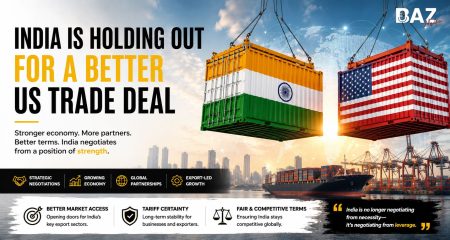
Instead of rushing toward an agreement, New Delhi is taking a more calculated approach. Armed with stronger export performance, diversified trade partnerships, and growing confidence in its economic position, India believes it can negotiate from a position of strength rather than necessity.
This shift reflects more than just trade policy it signals India’s emergence as a more influential player in global commerce.
Why India Is Slowing Down Trade Negotiations
Earlier stages of negotiations indicated India was prepared to offer significant concessions, including tariff reductions and broader market access, to accelerate a deal with Washington.
Today, the strategy has changed.
Indian policymakers are emphasizing that any agreement must be balanced, commercially meaningful, and beneficial for India’s long-term economic interests instead of simply reaching a quick political milestone.
Rather than accepting pressure to conclude negotiations, India appears comfortable waiting until better terms are available. This demonstrates growing confidence in India’s bargaining power within international trade
What Changed in India’s Position?
Several economic and geopolitical developments have strengthened India’s negotiating leverage.
1. Diversified Global Trade Partnerships
India has actively expanded its network of trade agreements beyond the United States.
Recent bilateral partnerships and broader economic cooperation with Europe and other regions have reduced India’s dependence on a single export destination.
As new markets open, India gains greater flexibility during negotiations with Washington.
2. Stronger Export Performance
India’s manufacturing and export sectors have become increasingly competitive across multiple industries.
Major export sectors include:
- Textiles
- Leather products
- Toys
- Furniture
- Gems and jewelry
- Auto components
- Pharmaceuticals
- Engineering goods
Higher export demand provides India with additional confidence during trade discussions.
3. Greater Economic Stability
India has gradually adapted to changing tariff environments and global supply chain disruptions.
Businesses have diversified production, expanded overseas partnerships, and strengthened domestic manufacturing under government initiatives.
This resilience means external tariff pressures have less immediate impact than they might have several years ago.
What India Wants From the US Trade Deal
India is not rejecting a trade agreement.
Instead, it wants a deal that delivers measurable economic benefits while protecting sensitive domestic industries.
Its priorities include several important objectives.
Better Market Access
India seeks improved access for labor-intensive industries that generate millions of jobs.
These sectors include:
- Apparel
- Textiles
- Leather goods
- Furniture
- Jewelry
- Automotive components
Greater access to the US market would significantly boost export earnings.
Long-Term Tariff Certainty
Indian businesses prefer predictable tariff policies instead of temporary concessions.
Stable tariff arrangements allow manufacturers and exporters to make long-term investments without uncertainty.
This is particularly important for pharmaceuticals and engineering exports.
Competitive Trade Terms
India also wants tariff conditions that are comparable or better than those offered to competing exporters across South and Southeast Asia.
If competing nations receive more favorable access to US markets, Indian exporters could lose market share.
Therefore, India is negotiating aggressively to secure competitive advantages.
Modi’s Political Strategy
Trade negotiations are closely linked to domestic politics.
Prime Minister Narendra Modi has consistently promoted economic self-reliance while encouraging foreign investment and manufacturing growth.
A trade agreement perceived as favoring foreign interests could create political challenges.
Conversely, securing stronger terms reinforces the government’s narrative that India is negotiating confidently on behalf of its businesses and workers.
This approach aligns with broader economic initiatives focused on expanding domestic manufacturing while increasing exports worldwide.
Why the US Faces a Different India
The United States has traditionally held stronger negotiating influence during many international trade discussions.
However, India’s growing economic size has altered that dynamic.
Today, India represents:
- One of the world’s fastest-growing major economies
- A critical manufacturing destination
- An expanding consumer market
- An increasingly attractive investment hub
- A strategic partner in Indo-Pacific economic cooperation
These factors give India alternatives that strengthen its bargaining position.
Rather than negotiating from weakness, New Delhi is signaling that it can afford to wait for a mutually beneficial agreement.
Global Impact of Delayed Trade Talks
The outcome of India-US trade negotiations extends well beyond the two countries.
A successful agreement could influence:
Global Supply Chains
Lower trade barriers would encourage companies to diversify manufacturing beyond traditional production centers.
Foreign Investment
Clearer trade rules could attract additional foreign direct investment into India’s manufacturing ecosystem.
Export Growth
Indian exporters would gain improved opportunities across one of the world’s largest consumer markets.
Regional Competition
Neighboring manufacturing economies are closely watching these negotiations since tariff structures influence global competitiveness.
What Happens Next?
Negotiations are expected to continue as both governments seek common ground.
The United States remains interested in expanding trade with one of the world’s fastest-growing economies, while India wants stronger protections and better commercial opportunities before finalizing any agreement.
Neither side appears willing to abandon talks.
Instead, both are working toward a deal that reflects changing economic realities.
The pace may be slower than initially expected, but the eventual agreement could prove more comprehensive and durable.
Final Thoughts
India’s decision to slow the pace of negotiations reflects a significant shift in global trade dynamics. Rather than prioritizing speed, New Delhi is focusing on securing favorable terms that support long-term economic growth, protect strategic industries, and strengthen export competitiveness.
For businesses, investors, and policymakers, this evolving approach highlights India’s increasing confidence as a major global economic power. Whether the final agreement arrives soon or after extended negotiations, one thing is clear: India is no longer negotiating from necessity it is negotiating from leverage.