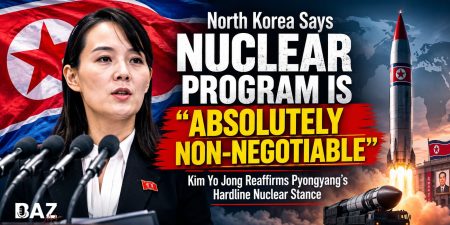
North Korea Reaffirms Nuclear Weapons Program as “Absolutely Non-egotiable”
North Korea has once again made its position on nuclear weapons crystal clear. In a strong statement published by state media, Kim Yo Jong, the influential sister of North Korean leader Kim Jong Un, declared that the country’s status as a nuclear power is “absolutely non-egotiable.”
The announcement signals that Pyongyang has no intention of abandoning its nuclear arsenal despite years of diplomatic efforts, international sanctions, and previous denuclearization discussions with global powers.
The statement comes at a time of increasing geopolitical uncertainty and renewed focus on security dynamics in East Asia.
Kim Yo Jong’s Strong Message to the International Community
Kim Yo Jong emphasized that North Korea’s nuclear status is permanent and that any attempts to pressure the country into disarmament would be unsuccessful.
According to her remarks, North Korea views its nuclear capabilities as essential to national security and sovereignty. She stated that the country would not tolerate threats and would continue strengthening its self-efensive nuclear deterrent.
Her comments represent one of the clearest indications yet that North Korea sees nuclear weapons not as a bargaining tool, but as a permanent pillar of state policy.
Key Highlights from the Statement
North Korea’s nuclear power status is “absolutely non-egotiable.”
The country rejects external pressure aimed at denuclearization.
Nuclear deterrence is considered essential for self-defence
The strategy of strengthening nuclear capabilities is described as irreversible.
Pyongyang warned that it would not tolerate threats against its security.
Why North Korea Refuses to Give Up Nuclear Weapons
For decades, North Korea has argued that nuclear weapons are necessary to protect the country from foreign intervention and military threats.
The leadership believes that maintaining a strong nuclear deterrent helps prevent potential attacks and strengthens its position in international negotiations.
A Major Shift from Previous Denuclearization Talks
Kim Yo Jong’s remarks highlight how dramatically North Korea’s position has evolved since the historic summits between Kim Jong Un and former U.S. President Donald Trump.
Those meetings generated optimism about the possibility of reducing tensions and achieving gradual denuclearization. While diplomatic engagement briefly improved relations, negotiations eventually stalled due to disagreements over sanctions relief and the scope of disarmament measures.
Today, North Korea’s leadership appears more determined than ever to maintain and expand its nuclear capabilities.
This represents a significant departure from earlier commitments that suggested a willingness to discuss denuclearization under certain conditions.
Regional Security Concerns Continue to Grow
North Korea’s latest declaration is likely to increase concerns among neighboring countries, including South Korea and Japan.
Both nations have repeatedly expressed concerns about Pyongyang’s missile tests and nuclear developments. The United States also continues to view North Korea’s nuclear program as a major security challenge in the Asia-acific region.
Security experts warn that the continued expansion of North Korea’s nuclear arsenal could contribute to:
Increased military tensions in East Asia
Expanded missile defense initiatives
Stronger military cooperation between regional allies
Reduced prospects for future diplomatic breakthroughs
As geopolitical competition intensifies globally, North Korea’s nuclear ambitions remain a central issue for policymakers.
Timing of the Announcement Raises Attention
The statement was published ahead of a high-rofile visit by Chinese President Xi Jinping to Pyongyang.
The timing has attracted international attention because China remains North Korea’s most important economic and diplomatic partner. Observers are closely monitoring whether the visit will influence regional security discussions or broader diplomatic efforts involving North Korea.
Although Beijing has historically supported denuclearization on the Korean Peninsula, China also prioritizes regional stability and maintaining strategic relations with Pyongyang.
What This Means for the Future
Kim Yo Jong’s declaration suggests that future negotiations with North Korea may become even more challenging.
If Pyongyang continues to treat its nuclear weapons program as a permanent and irreversible component of national policy, international efforts aimed at complete denuclearization could face significant obstacles.
Instead, policymakers may increasingly focus on risk reduction, arms control measures, and crisis management strategies designed to prevent escalation.
The statement underscores a reality that many analysts have been observing for years: North Korea appears committed to maintaining its nuclear arsenal regardless of external pressure.
Conclusion
North Korea’s latest statement marks a significant moment in the ongoing debate surrounding nuclear security and regional stability. By declaring its nuclear weapons program “absolutely non-negotiable” Kim Yo Jong has reinforced Pyongyang’s long-standing belied thatnuclear deterrence is essential to national defense.
As global leaders assess the implications of this position, the prospects for denuclearization appear increasingly uncertain. What remains clear, however, is that North Korea’s nuclear policy will continue to shape security discussions across Asia and beyond for years to come.