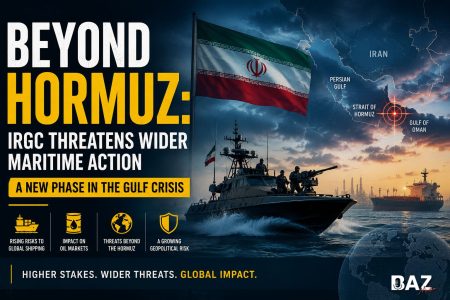
The latest warning from Iran’s Islamic Revolutionary Guard Corps (IRGC) suggests that the ongoing Strait of Hormuz crisis may be entering a far more dangerous phase. Rather than limiting its response to the strategic waterway alone, Iran has indicated it could target additional maritime export routes if the United States continues its naval blockade of Iranian ports.
This shift transforms what was previously viewed as a dispute centered around one of the world’s busiest shipping lanes into a broader regional maritime security challenge. For governments, energy traders, and global shipping companies, the implications extend far beyond the Persian Gulf.
Why the Strait of Hormuz Matters
The Strait of Hormuz remains one of the most strategically important waterways on Earth. Positioned between Iran and Oman, it connects the Persian Gulf with the Arabian Sea and serves as a critical transit route for global energy supplies.
Every day, millions of barrels of crude oil and liquefied natural gas pass through this narrow corridor. Major exporters including Saudi Arabia, Iraq, Kuwait, the United Arab Emirates, and Qatar rely heavily on uninterrupted shipping through Hormuz.
Because such a significant share of global energy exports moves through this single choke-point, even limited disruptions immediately influence international oil prices, freight costs, insurance premiums, and investor confidence.
The IRGC’s Latest Warning
Iranian media reported that the IRGC warned it could close “all other export corridors that benefit the United States and its allies” if Washington maintains pressure through its naval blockade.
This statement represents an important strategic shift.
Instead of focusing exclusively on defending Iranian waters or restricting movement through Hormuz, Tehran appears to be signaling that multiple maritime routes and energy-related infrastructure could become part of its broader deterrence strategy.
Military analysts often describe this approach as escalation signaling a method intended to convince an opponent that continuing pressure will generate increasingly costly consequences.
Rather than responding only at one location, Iran is suggesting it possesses multiple options capable of affecting regional trade and global energy flows.
From One Chokepoint to Regional Maritime Pressure
Until recently, international attention centered almost entirely on the Strait of Hormuz.
The newest threats indicate Iran may seek to expand pressure across a wider network of shipping routes, ports, and export infrastructure connected to Gulf energy markets.
Such a strategy could affect:
- Commercial shipping routes
- Oil export terminals
- Energy infrastructure
- Maritime logistics networks
- Regional naval operations
Even without large-scale military action, uncertainty alone can significantly disrupt commercial shipping. Shipping companies often reroute vessels, delay departures, or increase insurance coverage whenever geopolitical risks rise.
These indirect costs eventually reach consumers through higher transportation expenses and increased fuel prices.
How Global Energy Markets Could Be Affected
Energy markets react to uncertainty almost as strongly as they respond to actual supply disruptions.
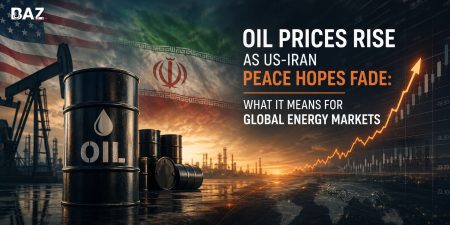
Whenever traders perceive a higher probability of interrupted oil exports, crude prices tend to rise as markets attempt to price in future supply risks.
A wider maritime confrontation could produce several economic consequences:
Higher Oil Prices
Reduced confidence in uninterrupted Gulf exports may increase global crude prices.
Rising Shipping Costs
Insurance premiums for vessels operating in high-risk regions often increase dramatically during geopolitical crises.
Supply Chain Delays
Commercial vessels may avoid conflict zones entirely, extending delivery times for energy products and manufactured goods.
Increased Market Volatility
Financial markets generally experience heightened volatility whenever geopolitical risks threaten global commodity supplies.
Countries heavily dependent on Middle Eastern energy imports including China, India, Japan, and South Korea would likely monitor developments closely because any sustained disruption could directly affect domestic energy costs.
Strategic Message Behind Iran’s Position
Iran’s warning is not necessarily an announcement of immediate military action.
Instead, it appears designed to reshape Washington’s strategic calculations.
By demonstrating the ability to influence multiple maritime corridors rather than only Hormuz, Tehran hopes to increase the perceived economic and political costs of continued pressure.
This form of strategic messaging has long been part of regional military doctrine.
The objective is deterrence convincing opponents that escalation will become increasingly expensive before additional military measures are taken.
Whether this warning evolves into actual operational activity remains uncertain.
The Risk of Miscalculation
Perhaps the greatest concern is not necessarily deliberate escalation but accidental escalation.
As more naval assets, commercial vessels, surveillance systems, and military patrols operate within confined maritime areas, the possibility of misunderstanding increases considerably.
History has repeatedly shown that relatively small incidents at sea can rapidly develop into wider geopolitical confrontations.
Should additional waterways or export terminals become involved, the conflict would no longer appear limited to a single strategic passage.
Instead, it could evolve into a broader regional maritime confrontation involving multiple countries, international naval coalitions, and global commercial shipping interests.
What This Means for the World
The Strait of Hormuz has always represented one of the world’s most sensitive geopolitical flashpoints.
The latest IRGC warning suggests future tensions may extend beyond this single corridor into a wider contest over maritime influence throughout the Gulf.
For governments, energy producers, investors, and shipping companies, the coming weeks will likely be shaped by diplomacy as much as military positioning.
Any successful diplomatic engagement could reduce tensions before further escalation occurs.
However, if maritime pressure continues to intensify, global markets may face prolonged uncertainty, higher transportation costs, elevated energy prices, and increased geopolitical instability.
Conclusion
The IRGC’s latest warning marks a significant evolution in the ongoing Gulf crisis. By threatening to expand pressure beyond the Strait of Hormuz, Iran is signaling that future confrontations may involve multiple maritime corridors rather than a single strategic chokepoint.
Whether this remains a deterrent message or develops into broader maritime action will largely depend on future diplomatic negotiations and military decisions by both Tehran and Washington.
For now, one fact remains clear: when one of the world’s most critical energy regions experiences heightened tension, the economic and geopolitical consequences rarely remain confined to the Middle East.