El Niño 2026: Why Pakistan Should Prepare for a Hotter and Drier Future
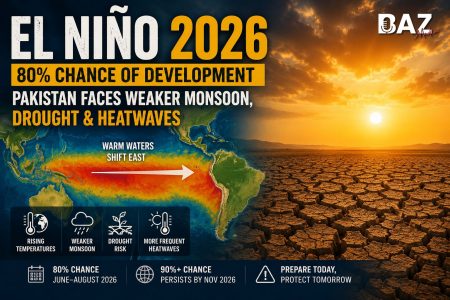
The world’s climate experts are closely monitoring the Pacific Ocean after the World Meteorological Organization (WMO) warned that there is an 80% chance of El Niño developing between June and August 2026. Climate models also suggest that the phenomenon has a greater than 90% probability of persisting into late 2026, potentially influencing weather patterns across the globe.
For Pakistan, the warning is particularly significant. Historically, El Niño events have been linked to weaker monsoon rainfall, higher temperatures, prolonged heatwaves, drought conditions, and pressure on agriculture and water resources. As climate change continues to amplify extreme weather events, the emergence of El Niño in 2026 could create additional challenges for South Asia.
What Is El Niño?
El Niño is a naturally occurring climate phenomenon that develops when surface waters in the central and eastern Pacific Ocean become warmer than normal. This warming alters atmospheric circulation patterns and disrupts weather systems worldwide.
Under normal conditions, strong trade winds push warm water toward the western Pacific. During El Niño, these winds weaken, allowing warm water to spread eastward toward the coast of South America.
As a result, global weather patterns shift dramatically, causing:
- Increased flooding in some regions
- Droughts in others
- Rising global temperatures
- Disruptions to marine ecosystems
- Changes in hurricane activity
Although El Niño is a natural climate cycle, scientists warn that its impacts can become more severe when combined with human-driven climate change.
Why Is El Niño 2026 Drawing Global Attention?
Several climate indicators suggest that ocean conditions are becoming increasingly favorable for El Niño development.
Recent observations show:
- Subsurface Pacific Ocean temperatures more than 6°C above average
- Weakening trade winds
- Ocean temperatures approaching El Niño thresholds
- Increasing confidence among global climate models
These indicators have prompted meteorological agencies to issue an El Niño Watch, signaling that conditions are favorable for development in the coming months.
The concern is not only whether El Niño will develop, but how strong it may become. Some forecasts indicate the event could reach moderate or strong intensity by late 2026.
How El Niño Could Impact Pakistan in 2026
Pakistan is among the countries most vulnerable to climate variability. The country’s economy, agriculture sector, and water resources depend heavily on seasonal rainfall and glacier-fed river systems.
1. Weaker Monsoon Rainfall
One of the most common impacts of El Niño across South Asia is the suppression of monsoon rainfall.
Climate experts warn that Pakistan may experience:
- Delayed monsoon onset
- Reduced seasonal rainfall
- Uneven rainfall distribution
- Longer dry periods between rain events
A weaker monsoon could affect millions of people who rely on rainfall for agriculture and water supplies.
2. Increased Heatwaves
Pakistan has already experienced several intense heatwaves in recent years. El Niño conditions typically contribute to higher-than-normal temperatures across South Asia.
Potential impacts include:
- More frequent heatwaves
- Longer periods of extreme temperatures
- Increased energy demand
- Greater health risks for vulnerable populations
Major urban centers such as Karachi, Lahore, Multan, and Islamabad could experience significant temperature spikes during summer.
3. Higher Drought Risk
If monsoon rainfall falls below normal levels, drought conditions may intensify across parts of the country.
Regions most vulnerable include:
- Southern Punjab
- Sindh
- Balochistan
Drought conditions can impact drinking water supplies, livestock, crop production, and rural livelihoods.
4. Agriculture and Food Security Challenges
Agriculture contributes significantly to Pakistan’s economy and employs millions of people.
A weak monsoon combined with higher temperatures could affect:
- Wheat production
- Cotton yields
- Rice cultivation
- Sugarcane output
- Livestock health
Reduced agricultural productivity may contribute to food inflation and economic pressure on farming communities.
5. Water Resource Stress
Pakistan is already considered a water-stressed country.
Lower rainfall and increased evaporation during El Niño could lead to:
- Reduced reservoir levels
- Increased groundwater extraction
- Irrigation challenges
- Water shortages in vulnerable regions
Could 2026 Become a “Super El Niño”?
The term “Super El Niño” refers to exceptionally powerful El Niño events that significantly alter global weather patterns.
Historically, major Super El Niño events occurred in:
1982-83
One of the strongest El Niño events on record, causing droughts, floods, and major economic losses worldwide.
1997-98
Often considered the benchmark Super El Niño event due to its extreme global impacts.
2015-16
Contributed to record global temperatures, widespread droughts, and severe weather disruptions.
While most forecasts currently point toward a moderate to strong El Niño in 2026, some climate projections suggest a smaller possibility that conditions could intensify further.
If that happens, global temperature records could again come under pressure.
Global Impacts Beyond Pakistan
The effects of El Niño are rarely limited to one region.
Potential worldwide impacts include:
South America
- Heavy rainfall
- Flooding
- Landslides
Australia
- Drought conditions
- Increased wildfire risk
- Water shortages
Southeast Asia
- Reduced rainfall
- Agricultural losses
- Extreme heat
North America
- Wetter conditions in some southern regions
- Warmer temperatures in northern areas
Pacific Ocean
- Increased tropical cyclone activity
What Can Pakistan Do to Prepare?
Preparation can significantly reduce the impact of climate-related disruptions.
Strengthen Water Conservation
Authorities should encourage:
- Efficient irrigation systems
- Rainwater harvesting
- Reservoir management
- Groundwater protection
Support Climate-Resilient Agriculture
Farmers can benefit from:
- Drought-resistant crop varieties
- Improved irrigation techniques
- Early weather forecasting
- Crop diversification strategies
Enhance Heatwave Preparedness
Public awareness campaigns can help communities:
- Stay hydrated
- Avoid outdoor activity during peak heat
- Protect vulnerable populations
- Reduce heat-related illnesses
Improve Climate Monitoring
Continuous monitoring of Pacific Ocean conditions and seasonal forecasts will be critical throughout 2026.
What Happens Next?
Climate experts expect conditions to become clearer during the coming months as ocean temperatures continue to evolve.
Key periods to watch include:
- June-August 2026: High probability of El Niño development
- August-October 2026: Potential strengthening phase
- November 2026 onward: Likely persistence of El Niño conditions
The next few months will provide crucial insights into the intensity and duration of the event.
Final Thoughts
The growing likelihood of El Niño in 2026 serves as an important reminder of how interconnected the world’s climate systems have become. For Pakistan, the potential impacts extend far beyond weather forecasts, affecting agriculture, water security, energy demand, public health, and economic stability.
While uncertainty remains regarding the event’s ultimate strength, early indicators suggest that preparation and proactive planning will be essential. Governments, businesses, farmers, and communities that act early will be better positioned to manage the challenges that a warmer and potentially drier climate may bring.
As global temperatures continue to rise and extreme weather events become more frequent, understanding El Niño is no longer just a scientific concern it is a matter of national resilience and sustainable development.