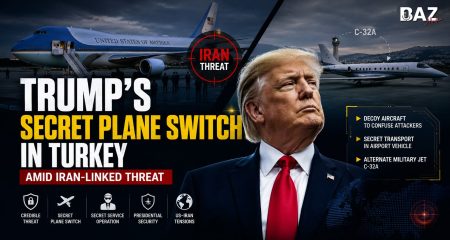
Trump Confirms Secret Plane Switch After NATO Summit
US President Donald Trump has confirmed that he was secretly moved to a different aircraft in Turkey last month following a credible security threat reportedly linked to Iran.
The unusual Trump secret plane switch took place after the NATO summit in Ankara and involved the US Secret Service and military personnel. According to reports, Trump initially appeared to board Air Force One in front of cameras before being discreetly transferred to a smaller, unmarked military aircraft.
The operation was designed to prevent potential attackers from determining which aircraft was carrying the president.
Trump later acknowledged the security maneuver, saying he followed the instructions of the Secret Service and military without questioning the decision. The revelation has drawn renewed attention to the evolving security environment surrounding the US president amid heightened tensions with Iran.
Why Did Trump Switch Planes in Turkey?
The reported reason behind the Trump plane switch in Turkey was a credible threat connected to Iran.
After the NATO summit, Trump was publicly seen boarding what appeared to be Air Force One. However, according to reports, the aircraft served as a decoy.
Trump was reportedly moved across the airport in a catering vehicle before boarding a smaller C-32A military aircraft. The maneuver allowed authorities to create uncertainty over the president’s actual location and flight path.
The decoy aircraft departed as expected, helping maintain the appearance that Trump was traveling aboard the aircraft that had been publicly identified.
Such tactics are intended to make it significantly more difficult for hostile actors to track or target a high-value individual.
How the Secret Service Protected Trump
The operation demonstrates the complexity of presidential security when intelligence agencies believe a credible threat may exist.
The US Secret Service is responsible for protecting the president, while military resources can provide additional transportation, intelligence, surveillance and security capabilities.
In this case, the reported operation involved several layers of deception:
- Trump initially appeared to board Air Force One.
- A decoy aircraft followed the publicly expected flight plan.
- Trump was secretly transported to another aircraft.
- The alternate aircraft departed under different circumstances.
- The movement was kept confidential until reports emerged.
The strategy essentially created uncertainty about which aircraft was carrying the president.
That uncertainty can be valuable in situations where adversaries may have access to sophisticated surveillance, intelligence or long-range weapons.
Was the Alternate Plane Actually Safer?
Interestingly, Trump said the aircraft he ultimately boarded could potentially have been at greater risk than Air Force One.
The logic is unusual but important.
Once an adversary knows that the president has changed aircraft, the alternate plane could become a more attractive target. The aircraft switch therefore does not necessarily eliminate danger; instead, it changes the security equation.
This highlights a fundamental challenge in protecting political leaders during periods of heightened geopolitical tension.
Security agencies must constantly balance secrecy, deception, intelligence and operational risk. A successful security operation is not necessarily one that eliminates every threat. Instead, it can be one that makes it harder for an attacker to identify the correct target.
What Does the Incident Say About the Iran Threat?
The Iran threat against Trump adds another dimension to an already tense US-Iran relationship.
American officials have previously expressed concerns about threats from Iran and Iran-linked groups against senior US officials. The reported aircraft operation suggests that security agencies were taking the possibility of an attack seriously enough to implement an unusually elaborate protection strategy.
The incident also demonstrates how modern threats extend beyond conventional military battlefields.
A presidential aircraft can potentially become a target through missiles, drones, intelligence operations or other forms of asymmetric warfare. As military technology becomes more accessible and surveillance capabilities become increasingly sophisticated, protecting senior political leaders requires increasingly complex countermeasures.
Has the US Used Plane-Switch Tactics Before?
The concept itself is not entirely new.
US presidents have previously used deceptive transportation tactics to reduce security risks. Former President Bill Clinton reportedly used a similar plane-switch strategy in 2000.
What makes the latest incident notable is the reported security environment surrounding it and the fact that the operation remained secret for weeks.
The use of an ordinary-looking airport catering vehicle to move the president adds another layer to the story. Rather than relying solely on visible security convoys or heavily protected transportation, authorities reportedly used an everyday airport operation to conceal Trump’s movement.
Why the Trump Plane Switch Matters
The Trump secret flight after the NATO summit offers a rare glimpse into the hidden security measures surrounding the US presidency.
It also raises broader questions about the risks facing world leaders during periods of international conflict.
For the United States, the incident highlights concerns over Iran’s potential reach and the possibility that threats could extend beyond traditional military targets. For other governments, it demonstrates how quickly diplomatic events can become security challenges when geopolitical tensions escalate.
The operation also illustrates an important principle of executive protection: information itself can become a security vulnerability.
If an adversary knows exactly where a protected individual is traveling, when they are moving and which aircraft they are using, the threat becomes easier to plan. By creating uncertainty, security agencies can make targeting considerably more difficult.
The Bigger Picture
Trump’s confirmation of the secret plane switch in Turkey has transformed what was previously an undisclosed security maneuver into a significant geopolitical story.
The incident is not simply about an unusual aircraft transfer. It reflects the increasingly sophisticated security environment surrounding the US presidency and the growing concern over threats associated with the US-Iran conflict.
For Trump, the decision was ultimately straightforward: follow the instructions of the people responsible for keeping him safe.
For security professionals, however, the episode represents a much more complicated calculation involving intelligence, deception, military logistics and potential risks to multiple aircraft.
As tensions between Washington and Tehran continue to shape international security, the Turkey plane-switch operation serves as a reminder that modern geopolitical conflicts can create risks far beyond the battlefield and that presidential protection increasingly depends on secrecy, unpredictability and sophisticated security planning.