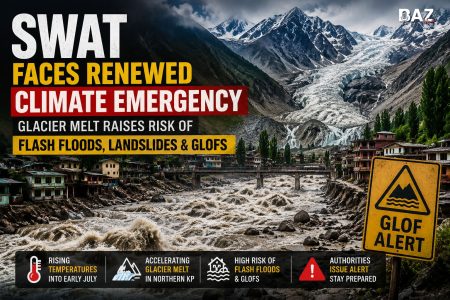

The devastating Nepal-Tibet floods that killed at least 177 people and left more than 1,300 missing were initially believed to have been triggered by an earthquake. Scientists have now reached a different conclusion: the disaster was caused by a massive glacier collapse and debris flow in the Himalayas.
The event has renewed concerns about Himalayan glacier instability, glacial lake outburst floods (GLOFs), climate change, and disaster preparedness across one of the world’s most vulnerable mountain regions.
Nepal-Tibet Floods Were Caused by a Glacier Collapse
The United States Geological Survey (USGS) initially recorded a magnitude 4.4 earthquake in the region. However, further investigation found that the seismic signal was not caused by tectonic activity. Instead, it was generated by the enormous force of a glacial collapse and subsequent debris flow.
Satellite imagery helped scientists reconstruct what happened. A large section of glacier at an elevation of approximately 5,200 metres (17,000 feet) broke away and plunged roughly 1,200 metres toward the valley below.
As the ice descended, it accumulated rocks, sediment and other debris. The resulting mass hit the valley with tremendous force, generating seismic waves that initially resembled those produced by an earthquake.
Researchers believe the collapsed glacier was located near Langtang Lirung peak, around 15 kilometres west of the area devastated by the floods.
How Did the Glacier Collapse Cause Such Severe Flooding?
The scale of the disaster was not caused by falling ice alone.
The collapsing glacier triggered a massive debris flow containing water, mud, ice and boulders. This mixture travelled rapidly through mountain valleys and river systems, creating what scientists have described as a tsunami-like surge.
The destructive flow affected the Bhote Koshi and Trishuli river systems, destroying infrastructure and settlements along its route.
Roads and bridges were swept away, power facilities were damaged and villages were inundated. The flooding also severely affected the Gyirong port in Tibet, an important crossing and trade route between China and Nepal.
The incident demonstrates how a relatively remote glacier collapse can quickly transform into a large-scale humanitarian disaster downstream.
Why Are Himalayan Glaciers Becoming a Growing Risk?
The Himalayas contain some of the world’s largest concentrations of ice outside the polar regions. These glaciers provide water to millions of people and feed major river systems across South Asia.
But the region is experiencing significant environmental changes.
Rising temperatures are contributing to glacier retreat and ice loss, while unstable slopes, changing snowfall patterns and increased meltwater can create dangerous conditions in high-altitude environments.
One major concern is the formation and expansion of glacial lakes. When unstable ice or rock dams fail, huge volumes of water can suddenly rush downstream. These events are known as glacial lake outburst floods, or GLOFs.
Although scientists have not yet established that this particular disaster was a conventional GLOF, the Nepal–Tibet event highlights the broader dangers associated with rapidly changing Himalayan glaciers.
What Caused the Glacier to Collapse?
One of the biggest unanswered questions is why the glacier collapsed in the first place.
Researchers are investigating several possible factors, including recent seismic activity, rapid snow or ice melt and human activity such as local construction.
However, scientists have cautioned against immediately attributing the specific collapse entirely to climate change.
There is an important distinction between saying that climate change is increasing glacier instability and proving that climate change directly caused one particular collapse.
More research, satellite analysis and field investigations will be needed to determine the precise trigger.
Nepal Flood Disaster Leaves Hundreds Missing
The human consequences have been catastrophic.
At least 177-180 people have been reported dead, while more than 1,300 people remain missing. The number could change as rescue teams gain access to affected areas and communications are restored.
Among those missing are foreign tourists who were travelling in the region.
The disaster has also exposed the vulnerability of mountain communities and infrastructure located along narrow valleys. In such environments, there may be very little time to respond when an enormous volume of water, rock and ice suddenly moves downstream.
What the Nepal-Tibet Disaster Means for the Future
The Nepal-Tibet floods offer a powerful warning about the changing risk landscape in the Himalayas.
Traditional earthquake monitoring alone may not be enough to identify every major hazard. Massive glacier collapses can generate seismic signals, meaning that authorities could potentially mistake a geological or cryospheric event for an earthquake without additional monitoring.
This makes early warning systems, satellite monitoring, glacier surveillance and real-time river monitoring increasingly important.
Mountain communities also need stronger evacuation plans and emergency communication systems capable of delivering warnings quickly to people living downstream.
For countries such as Nepal, China, India, Bhutan and Pakistan, Himalayan glacier hazards are not simply environmental concerns. They are increasingly connected to water security, infrastructure, tourism, agriculture and disaster management.
Conclusion
The deadly Nepal-Tibet floods were initially reported as an earthquake-related disaster, but scientists now believe that a massive glacier collapse triggered the destructive debris flow.
The event highlights the extraordinary power of rapidly moving ice, water, rocks and sediment in the Himalayas and the difficulty of predicting exactly when unstable mountain systems may fail.
As Himalayan glaciers continue to change, governments and scientists will need to strengthen glacier monitoring, flood forecasting and disaster preparedness. Understanding what happened in Nepal and Tibet could help authorities identify similar risks elsewhere before another catastrophic event occurs.