France and Spain Wildfires 2026: A Massive Evacuation Crisis Across Europe
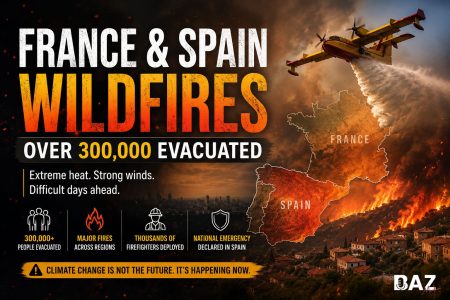
Wildfires sweeping across France and Spain have triggered one of Europe’s largest emergency evacuations in recent years, forcing hundreds of thousands of residents to leave their homes as authorities struggle to contain rapidly spreading flames.
More than 300,000 people have been displaced as extreme heat, prolonged drought, and powerful winds create dangerous conditions for firefighters. Emergency services in both countries have mobilised thousands of firefighters, military personnel, and aircraft to battle the devastating blazes.
Officials have warned that the situation remains highly unpredictable, with hotter temperatures and dry landscapes increasing the possibility of further fire expansion.
Wildfires in France: Thousands Forced to Evacuate
France’s southwestern region, particularly the Gironde area near Bordeaux, has become one of the hardest-hit zones during the wildfire outbreak.
Authorities have carried out major evacuation operations, moving residents away from areas threatened by advancing flames and heavy smoke. Thousands of emergency shelters have been opened to support displaced families.
The scale of the evacuation has highlighted the growing challenge France faces from increasingly intense wildfire seasons. Regions that previously experienced seasonal fires are now witnessing larger and more destructive events due to changing weather patterns.
Firefighters have been working continuously to create firebreaks, control hotspots, and prevent flames from reaching populated communities.
However, officials say that even after visible flames are controlled, the risk may continue for weeks because dry vegetation can reignite under favourable conditions.
Spain Declares Emergency as Wildfires Spread
Spain has also faced a severe wildfire emergency, with multiple regions reporting dangerous fires that have threatened towns, forests, and critical infrastructure.
Authorities have deployed extensive resources, including firefighting aircraft, ground teams, and military support, to slow the spread of flames.
The government’s emergency response reflects the seriousness of the crisis, as firefighters battle fires intensified by extreme temperatures and dry conditions.
Several areas near Madrid and other regions have experienced evacuations as authorities prioritise public safety.
Spain has historically faced wildfire challenges during summer months, but experts say recent fires have become more intense due to longer heatwaves, reduced rainfall, and rising temperatures.
Why Are France and Spain Experiencing Severe Wildfires?
Several environmental factors have combined to create ideal conditions for major wildfires across Europe.
Extreme Heat
Europe has experienced increasingly frequent and intense heatwaves in recent years. High temperatures dry out forests, grasslands, and agricultural areas, making them easier to ignite.
When vegetation loses moisture, even a small spark can quickly develop into a large wildfire.
Prolonged Drought Conditions
Drought has become a major factor behind the growing wildfire threat. Reduced rainfall leaves landscapes extremely dry and vulnerable.
Dry forests act as fuel, allowing fires to spread faster and become more difficult to control.
Strong Winds
Wind plays a critical role in wildfire expansion. Strong gusts can carry burning embers over long distances, creating new fire zones away from the original flames.
This makes firefighting operations significantly more challenging.
Climate Change and Europe’s Growing Wildfire Risk
The increasing frequency of wildfires across Europe has raised concerns about the impact of climate change.
Scientists have warned that rising global temperatures are contributing to longer fire seasons, more severe heatwaves, and increased drought risks.
Countries across southern Europe, including France, Spain, Italy, and Greece, are experiencing growing pressure to improve wildfire prevention systems and climate adaptation strategies.
Experts believe that future wildfire management will require more than emergency response. Governments will need stronger forest management, early warning systems, improved infrastructure, and long-term climate policies.
Economic and Environmental Impact of the Wildfire Crisis
The damage caused by large-scale wildfires extends far beyond immediate evacuations.
Thousands of hectares of forests and natural habitats can be destroyed, affecting biodiversity and ecosystems. Wildlife populations also face serious threats as fires eliminate natural habitats.
The economic impact can be significant, affecting tourism, agriculture, transportation, and local businesses.
Communities forced to evacuate often face uncertainty as they wait for permission to return home and assess possible damage.
The smoke generated by major wildfires can also impact air quality, creating health concerns even for people living far from the affected areas.
Difficult Days Ahead as Firefighters Continue the Battle
Authorities in France and Spain have warned that the wildfire situation could remain dangerous for an extended period.
Even when flames appear to be under control, hidden hotspots beneath the ground can restart fires when temperatures rise or winds increase.
Emergency officials continue to monitor weather forecasts closely, as upcoming heat conditions could determine how quickly the crisis improves.
The current wildfire emergency serves as another reminder of how extreme weather events are reshaping risks across Europe.
Conclusion: Europe Faces a New Era of Extreme Wildfire Challenges
The devastating wildfires in France and Spain represent a major climate and disaster management challenge for Europe.
With more than 300,000 people evacuated, thousands of firefighters deployed, and communities facing uncertain futures, the crisis demonstrates the growing impact of extreme heat and environmental changes.
As wildfire seasons become longer and more intense, governments, communities, and individuals will need stronger preparation and prevention strategies to protect lives, ecosystems, and economies.
The situation in France and Spain is not only a regional emergency it is a warning about the wider challenges posed by a changing climate.