A High-Stakes Battle Over Presidential War Authority
A major constitutional and political confrontation is unfolding in Washington as leading Senate Democrats intensify efforts to limit the military authority of Donald Trump in relation to ongoing operations against Iran.
The push, led by senior Democratic figures including Chuck Schumer, Tim Kaine, and Adam Schiff, aims to enforce compliance with the War Powers Resolution (1973) a landmark US law designed to limit unilateral military action by the President.
At the center of the debate is an escalating conflict involving Iran that has stretched beyond constitutional time limits without formal congressional authorization, triggering political outrage and repeated Senate votes.
What Is the War Powers Resolution (1973)?
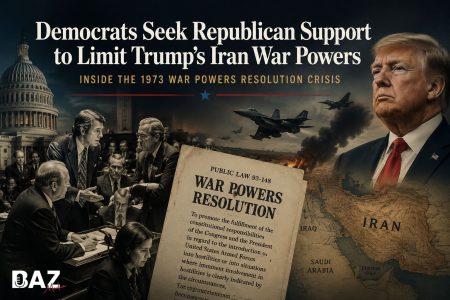
The War Powers Resolution of 1973 is a US federal law designed to check the President’s ability to engage in military action without congressional approval.
Key Provisions:
- President must notify Congress within 48 hours of military action
- Military engagement must end within 60 days without authorization
- A 90 day extension is allowed under emergency conditions
- Congress must approve war through a declaration or AUMF (Authorization for Use of Military Force)
Why It Matters in 2026
The current crisis revolves around claims that US military operations against Iran have exceeded the 60 day legal limit, raising questions about constitutional violations and executive overreach.
The Iran Conflict and “Operation Epic Fury”
The ongoing confrontation often referred to in strategic reports as Operation Epic Fury began with US strikes on Iranian nuclear infrastructure.
Key targets reportedly included:
- Fordow nuclear facility
- Natanz enrichment site
- Isfahan nuclear complex
The escalation has led to sustained hostilities, with lawmakers arguing that the war has continued well beyond legal authorization limits.
Trump’s War Powers Controversy Explained
Supporters of President Trump argue that military action was necessary for national security. However, critics claim the administration bypassed Congress entirely.
According to Senate Democrats, the war formally began without proper legislative approval and continued past the 60-day deadline outlined in federal law.
Senate Democrats Launch Repeated War Powers Votes
The US Senate has seen an unprecedented series of votes aimed at restricting presidential authority over Iran-related military actions.
Despite repeated attempts, most efforts have failed due to Republican opposition.
Voting Timeline Summary:
- First attempts in March and April 2026 failed narrowly
- Multiple votes showed consistent partisan division
- One breakthrough vote on May 18, 2026 showed shifting momentum
- Four Republican senators crossed party lines
Republican Defectors:
- Susan Collins
- Lisa Murkowski
- Rand Paul
- Bill Cassidy
Why Democrats Are Pushing So Hard
Democrats argue the issue is not just foreign policy it is constitutional authority.
Key Arguments:
- Presidents cannot unilaterally start long-term wars
- Congress must retain war-declaring power
- The 60 day rule has allegedly been violated
- Continued military escalation risks broader regional war
Senator Tim Kaine stated that the situation represents “a war requiring full congressional oversight,” reinforcing the urgency behind the resolution.
Republican Resistance and Political Division
Despite some defections, most Senate Republicans continue to oppose the resolution, arguing:
- The President needs flexibility in national security
- Iran poses an ongoing strategic threat
- War powers restrictions could weaken US deterrence
This deep political divide has resulted in repeated vote failures, making this one of the most contested war powers debates in recent US history.
What Happens If the Resolution Passes?
If the Senate War Powers Resolution succeeds, it would require:
- Immediate withdrawal of US forces from unauthorized hostilities
- Formal congressional approval for continued military operations
- Strict enforcement of the War Powers Act timeline
This could significantly reshape executive military authority and redefine US foreign policy toward Iran.
Impact on US Foreign Policy
If the Senate eventually limits presidential authority, it could:
- Strengthen Congressional war authority
- Reduce unilateral military strikes
- Create stricter legal oversight for future conflicts
- Impact US relations with Iran and allies
- Set precedent for future administrations
Conclusion
A Constitutional Test for American Democracy
The ongoing confrontation between Senate Democrats and President Donald Trump over Iran represents one of the most important war powers disputes in decades.
At its core, the issue is simple but powerful:
Who has the final authority to send America into war Congress or the President?
With multiple failed votes, rare bipartisan defections, and escalating geopolitical tension, the outcome of this debate could reshape US constitutional power for generations.
As the Senate continues weekly votes, all eyes remain on whether enough Republican senators will break ranks again to change the course of US military policy.