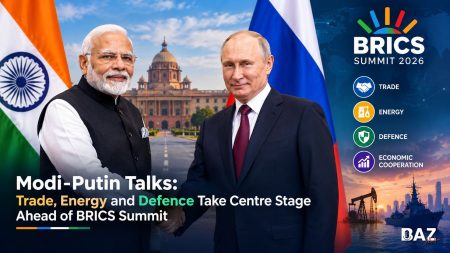
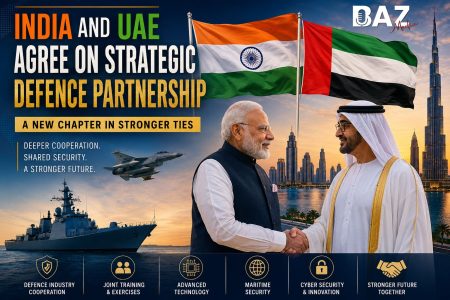
India and the United Arab Emirates have taken their relationship to a new level by agreeing on a framework for a strategic defence partnership during Prime Minister Narendra Modi’s high-profile visit to the UAE.
While the announcement generated major headlines, the real significance of the agreement lies in what it represents: a long-term shift from primarily economic cooperation toward a broader strategic partnership that includes defence, security, technology, energy, and regional stability.
The agreement comes at a time when geopolitical competition is intensifying across West Asia and the Indian Ocean region. For both countries, the partnership reflects growing recognition that economic strength and security cooperation increasingly go hand in hand.
According to reporting from, the two countries also expanded discussions on trade, liquefied natural gas supplies, and strategic energy cooperation during the visit, reinforcing the idea that this is a multidimensional strategic alignment rather than a single defence deal.
What the India-UAE strategic defence framework includes
The defence framework builds on earlier agreements and official letters of intent between the two countries. India’s Ministry of External Affairs has previously outlined the scope of the strategic defence partnership, which includes:
- Defence industrial cooperation
- Joint training and military exchanges
- Defence innovation and advanced technologies
- Counter-terrorism coordination
- Cybersecurity cooperation
- Maritime and regional security collaboration
Importantly, officials have described the framework as an expansion of already existing cooperation rather than a sudden policy shift. Over the past decade, India and the UAE have steadily strengthened military dialogue, naval cooperation, intelligence sharing, and security coordination.
Why the timing matters
The strategic timing of this partnership is significant.
West Asia has become increasingly complex due to regional rivalries, maritime security concerns, energy supply vulnerabilities, and shifting alliances among Gulf states. Countries across the region are diversifying their defence and diplomatic partnerships to reduce dependence on any single global power.
For India, stronger defence ties with the UAE fit into a broader foreign policy approach that seeks deeper engagement with Gulf countries while maintaining strategic flexibility.
India’s growing role in the Indian Ocean region has also increased the importance of partnerships with countries positioned along major maritime trade routes. The UAE sits at the center of critical energy and shipping corridors connecting Asia, Europe, and Africa.
By strengthening defence cooperation with Abu Dhabi, India improves its strategic access and influence in one of the world’s most economically important regions.
The partnership goes far beyond defence
Although defence headlines dominate the news cycle, the India-UAE relationship is fundamentally built on economic interdependence.
The UAE is one of India’s largest trading partners and an important source of investment, energy imports, and infrastructure cooperation. Bilateral trade between the two countries has expanded rapidly in recent years, with leaders now targeting even higher trade volumes over the next several years.
The relationship also includes cooperation in:
- Strategic petroleum reserves
- LNG and energy supply agreements
- Infrastructure development
- Food security initiatives
- Financial technology and digital payments
- Space and advanced technology sectors
This economic depth gives the defence partnership greater resilience and long-term value. Unlike relationships built only on military agreements, the India-UAE partnership is reinforced by trade flows, investment ties, energy dependence, and strong people-to-people connections.
India’s larger regional strategy
India’s expanding engagement with Gulf countries reflects a major shift in its foreign policy priorities.
Historically, India’s relationship with Gulf states focused heavily on energy imports and expatriate workers. Today, the relationship has evolved into a strategic partnership involving diplomacy, defence, logistics, and technology.
India increasingly sees West Asia as an extension of its broader Indo-Pacific strategy. Maritime trade routes through the Arabian Sea and Indian Ocean are vital for India’s economic growth and energy security.
The UAE, meanwhile, has emerged as one of the Gulf’s most influential economic and strategic actors. Abu Dhabi has pursued an active foreign policy centered on diversification, investment, technology, and strategic partnerships with major global powers.
This convergence of interests explains why India and the UAE are moving toward more formalized defence cooperation.
What this means for defence industry cooperation
One of the most important aspects of the agreement could be defence industrial collaboration.
India has been aggressively promoting domestic defence manufacturing under its “Make in India” initiative, aiming to reduce reliance on imported weapons systems and grow its defence export industry.
The UAE has also invested heavily in advanced defence technologies, aerospace industries, and military innovation ecosystems.
That creates opportunities for cooperation in areas such as:
- Joint production projects
- Defence technology transfer
- Maintenance and repair services
- Drone and unmanned systems
- Cybersecurity infrastructure
- Artificial intelligence applications in defence
Rather than focusing solely on purchasing military equipment, the partnership may evolve into collaborative industrial development.
This would align with global trends where countries increasingly seek co-development arrangements instead of traditional buyer-seller defence relationships.
Maritime security and the Indian Ocean
Another major dimension of the partnership is maritime security.
The Indian Ocean is one of the world’s most important trade corridors, carrying a massive share of global energy shipments and commercial cargo. Any instability in these sea lanes affects global markets and regional economies.
India has been working to strengthen its maritime partnerships across the region, including with Gulf states, Southeast Asian countries, and African coastal nations.
The UAE’s strategic geographic position near key shipping chokepoints makes it an important partner in ensuring maritime stability.
Cooperation could include:
- Naval exercises
- Anti-piracy coordination
- Maritime domain awareness
- Port infrastructure cooperation
- Intelligence sharing on regional threats
This strengthens both countries’ ability to respond to disruptions in one of the world’s most strategically sensitive maritime zones.
Counter-terrorism and cybersecurity cooperation
Security cooperation between India and the UAE has already expanded significantly in recent years, especially in counter-terrorism coordination.
Both countries face concerns related to extremist networks, cyber threats, and regional instability. Improved intelligence sharing and security coordination have therefore become increasingly important.
Cybersecurity is also emerging as a key area of collaboration. As economies become more digitally integrated, protecting financial systems, energy infrastructure, and communications networks has become a national security priority.
The defence framework’s inclusion of advanced technologies and cyberspace threats suggests both countries see digital security as central to future cooperation.
Does the agreement mean India will join Gulf conflicts?
One of the most common questions surrounding the partnership is whether it could pull India into regional conflicts in West Asia.
Indian officials have repeatedly clarified that deeper defence cooperation does not automatically mean military involvement in regional wars or alliances.
Instead, the framework appears focused on strategic coordination, defence industry development, maritime security, and regional stability rather than collective military commitments.
This allows India to maintain its traditional strategic autonomy while still expanding its regional influence.
Strategic significance for the future
The India-UAE strategic defence partnership represents a broader transformation in international relationships.
Modern strategic partnerships are no longer limited to military cooperation alone. Instead, they combine trade, energy, technology, investment, logistics, and security into a single integrated framework.
For India, the UAE offers access to a crucial economic and geopolitical hub in West Asia. For the UAE, India represents a massive market, technology partner, and rising global power with growing regional influence.
The agreement signals that both countries are preparing for a future in which economic security and national security are deeply interconnected.
Conclusion:
The India-UAE strategic defence partnership is much more than a symbolic diplomatic announcement.
It reflects a deeper shift toward long-term cooperation in defence, technology, trade, maritime security, and regional stability. As geopolitical competition intensifies across West Asia and the Indian Ocean, both countries are positioning themselves as strategic partners with shared economic and security interests.
The framework also highlights how modern diplomacy increasingly blends military cooperation with economic statecraft and technological collaboration.
Ultimately, the significance of this agreement lies not only in what was signed during Modi’s visit, but in what it signals for the future of India-UAE relations and the broader strategic landscape of the region.