Israel-Lebanon Ceasefire 2026: Can the New 60-Day Deal End Months of Fighting?
After months of deadly clashes, regional tensions, and repeated ceasefire violations, Israel and Lebanon have agreed to implement a new 60-day conditional ceasefire aimed at halting hostilities along one of the Middle East’s most volatile borders.
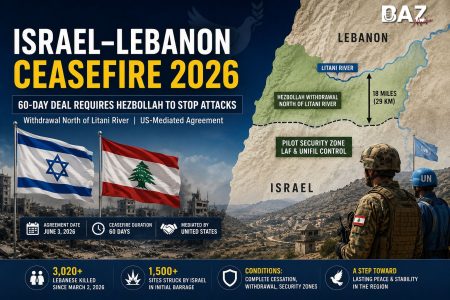
The agreement, finalized on June 3, 2026, was brokered through intensive US-led negotiations and introduces stricter security mechanisms than previous arrangements. The ceasefire requires Hezbollah to completely stop attacks against Israel and withdraw its operatives north of the Litani River, while the Lebanese Armed Forces (LAF) assume greater responsibility for security in southern Lebanon.
With more than 3,000 reported deaths and widespread destruction since fighting escalated in March, the deal represents one of the most significant diplomatic efforts in the region this year.
What Is the Israel-Lebanon Ceasefire Agreement?
The new Israel-Lebanon ceasefire agreement establishes a 60-day cessation of hostilities between Israel and Hezbollah-linked forces operating from Lebanese territory.
Unlike previous ceasefires, this agreement is conditional and tied directly to security benchmarks. The framework seeks not only to stop current fighting but also to create conditions for a more sustainable security arrangement in southern Lebanon.
The agreement emerged from the fourth round of high-level trilateral discussions involving the United States, Israel, and Lebanon.
Key Conditions of the Ceasefire
The success of the agreement depends on three major requirements.
1. Complete End to Hezbollah Attacks
The ceasefire requires Hezbollah to cease all rocket launches, missile strikes, and military operations targeting Israel.
Israeli officials have repeatedly stated that continued attacks would trigger military responses, making this condition central to the deal’s survival.
2. Evacuation of Hezbollah Operatives
All Hezbollah personnel are expected to leave designated areas in southern Lebanon, particularly within the South Litani Sector.
The move is intended to reduce the risk of direct confrontations near the border.
3. Withdrawal North of the Litani River
One of the most significant provisions requires Hezbollah forces to relocate north of the Litani River.
The Litani River lies roughly 29 kilometers (18 miles) north of the Israeli border and has long served as a strategic reference point in international peace agreements.
The area between the Blue Line and the Litani River is expected to function as a demilitarized buffer zone under enhanced monitoring.
What Are the New “Pilot Security Zones”?
A major innovation in the 2026 ceasefire is the creation of pilot security zones.
These zones are designed to test whether Lebanese state institutions can effectively maintain security without the presence of armed non-state actors.
Key Features of the Pilot Zones
- Lebanese Armed Forces maintain exclusive control.
- Hezbollah and other non-state armed groups are prohibited.
- Security oversight is coordinated with UN peacekeeping forces.
- Gradual expansion is planned if the initial phase succeeds.
- The system aims to strengthen Lebanese state authority in southern regions.
Why the Litani River Matters
The Litani River has played a central role in virtually every major Israel-Lebanon security arrangement since the 2006 Lebanon War.
Under United Nations Security Council Resolution 1701 (UNSCR 1701), the area between the Israeli border and the Litani River was intended to remain free from unauthorized armed groups.
However, implementation challenges and recurring tensions have prevented full enforcement over the past two decades.
The 2026 ceasefire attempts to revive and strengthen those original commitments by linking military withdrawal requirements directly to ceasefire compliance.
The Road to the 2026 Ceasefire
The latest conflict intensified on March 2, 2026, when renewed hostilities between Hezbollah and Israel escalated into one of the most serious confrontations in recent years.
Over the following months:
- Thousands of military strikes were reported.
- Israeli operations expanded deeper into Lebanese territory.
- Hezbollah continued attacks on northern Israeli positions.
- Civilian casualties increased significantly.
- International pressure for de-escalation intensified.
Several earlier ceasefire attempts failed to produce lasting results.
Previous Ceasefire Attempts
November 2024 Agreement
A broader ceasefire framework was signed but faced implementation difficulties and remained fragile.
April 2026 Ceasefire
A 10-day ceasefire was announced but quickly encountered violations and failed to achieve lasting calm.
May 2026 Extension
The agreement was extended for 45 days but continued to face accusations of repeated breaches from both sides.
The June 2026 agreement therefore represents another attempt to stabilize the border under stricter conditions.
Humanitarian Impact of the Conflict
The humanitarian consequences of the conflict have been severe.
Thousands of people have reportedly lost their lives, while many more have been displaced from their homes.
Communities in southern Lebanon have experienced significant infrastructure damage, while northern Israeli communities have faced ongoing security threats and disruptions.
Humanitarian organizations continue to call for:
- Protection of civilians
- Safe access for aid deliveries
- Restoration of essential services
- Long-term political solutions
The success of the ceasefire could provide an opportunity for relief efforts and reconstruction activities to expand.
The Role of the United States
The United States played a leading role in mediating the agreement.
American diplomats coordinated multiple rounds of negotiations involving Israeli and Lebanese representatives.
Washington has positioned the ceasefire as part of a broader effort to reduce regional tensions and prevent further escalation across the Middle East.
US officials have also emphasized the importance of implementing existing international agreements, particularly UNSCR 1701.
Pakistan’s Diplomatic Involvement
Pakistan has also emerged as an active diplomatic participant in regional peace efforts.
Prime Minister Shehbaz Sharif was reported to have played an intermediary role during earlier ceasefire discussions linked to wider regional negotiations.
Islamabad’s involvement highlights Pakistan’s growing interest in diplomatic engagement and conflict resolution initiatives in the Middle East.
Understanding UNSCR 1701
United Nations Security Council Resolution 1701 remains the legal foundation behind many provisions of the current agreement.
The resolution was adopted following the 2006 Lebanon War and includes several key objectives:
- Full cessation of hostilities
- Israeli withdrawal behind the Blue Line
- Deployment of Lebanese security forces in southern Lebanon
- Strengthening of UN peacekeeping operations
- Prevention of unauthorized armed activity in the buffer zone
What Challenges Could Threaten the Ceasefire?
Despite optimism surrounding the agreement, several risks remain.
Potential Obstacles
Trust Deficit
Years of conflict have created deep mistrust between all parties involved.
Enforcement Challenges
Monitoring compliance across a sensitive border region remains difficult.
Political Pressures
Domestic political considerations in both Israel and Lebanon could affect decision-making.
Non-State Actors
The presence of armed groups and regional proxy dynamics continues to complicate security arrangements.
Regional Escalation Risks
Developments elsewhere in the Middle East could quickly influence conditions on the Israel-Lebanon front.
What Happens Next?
The coming weeks will determine whether the ceasefire can hold.
Several key developments will be closely monitored:
- Hezbollah’s compliance with withdrawal requirements.
- Lebanese Armed Forces expansion into designated security zones.
- Israeli military adjustments along the border.
- Implementation of pilot security zones.
- Progress toward broader diplomatic negotiations.
If successful, the agreement could become the most meaningful step toward stability since the 2006 framework.
Final Thoughts
The Israel-Lebanon ceasefire of June 2026 represents a significant diplomatic breakthrough after months of intense conflict and humanitarian suffering.
By combining military withdrawal requirements, enhanced security arrangements, and renewed implementation of UNSCR 1701, the agreement seeks to address many of the issues that undermined previous ceasefires.
However, history suggests that success will depend not on the signing of the agreement itself, but on whether all parties adhere to its terms in the weeks ahead.
For now, the 60-day ceasefire offers a rare opportunity to reduce violence, stabilize southern Lebanon, and potentially create momentum toward a more durable peace between Israel and Lebanon.