
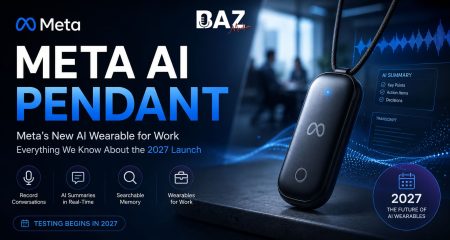
Meta AI pendant could become one of the most significant wearable technology launches of 2027. As artificial intelligence continues reshaping how people work, communicate, and manage information, Meta is reportedly developing a new AI-powered wearable device designed to act as a personal digital assistant throughout the day.
The move comes at a critical time for Meta, whose Reality Labs division continues to face significant financial pressure despite major investments in virtual reality, augmented reality, and AI technologies. Reports suggest the company is preparing to test an AI pendant and launch a new business-focused initiative called “Wearables for Work”, signaling a strategic shift toward practical AI-powered productivity tools.
What Is the Meta AI Pendant?
The “Meta AI pendant” is expected to be a small wearable device that users can wear around their neck or clip onto their clothing. Unlike smartwatches or smart glasses, the pendant focuses primarily on capturing conversations, understanding context, and delivering AI-powered assistance throughout the day.
Industry observers have compared the concept to products developed by AI wearable startups, particularly those specializing in voice-based productivity tools.
The device is expected to function as an always-available AI companion capable of:
Recording conversations and meetings
Generating real-time transcripts
Creating AI-powered summaries
Organizing notes automatically
Providing searchable memory features
Delivering contextual workplace assistance
If successful, the wearable could become a central component of Meta’s broader AI ecosystem.
Why Meta Is Investing in AI Wearables
Meta’s interest in AI wearables is not happening in isolation. The company has spent years investing billions of dollars in virtual reality and metaverse technologies through its Reality Labs division.
While products such as VR headsets and smart glasses have gained attention, profitability remains a challenge. Reports indicate Reality Labs recorded substantial losses in recent quarters, increasing pressure on Meta to identify new hardware categories with stronger consumer and enterprise adoption potential.
The “Meta AI wearable 2027 strategy” appears to focus on practical productivity rather than immersive virtual experiences.
Instead of asking users to enter virtual worlds, the AI pendant aims to enhance real-world interactions by helping users remember conversations, capture important information, and manage workflows more effectively.
This shift could represent a major evolution in Meta’s hardware roadmap.
Meta’s “Wearables for Work” Initiative
One of the most intriguing aspects of the announcement is the introduction of “Meta Wearables for Work”.
Unlike consumer-focused smart devices, this initiative appears to target professionals, remote workers, executives, consultants, sales teams, and enterprise organizations.
Potential business applications include:
Meeting Intelligence
Productivity Enhancement
Knowledge Management
Collaboration Support
Expected Features of the Meta AI Pendant
Although Meta has not officially revealed detailed specifications, industry reports and market trends suggest several likely features.
- AI-Powered Conversation Capture
The device may continuously listen for user commands and record conversations when authorized. - Real-Time Transcription
Automatic transcription could convert spoken conversations into searchable text instantly. - Smart Summaries
One of the most valuable capabilities could be AI-generated summaries. - Searchable Memory
Many AI wearable companies are focusing on “digital memory” capabilities.
Users could potentially ask questions such as:
- “What did Sarah say about the project deadline?”
- “When did we discuss the budget proposal?”
- “What were the key decisions from yesterday’s meeting?”
Integration With Meta AI
The pendant will likely integrate closely with Meta AI services, enabling voice commands, scheduling assistance, productivity recommendations, and contextual support.
Enterprise Security Features
For workplace adoption, Meta will need to prioritize:
Data encryption
Privacy controls
User consent mechanisms
Enterprise compliance standards
Security will be a major factor in determining business adoption rates.
Potential Release Date and Testing Timeline
Current reports suggest Meta plans to begin testing the AI pendant within the next year.
This places initial trials around 2027, although public availability could vary depending on development progress and market feedback.
The company is reportedly pursuing ambitious wearable sales targets while expanding its AI hardware portfolio.
Industry analysts believe Meta’s growing focus on AI could accelerate development timelines compared with previous hardware initiatives.
Privacy Concerns and Challenges
As with any device capable of recording conversations, privacy concerns will play a significant role in public acceptance.
Key concerns include:
Consent Issues
Data Security
Regulatory Compliance
Workplace Policies
Many organizations may require strict governance before allowing AI recording devices in meetings.
Meta’s ability to address these concerns will significantly influence adoption rates.
The Future of AI Wearables
The wearable technology industry is entering a new phase driven by artificial intelligence.
Instead of focusing solely on fitness tracking or notifications, next-generation wearables are becoming intelligent assistants capable of understanding context and helping users make better decisions.
The “Meta AI pendant” represents a broader trend toward ambient computing, where technology becomes less visible while remaining constantly available.
Future AI wearables may eventually:
Manage schedules automatically
Provide real-time coaching
Assist with communication
Generate workplace insights
Serve as personal knowledge repositories
As AI models become more capable, wearables could become indispensable productivity tools.
Final Thoughts
Meta’s reported AI pendant project signals a significant shift in the company’s wearable technology strategy. By focusing on workplace productivity, AI-powered memory, and real-world utility, Meta appears to be targeting a rapidly growing market for intelligent personal assistants.
While many details remain unconfirmed, the combination of AI conversation capture, searchable memory, meeting intelligence, and enterprise-focused functionality could make the Meta AI pendant one of the most closely watched technology products of 2027.
If Meta successfully balances innovation, privacy, and usability, its AI wearable could help redefine how professionals interact with information throughout the workday and potentially open an entirely new chapter in the evolution of wearable computing.