China Skips Shangri-La Dialogue 2026 Again as US Expands Indo-Pacific Presence
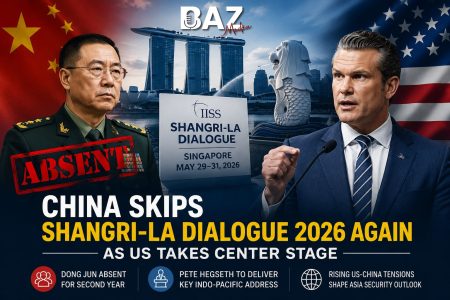
The 2026 Shangri-La Dialogue in Singapore has opened under intense geopolitical scrutiny after China confirmed that Defence Minister Dong Jun would not attend the summit for the second consecutive year. Instead of sending its top defence official, Beijing has delegated a lower-level People’s Liberation Army (PLA) team to represent the country at Asia’s most influential defence and security forum.
The move comes at a time of escalating tensions between the United States and China over trade disputes, military expansion, Taiwan, and regional influence in the Indo-Pacific.
Meanwhile, the United States has strengthened its presence at the summit by sending Defense Secretary Pete Hegseth, who is expected to deliver a keynote speech outlining Washington’s Indo-Pacific strategy and regional security priorities.
What Is the Shangri-La Dialogue?
The Shangri-La Dialogue is Asia’s premier annual defence summit held in Singapore and organized by the International Institute for Strategic Studies (IISS). The event gathers defence ministers, military officials, diplomats, and security experts from across the globe to discuss regional security challenges and geopolitical developments.
The summit plays a critical role in shaping defence cooperation, military diplomacy, and strategic dialogue in the Asia-Pacific region.
For years, the event has served as a platform where the United States and China publicly present their competing visions for regional security and global influence.
Dong Jun’s Absence Raises Questions
Chinese Defence Minister Dong Jun’s decision to skip the forum marks the second consecutive year that Beijing has avoided sending its top defence official to the summit.
This breaks a previous pattern in which China consistently participated at the ministerial level before the recent deterioration in US-China relations.
Beijing has not officially explained the absence, leading to widespread speculation about the reasons behind the move.
US Takes the Spotlight at the Summit
With China’s top defence leadership absent, the spotlight has shifted heavily toward the United States.
US Defense Secretary Pete Hegseth is expected to deliver one of the summit’s most anticipated speeches, focusing on America’s Indo-Pacific strategy, regional military cooperation, and concerns over China’s expanding military activities.
Washington has increasingly strengthened alliances with countries such as Japan, Australia, the Philippines, and South Korea in response to China’s rising influence in the region.
The US is also expected to emphasize freedom of navigation in the South China Sea, regional deterrence strategies, and support for Taiwan’s security.
Rising US-China Tensions Continue to Shape Asia
The Shangri-La Dialogue is taking place against the backdrop of worsening US-China relations.
Tensions between the two global powers have intensified over several major issues, including:
Trade disputes and tariffs
Taiwan and cross-strait security
Military activity in the South China Sea
Semiconductor and technology restrictions
Cybersecurity concerns
Strategic competition in the Indo-Pacific
Under the Trump administration, Washington has adopted a tougher stance on Beijing through economic pressure, military partnerships, and strategic deterrence measures.
China, meanwhile, has accused the United States of attempting to contain its rise and interfere in regional affairs.
Why China’s Absence Matters
China’s decision to skip the Shangri-La Dialogue carries symbolic and strategic implications.
The summit has historically offered rare opportunities for direct military diplomacy between rival powers. Without senior Chinese representation, opportunities for face-to-face crisis management and communication become more limited.
Defence experts warn that reduced dialogue between major military powers increases the risk of misunderstandings, especially in contested regions like the South China Sea and Taiwan Strait.
At the same time, China’s absence may allow the United States and its allies to dominate discussions on regional security architecture without strong public opposition from Beijing.
This could further deepen geopolitical divisions in the Asia-Pacific region.
Regional Reactions and Global Concerns
Several Asian countries are carefully observing the developments at the summit.
Nations across Southeast Asia are increasingly concerned about becoming caught between US-China rivalry while trying to maintain economic ties with both powers.
Singapore, which hosts the Shangri-La Dialogue, has repeatedly emphasized the importance of open communication and strategic stability in the region.
Global markets and international observers are also closely monitoring the summit for signals about future military policies, trade tensions, and diplomatic engagement between Washington and Beijing.
Could Relations Improve in the Future?
Despite the current tensions, analysts believe both countries still recognize the importance of maintaining communication channels to avoid military escalation.
While the absence of high-level Chinese representation may indicate strained relations, diplomatic engagement between the two nations continues through other international forums and backchannel discussions.
However, many experts warn that unless both sides rebuild trust and improve strategic communication, tensions in the Indo-Pacific could continue to intensify throughout the coming years.
The Shangri-La Dialogue 2026 may ultimately be remembered not for what was said but for who chose not to attend.
Conclusion
China’s decision to skip the 2026 Shangri-La Dialogue for the second year in a row has become one of the defining stories of this year’s summit.
As the United States expands its influence in the Indo-Pacific and Beijing remains cautious about direct public engagement, the geopolitical divide between the world’s two largest powers continues to widen.
With Asia at the center of global strategic competition, the future of regional security may depend heavily on whether Washington and Beijing can restore meaningful military dialogue and prevent tensions from escalating further.
For now, the absence of China’s defence minister speaks volumes about the fragile state of international relations in 2026.