

China’s Submarine-Launched Ballistic Missile Test Signals Growing Strategic Ambitions
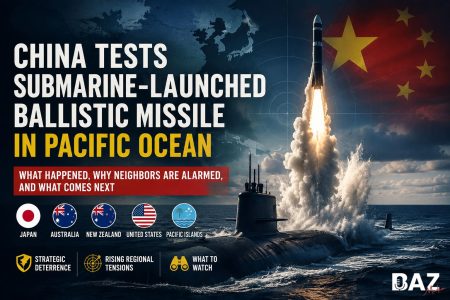
China has once again drawn international attention after confirming it conducted a submarine-launched ballistic missile (SLBM) test into the Pacific Ocean. While Beijing described the launch as part of its routine military training, the announcement has intensified concerns among regional governments and security analysts about China’s expanding military reach and its impact on Indo-Pacific stability.
The missile reportedly carried a dummy warhead and landed within its designated area in the Pacific. Although China emphasized that the exercise was not directed at any specific country, the public disclosure of the launch has been widely interpreted as a strategic signal demonstrating Beijing’s growing confidence in its long-range nuclear deterrence capabilities.
As geopolitical tensions continue to rise across the Indo-Pacific, this latest missile test has become another focal point in the evolving regional security landscape.
What Happened During China’s Missile Test?
According to Chinese officials, the ballistic missile was launched from a submarine operating in the Pacific Ocean. State media described the exercise as an annual military training event designed to verify the reliability and operational readiness of China’s strategic missile forces.
Unlike many previous missile exercises that received limited publicity, this launch was officially acknowledged, making it particularly noteworthy. Analysts believe that publicly announcing such a sensitive test serves not only military objectives but also broader political and diplomatic messaging.
Submarine-launched ballistic missiles are considered among the most survivable components of a country’s nuclear deterrent because submarines are difficult to detect and can operate far from national coastlines.
Why the Missile Test Matters
The significance of the launch extends well beyond the missile itself.
Modern submarine-launched ballistic missiles are a critical component of nuclear deterrence. By successfully demonstrating this capability, China reinforces its ability to maintain a credible second-strike capability, ensuring that it could respond even if its land-based missile infrastructure were compromised.
Security experts also note that the timing of the announcement comes amid increasing military competition between China and several regional powers. Recent concerns regarding potential long-range missile testing had already heightened tensions, making this confirmation even more sensitive.
For many observers, the launch reflects China’s broader military modernization efforts, which include expanding its naval fleet, improving missile technology, and strengthening strategic deterrence.
Why Indo-Pacific Countries Are Concerned
Several countries across the Indo-Pacific including Japan, Australia, New Zealand, and Pacific Island nations have previously expressed concerns regarding China’s long-range missile activities.
One of the primary issues is the lack of advance notification. Missile launches across international waters can create uncertainty for commercial aviation, maritime traffic, and regional defense forces. Without transparent communication, neighboring countries may struggle to distinguish between routine military exercises and genuine security threats.
Governments throughout the region also view these demonstrations as indicators of China’s growing military confidence. As Beijing continues expanding its strategic capabilities, neighboring countries are reassessing their own defense policies and strengthening regional security cooperation.
The latest launch therefore contributes to an already fragile security environment where misunderstanding or miscalculation could increase geopolitical risks.
Strategic Message Behind the Launch
Military analysts widely believe the missile test sends several strategic messages simultaneously.
First, it demonstrates that China’s submarine fleet possesses increasingly capable long-range strike options capable of operating far from the mainland.
Second, it reinforces Beijing’s commitment to maintaining a credible nuclear deterrent as global strategic competition intensifies.
Third, publicly acknowledging the launch serves diplomatic purposes by showcasing China’s technological progress and military modernization to both domestic and international audiences.
Although Chinese officials maintain that such exercises are routine, many regional governments interpret these actions as strategic signaling intended to project strength and influence across the Indo-Pacific.
Growing Competition in the Indo-Pacific
The Indo-Pacific has become one of the world’s most strategically important regions.
Increasing naval deployments, expanding military alliances, freedom-of-navigation operations, and rapid defense modernization programs have all contributed to heightened competition among major powers.
China’s continued investment in advanced missile systems, aircraft carriers, submarines, and naval infrastructure reflects its long-term objective of enhancing regional influence while protecting what it considers core national interests.
At the same time, countries such as the United States, Japan, Australia, India, and several Southeast Asian partners continue strengthening defense cooperation to preserve regional stability and maintain freedom of navigation.
As military capabilities improve on multiple sides, strategic signaling through missile tests has become increasingly common.
What Happens Next?
The international community will likely monitor several key developments in the coming months.
These include potential diplomatic responses from neighboring countries, future Chinese missile activities, regional military exercises, and any adjustments to defense policies among Indo-Pacific governments.
Analysts will also observe whether Beijing increases transparency around future strategic weapons testing or continues emphasizing that such launches are routine military training.
As geopolitical competition continues evolving, China’s missile capabilities will remain a central topic in discussions surrounding regional security, nuclear deterrence, and strategic stability.
Final Thoughts
China’s submarine-launched ballistic missile test represents more than a routine military exercise. It highlights the country’s growing strategic capabilities, underscores its commitment to strengthening nuclear deterrence, and raises fresh questions about the future security environment across the Indo-Pacific.
Although Beijing insists the launch was part of normal training, neighboring countries view such demonstrations through a broader geopolitical lens shaped by rising military competition and regional uncertainty.
The coming years will likely determine whether increased military modernization is accompanied by stronger diplomatic communication and confidence-building measures or whether strategic rivalry continues to intensify across one of the world’s most important geopolitical regions.