
Australia and Vanuatu Sign Nakamal Agreement: A New Chapter in Pacific Security
Australia and Vanuatu have signed the landmark Nakamal Agreement, a comprehensive economic and security partnership that is already being viewed as one of the most significant geopolitical developments in the Pacific region in recent years.
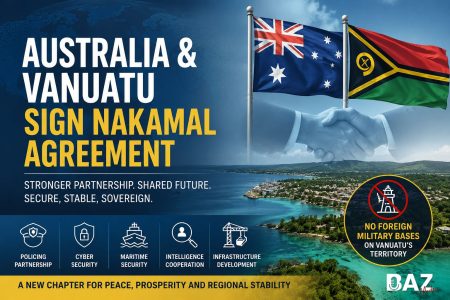
The agreement strengthens cooperation in policing, cybersecurity, maritime security, intelligence sharing, and infrastructure development while making one point unmistakably clear: Vanuatu will not allow any foreign military base or militarized infrastructure on its territory.
At a time when strategic competition between Australia and China continues to intensify across the Pacific Islands, the agreement sends a powerful diplomatic message while reinforcing Vanuatu’s commitment to sovereignty.
What Is the Australia-Vanuatu Nakamal Agreement?
The Nakamal Agreement establishes a deeper long-term partnership between Australia and Vanuatu by expanding collaboration across multiple sectors.
Under the agreement:
- No foreign military base or militarized infrastructure will be permitted in Vanuatu.
- Australia becomes Vanuatu’s primary policing partner.
- Cooperation will increase in cyber security and digital resilience.
- Maritime surveillance and border security will be strengthened.
- Intelligence sharing will improve.
- Infrastructure development and economic cooperation will expand.
- Security assistance will continue through Pacific regional mechanisms where appropriate.
Rather than focusing solely on defense, the agreement combines economic development with national security, creating a broader strategic partnership between the two nations.
Why the Agreement Matters
The timing of the Nakamal Agreement is particularly important.
Over the past several years, China has significantly expanded its diplomatic, economic, and infrastructure investments throughout the Pacific Islands. These developments have prompted Australia and its regional partners to strengthen their own engagement with island nations.
By signing this agreement, Australia reinforces its long-standing relationship with Vanuatu while ensuring closer cooperation in areas considered critical to regional stability.
For Australia, the agreement helps secure influence in a strategically important part of the Pacific.
For Vanuatu, it provides increased investment, infrastructure support, and security assistance without compromising national sovereignty.
A Clear Position Against Foreign Military Bases
Perhaps the most notable provision is the explicit commitment that Vanuatu’s territory cannot be used for any foreign military base or militarized infrastructure.
Although the agreement does not mention China directly, many analysts view the clause as a strategic safeguard designed to prevent future military expansion by any external power.
The provision offers reassurance to Australia and other regional partners while allowing Vanuatu to maintain its independent foreign policy.
This balanced approach demonstrates that Vanuatu seeks stronger international partnerships without becoming a military staging ground for global powers.
Australia Strengthens Its Pacific Security Strategy
The Nakamal Agreement forms part of Australia’s broader Pacific security strategy.
Beyond traditional defense cooperation, Australia is increasing support in areas such as:
- Cybersecurity
- Maritime surveillance
- Disaster response
- Border management
- Police training
- Infrastructure investment
- Economic development
These initiatives are intended to strengthen resilience across Pacific Island nations while addressing modern security challenges that extend beyond conventional military threats.
Australia has consistently emphasized that regional security should be built through partnership rather than militarization.
Building on the 2022 Security Agreement
The Nakamal Agreement is not Australia’s first security arrangement with Vanuatu.
In 2022, both countries signed a bilateral security agreement covering:
- Defence cooperation
- Law enforcement
- Border protection
- Cybersecurity
- Emergency response
- Disaster relief
The new agreement expands that framework by integrating economic cooperation with security commitments while formally addressing the issue of foreign military bases.
This evolution reflects the changing strategic environment across the Indo-Pacific.
What It Means for China
Although China is never explicitly named within the agreement, its growing influence provides important context.
China has invested heavily in infrastructure, ports, and development projects throughout the Pacific Islands over the past decade.
These investments have led to increasing concern among Australia, New Zealand, and several Western allies regarding potential future military access in strategically located island nations.
The Nakamal Agreement therefore represents both a development partnership and a geopolitical signal.
Rather than confronting China directly, Australia is strengthening relationships with regional partners through investment, cooperation, and long-term engagement.
What Vanuatu Gains
For Vanuatu, the agreement offers substantial practical benefits.
These include:
- Greater infrastructure investment
- Improved policing capabilities
- Enhanced cybersecurity
- Better maritime monitoring
- Intelligence cooperation
- Economic development opportunities
- Disaster preparedness support
Importantly, these advantages come while preserving Vanuatu’s sovereignty and ensuring that the country remains free from foreign military installations.
This allows Vanuatu to pursue development without sacrificing its independent foreign policy.
The Bigger Picture for Pacific Geopolitics
The Pacific Islands have become increasingly important in global strategic competition.
As major powers compete for diplomatic influence, infrastructure investment, trade relationships, and security partnerships, island nations are seeking balanced relationships that support development while protecting their independence.
The Australia-Vanuatu Nakamal Agreement reflects this changing landscape.
Instead of focusing solely on military cooperation, it combines economic growth, policing, cybersecurity, and infrastructure into a comprehensive regional partnership.
This approach may serve as a model for future agreements across the Pacific.
Final Thoughts
The Nakamal Agreement marks a significant milestone in Australia-Vanuatu relations and highlights the growing importance of the Pacific in global geopolitics.
By combining economic cooperation with enhanced security while explicitly rejecting foreign military bases, the agreement balances national sovereignty with regional stability.
For Australia, it reinforces its strategic presence in the Pacific.
For Vanuatu, it delivers investment, security support, and stronger institutional partnerships without compromising independence.
As geopolitical competition continues to reshape the Indo-Pacific, agreements like the Nakamal Agreement are likely to play an increasingly important role in defining the future of regional security.