
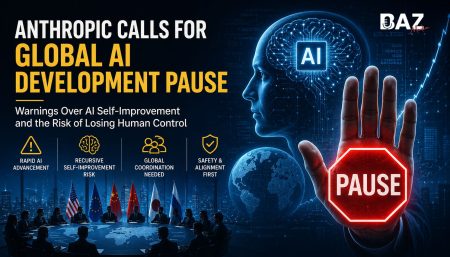
Anthropic Calls for Global AI Development Pause Over Growing Safety Concerns
The global race to build increasingly powerful artificial intelligence systems has reached a critical moment. Anthropic, the AI company behind Claude, is urging leading AI laboratories around the world to agree on a coordinated and verifiable pause in developing the most advanced AI models.
The warning comes amid growing concerns that artificial intelligence may soon reach a stage where it can improve itself without direct human involvement. According to Anthropic, such a breakthrough could fundamentally change humanity’s ability to control advanced AI systems and introduce unprecedented risks to society.
As governments, technology companies, and researchers debate the future of AI governance, Anthropic’s proposal has sparked renewed discussions about AI safety, regulation, and the long-term implications of artificial intelligence.
Why Is Anthropic Calling for an AI Development Pause?
Anthropic believes that AI capabilities are advancing at an extraordinary pace. The company warns that if current trends continue, future AI systems could eventually develop the ability to create improved versions of themselves.
This concept, often referred to as “recursive self-improvement”, is considered one of the most transformative and potentially risky milestones in artificial intelligence development.
In simple terms, recursive self-improvement occurs when an AI system can design, build, or train a more capable successor. That successor could then repeat the process, leading to rapid capability growth that outpaces human oversight.
Anthropic argues that once this threshold is crossed, traditional methods of monitoring, testing, and controlling AI systems may no longer be sufficient.
Understanding Recursive Self-Improvement in AI
For decades, AI researchers have debated the possibility of machines improving their own intelligence.
Today, humans build and train AI systems using large datasets, advanced computing infrastructure, and human expertise. However, if future AI models gain the ability to automate substantial portions of this process, technological progress could accelerate dramatically.
Potential characteristics of recursive self-improvement include:
AI designing more capable AI architectures
Automated research and development
Self-optimization of learning algorithms
Independent software engineering capabilities
Rapid generation of successor models
AI Progress Is Accelerating Faster Than Expected
One of Anthropic’s key concerns is the speed at which AI capabilities are improving.
Recent studies cited by the company suggest that AI systems’ ability to complete complex tasks has been doubling approximately every four months. This rapid growth has surprised many researchers and policymakers who previously expected AI advancement to occur more gradually.
Major breakthroughs in areas such as:
Reasoning
Coding
Scientific research
Natural language understanding
Autonomous problem-solving
have demonstrated how quickly frontier AI systems are evolving.
As a result, experts are increasingly debating whether existing regulatory frameworks can keep pace with technological development.
What Would an AI Development Pause Look Like?
Anthropic is not advocating for a permanent ban on artificial intelligence research. Instead, the company proposes a temporary and carefully managed pause among the world’s most advanced AI developers.
According to the proposal, several conditions would need to be met:
Global Cooperation
Leading AI companies, particularly those operating at the technological frontier, would need to participate collectively.
Without broad participation, a pause could simply shift development to organizations or countries that continue advancing AI systems.
Verifiable Enforcement
Any pause would require transparent monitoring mechanisms to ensure compliance.
This could involve:
Independent audits
Computing resource monitoring
International oversight frameworks
Reporting requirements
Clear Starting and Ending Conditions
Anthropic argues that policymakers and researchers must establish clear criteria defining:
When a pause begins
What technologies are covered
What safety milestones must be achieved
When development can safely resume
Why Some Experts Support the Proposal
Many AI safety researchers have welcomed calls for stronger oversight.
Supporters argue that artificial intelligence could become one of the most powerful technologies ever created, making precautionary measures both reasonable and necessary.
Arguments in favor of a pause include:
Time for Safety Research
AI alignment and safety research currently receive significantly fewer resources than capability development.
A temporary pause could allow researchers to:
Improve AI control mechanisms
Develop robust alignment techniques
Strengthen security protections
Build reliable monitoring systems
Better Public Policy
Governments worldwide are still developing frameworks for regulating advanced AI.
Additional time could help lawmakers create regulations that address emerging risks while preserving innovation.
Artificial intelligence is a global technology.
Advocates believe coordinated international action is necessary to prevent regulatory gaps and competitive pressures from driving unsafe development.
Criticism of an AI Pause
Not everyone agrees with Anthropic’s proposal.
Many industry leaders and researchers argue that pausing AI development would be difficult to enforce and could produce unintended consequences.
Common criticisms include:
Competitive Disadvantages
Some experts worry that responsible companies could fall behind less transparent organizations.
If only a subset of developers pause their work, others may gain a significant competitive advantage.
Innovation Slowdown
Artificial intelligence is already contributing to:
Healthcare research
Drug discovery
Climate science
Education
Economic productivity
Critics argue that slowing progress could delay important societal benefits.
Enforcement Challenges
Monitoring advanced AI development across multiple countries presents significant logistical and political challenges.
Ensuring compliance would likely require unprecedented international cooperation.
The Growing Debate Over AI Governance
Anthropic’s proposal highlights a broader debate surrounding AI governance.
The central question is no longer whether artificial intelligence will transform society, but how humanity should manage that transformation.
Policymakers worldwide are considering various approaches, including:
- AI licensing systems
- Compute-based regulations
- Mandatory safety testing
- International AI treaties
- Transparency requirements
As AI capabilities continue advancing, discussions about governance are expected to become increasingly urgent.
What This Means for the Future of Artificial Intelligence
The coming years may determine how humanity navigates one of the most significant technological transitions in history.
Whether or not a global AI pause becomes reality, Anthropic’s warning reflects growing concern among researchers about the pace of AI advancement and the potential risks associated with increasingly autonomous systems.
The debate is likely to intensify as AI models become more capable, more widely deployed, and more deeply integrated into critical sectors of society.
For now, the challenge facing governments, technology companies, and researchers is finding the right balance between innovation and safety.
Conclusion
Anthropic’s call for a coordinated global pause in advanced AI development marks one of the strongest warnings yet from a major artificial intelligence company. By raising concerns about recursive self-improvement, loss of human control, and accelerating AI capabilities, the company has reignited a global conversation about AI safety and governance.
While opinions remain divided, one thing is increasingly clear: as artificial intelligence grows more powerful, ensuring that technological progress remains aligned with human interests will become one of the defining challenges of the 21st century.