
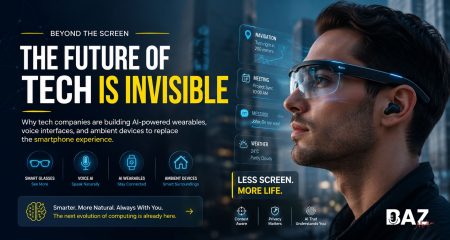
For nearly two decades, smartphones have been the center of our digital lives. From messaging and navigation to shopping and entertainment, almost everything happens through a screen that fits in our pocket.
Now, however, the biggest names in technology including Apple, Google, Meta, OpenAI, and other AI innovators are working toward a future where we interact with technology differently. Instead of constantly looking down at a phone, the next generation of computing may happen through AI-powered wearables, voice assistants, smart glasses, and ambient computing.
But is this evolution truly designed to reduce screen addiction, or is it simply introducing an even more immersive digital world?
Why Tech Companies Are Moving Beyond Smartphone Screens
The smartphone revolution transformed the world, but it also introduced new challenges.
People now spend several hours every day staring at screens. Continuous notifications, endless scrolling, and constant app switching have contributed to digital fatigue and shorter attention spans.
This has pushed technology companies to rethink how humans interact with computers.
Instead of forcing users to open an app for every task, AI systems can now understand spoken commands, recognize surroundings through cameras, and deliver information only when it’s actually needed.
The goal is simple:
Less screen time
Faster interactions
More natural communication
AI that works quietly in the background
This concept is commonly known as ambient computing.
What Is Ambient Computing?
Ambient computing refers to technology that blends naturally into everyday life rather than demanding constant attention.
Instead of unlocking a smartphone dozens of times each day, users simply speak, gesture, or wear devices that understand context automatically.
Examples include:
AI smart glasses displaying navigation directions
Voice assistants answering questions instantly
Wearables translating languages in real time
AI earbuds summarizing conversations
Smart home devices responding without manual input
Rather than opening apps repeatedly, technology becomes nearly invisible while remaining constantly available.
How AI Wearables Could Replace Smartphones
Artificial Intelligence is making wearable devices significantly smarter than previous generations.
Modern AI wearables can:
Voice-Based Assistance
Instead of typing, users simply ask questions naturally.
Whether checking weather forecasts, sending messages, or scheduling meetings, AI handles requests conversationally.
Context Awareness
Future devices won’t simply respond they’ll understand context.
For example:
Detecting your location
Recognizing nearby landmarks
Understanding ongoing conversations
Predicting your next action
This allows AI to provide information before you even ask.
Hands-Free Productivity
Imagine walking through an airport while your smart glasses display your boarding gate, flight updates, and navigation directions automatically.
No phone required.
This hands-free experience is one of the strongest selling points behind AI-powered wearable technology.
Personalized AI Assistants
Instead of generic digital assistants, future AI may learn your habits, preferences, schedules, and routines to offer highly personalized recommendations throughout the day.
Why Consumers Might Welcome Screen-Free Technology
Many users already feel overwhelmed by smartphone usage.
Screen-free AI experiences could offer several advantages.
Reduced Digital Distractions
Without constantly unlocking phones, users may become more present during work, meetings, family gatherings, and travel.
Better Accessibility
AI wearables may significantly improve accessibility for people with visual impairments, mobility limitations, or those who struggle with traditional smartphone interfaces.
More Natural Human-Computer Interaction
Technology becomes less about tapping icons and more about communicating naturally.
That represents one of the biggest shifts in computing since the invention of touchscreen smartphones.
The Hidden Risks of Always-On AI
Despite the excitement, critics warn that replacing screens doesn’t necessarily reduce digital dependence.
It may simply change how that dependence looks.
Increased Surveillance
Many AI wearables rely on:
Cameras
Microphones
Location tracking
Environmental sensors
This raises important privacy concerns.
If devices constantly observe surroundings to provide helpful assistance, they also collect enormous amounts of personal data.
Continuous Connectivity
Instead of checking a phone occasionally, AI could remain active throughout every moment of the day.
Notifications may become whispers, vibrations, visual overlays, or proactive suggestions.
Technology doesn’t disappear it simply becomes harder to notice.
New Forms of Digital Addiction
The smartphone created habits around checking screens.
Future AI devices could create habits around continuous conversations with digital assistants.
Rather than reducing dependence, they may expand it into nearly every daily activity.
Security Challenges
Always–connected wearable devices increase potential cybersecurity risks.
Personal conversations, biometric information, voice recordings, and location data become valuable targets if security protections fail.
Will Smartphones Actually Disappear?
Probably not at least not anytime soon.
Smartphones remain incredibly versatile devices capable of handling productivity, entertainment, photography, gaming, banking, and communication from a single platform.
Instead of disappearing completely, smartphones may gradually become background devices while AI wearables handle quick, everyday interactions.
Think of today’s relationship between laptops and smartphones.
Laptops didn’t disappear after smartphones arrived they simply became tools for different purposes.
The same transition may happen with AI wearables and smartphones.
The Future of Computing Is Becoming Invisible
The biggest shift isn’t about eliminating phones.
It’s about changing how people interact with technology.
Instead of constantly opening apps and staring at displays, future computing may happen through natural conversation, intelligent automation, and wearable devices that quietly assist throughout the day.
Whether this creates healthier digital habits or deeper technological dependence will largely depend on how responsibly companies develop these AI systems and how users choose to adopt them.
One thing is certain: the next era of computing won’t simply be smaller smartphones. It will be smarter, more contextual, and increasingly invisible.
Final Thoughts
AI-powered wearables, ambient computing, and voice-first interfaces represent one of the most significant shifts in consumer technology since the smartphone revolution. While these innovations promise convenience, accessibility, and reduced screen dependence, they also introduce complex questions about privacy, surveillance, and always-on connectivity. The future is unlikely to be completely screenless but it will almost certainly be less centered on the smartphone. As AI becomes more integrated into everyday life, finding the right balance between convenience and control will be the defining challenge for both technology companies and users.