
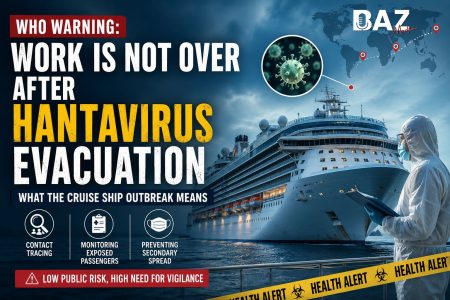
The recent hantavirus incident linked to a cruise ship evacuation has drawn global attention, but the World Health Organization (WHO) has made one thing very clear: the situation is not over.
Even though officials have assessed the overall public risk as low, WHO has stressed that monitoring must continue due to the nature of hantavirus infections, according to WHO leadership, no evidence currently suggests a large-scale outbreak, but additional cases could still emerge because of the virus’s incubation period and the way exposure events unfold across international travel routes.
The incident has also involved coordination with the European Centre for Disease Prevention and Control (European Centre for Disease Prevention and Control), which has been tracking cases and advising on risk levels across affected regions.
What happened on the cruise ship?
The outbreak began when a cluster of severe respiratory illness was detected among passengers and crew on a cruise ship operating in the Atlantic. Health authorities responded quickly, initiating evacuation procedures for affected individuals and starting large-scale contact tracing across multiple countries.
Early reports indicated multiple confirmed and probable cases linked to the same exposure environment. WHO outbreak updates have referenced fatalities among the cases and noted that investigations were still ongoing as more data became available.
Later surveillance updates from European health authorities suggested that the case count evolved as classification continued (confirmed, probable, and inconclusive cases), which is common in real-time outbreak investigations.
The central concern was that exposure occurred in a closed environment, ideal conditions for respiratory disease transmission and delayed detection.
Why the WHO says the risk is still being monitored
Even after evacuation, the WHO continues to emphasize that the response phase is not complete. The reason lies in how hantavirus behaves in the human body.
Hantavirus infections can have a relatively long incubation period, meaning symptoms may not appear immediately after exposure. This creates a delay between the initial event and the appearance of new cases.
Research on hantavirus cardiopulmonary syndrome shows incubation can range from several days to a few weeks, which explains why public health agencies continue monitoring exposed individuals long after the initial incident.
Because passengers and crew were dispersed across multiple countries after evacuation, tracking potential cases becomes more complex. This is why coordinated international monitoring is essential.
What is hantavirus?
Hantaviruses are a group of viruses primarily transmitted through rodents. Infection usually occurs when humans inhale particles contaminated with rodent urine, droppings, or saliva, especially in enclosed or poorly ventilated spaces.
According to the Centers for Disease Control and Prevention, hantavirus infections can lead to serious illnesses, including hantavirus pulmonary syndrome (HPS), which affects the lungs and can become life-threatening.
In this particular cruise ship investigation, health authorities identified the strain as Andes hantavirus, which is notable because it is the only hantavirus known to potentially spread from person to person, though such transmission is rare and typically requires close, prolonged contact.
Why the Andes virus matters in this outbreak
The Andes virus changes how public health teams respond because it introduces the possibility, however limited, of human-to-human transmission.
Unlike most hantaviruses, which are strictly rodent-to-human, the Andes virus has been linked to clusters where transmission between infected individuals may have occurred in close-contact environments.
This makes cruise ships a particularly sensitive setting. Shared air spaces, dining areas, and living quarters can increase exposure risk, especially before symptoms are recognized.
WHO has therefore emphasized careful monitoring of all close contacts rather than limiting surveillance to only those with confirmed infection.
Symptoms people should watch for
One of the challenges with hantavirus is that early symptoms often resemble common viral infections.
Early-stage symptoms may include:
- Fever
- Muscle aches
- Headache
- Fatigue
- Dizziness
- Abdominal discomfort
As the disease progresses, more severe respiratory symptoms can develop, including coughing and shortness of breath.
In severe cases, fluid may accumulate in the lungs, leading to respiratory distress. This is why early medical attention is critical for anyone with potential exposure and flu-like symptoms.
Incubation period and why timing matters
One of the most important scientific factors in this outbreak is the incubation period, the time between exposure and symptom onset.
Studies show hantavirus incubation can vary widely, often ranging from about 1 to 6 weeks depending on the strain and exposure level. Some cases fall outside this range, making monitoring even more important.
This delayed onset is exactly why the WHO has stated that the response is not finished after evacuation. A single travel-related event can generate new cases days or weeks later in different countries.
How hantavirus spreads
Most hantavirus infections occur through inhalation of contaminated particles in environments where rodents are present. These can include:
- Rural buildings
- Storage areas
- Poorly ventilated enclosed spaces
The virus can become airborne when contaminated dust is disturbed.
Prevention guidelines from global health authorities, including the Pan American Health Organization (PAHO), stress that rodent control and safe cleaning practices are the most effective protection methods.
Public health response: what authorities are doing now
After the evacuation, the response shifted from emergency action to long-term monitoring.
Key measures include:
- Tracking all exposed passengers and crew
- Monitoring for symptoms during the full incubation period
- Isolating suspected cases where needed
- Coordinating across international health agencies
- Updating risk assessments as new data emerges
WHO has consistently emphasized that outbreak control is not just about stopping immediate transmission; it is also about preventing secondary spread through early detection.
This is especially important in cruise ship scenarios, where individuals return to multiple countries within hours or days.
Why is the WHO still concerned despite low public risk
Even though both WHO and ECDC assessments currently indicate low risk to the general public, the concern is not about widespread transmission.
Instead, the focus is on:
- Delayed symptom onset
- International passenger movement
- Close-contact exposure environments
- Uncertainty in early case classification
This combination means that outbreaks can appear “resolved” before all cases have actually surfaced.
What travelers and the public should know
For the general public, hantavirus remains a rare disease. The likelihood of infection outside of high-risk exposure environments is very low.
However, awareness is important, especially for travelers or individuals who may have been in affected settings.
Key precautions include:
- Avoid contact with rodents or rodent waste
- Do not disturb dusty enclosed areas without protection
- Seek medical attention if symptoms appear after potential exposure
- Inform healthcare providers about travel history if symptoms develop
Why this story matters
The hantavirus cruise ship evacuation highlights a critical truth in modern outbreak management: public health response does not end when patients are removed from a danger zone.
Instead, the real work begins after evacuation tracking, monitoring, and preventing secondary cases across borders and timelines.
WHO’s message is not one of alarm, but of vigilance. Even when risk is low, preparedness and surveillance remain essential tools in preventing a small cluster from becoming a wider outbreak.