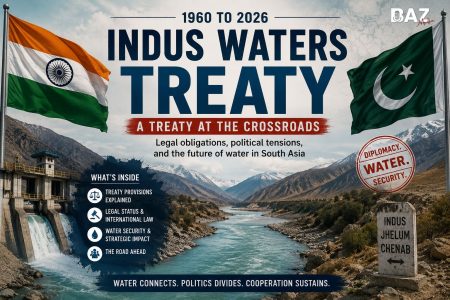
The India-Pakistan Indus Waters Treaty has long been regarded as one of the world’s most resilient water-sharing agreements. Despite decades of military conflicts, diplomatic tensions, and political crises, the treaty survived largely intact for more than six decades.
Today, however, it faces one of its greatest challenges.
Following heightened tensions after the April 2025 attack in Indian-administered Kashmir, India announced that it was placing the treaty “on hold.” Since then, political rhetoric has intensified, with both countries presenting sharply different interpretations of the treaty’s legal status and future.
The current dispute is no longer just about rivers it has evolved into a broader contest involving international law, regional security, strategic leverage, and the future of water diplomacy in South Asia.
Understanding the Indus Waters Treaty
Signed in 1960 with the support of the World Bank, the Indus Waters Treaty established a comprehensive framework for sharing the waters of the Indus River system between India and Pakistan.
The agreement divided six major rivers into two groups.
India received exclusive rights over:
- Ravi
- Beas
- Sutlej
Pakistan was granted primary rights over:
- Indus
- Jhelum
- Chenab
However, the treaty also permits India limited use of the western rivers for:
- Domestic consumption
- Non-consumptive purposes
- Navigation
- Certain agricultural activities
- Run-of-river hydroelectric projects that comply with treaty design standards
This distinction is important because it contradicts claims that the entire Indus Basin belongs exclusively to India. Instead, the treaty carefully balances upstream development rights with downstream water security.
Why the Treaty Is Under Pressure
The latest crisis emerged after India linked the treaty to national security concerns following the 2025 Kashmir attack.
Indian officials announced that the agreement would remain suspended until Pakistan addressed concerns over cross-border terrorism. Statements from senior Indian leadership further emphasized that Pakistan would not receive water over which India has rights.
Pakistan, meanwhile, argues that the treaty remains legally binding under international law and cannot be suspended through a unilateral political declaration.
This disagreement has transformed what was once primarily a technical water-management issue into a significant diplomatic confrontation.
Can India Legally Suspend the Indus Waters Treaty?
One of the most debated questions surrounding the current dispute is whether India possesses the legal authority to suspend the treaty unilaterally.
International legal experts generally point to the principle of pacta sunt servanda, a cornerstone of treaty law requiring agreements to be honored in good faith unless they are lawfully amended or terminated according to established legal procedures.
Supporters of Pakistan’s legal position argue that no provision within the treaty explicitly allows either country to place it “on hold.”
India, on the other hand, maintains that evolving security circumstances justify reassessing its commitments.
This legal disagreement extends beyond bilateral relations. It raises broader questions about the durability of international agreements during periods of geopolitical conflict and whether states can effectively neutralize treaty obligations without formally withdrawing from them.
Why Water Has Become a Strategic Tool
Water has increasingly become intertwined with national security across South Asia.
For Pakistan, the western rivers support:
- Agricultural irrigation
- Hydroelectric generation
- Drinking water supplies
- Food security
- Industrial production
Agriculture alone depends heavily on predictable river flows, making any sustained disruption potentially damaging for millions of people and large segments of the country’s economy.
Although experts note that India currently lacks the infrastructure to completely halt river flows, expanded storage capacity and future hydroelectric projects could increase its ability to influence seasonal water management.
As a result, water is increasingly viewed not only as a natural resource but also as an instrument of strategic leverage.
Regional and Global Implications
The Indus Waters Treaty has often been cited as a successful example of conflict management between rival nuclear powers.
If the treaty weakens significantly, several consequences could follow.
First, bilateral trust may deteriorate further, making future negotiations on security and trade even more difficult.
Second, international confidence in long-standing water-sharing agreements could decline if political disputes begin overriding legal commitments.
Third, climate change adds another layer of complexity.
Accelerating glacier melt in the Himalayas, changing monsoon patterns, and growing water demand are already placing unprecedented stress on regional water resources. These environmental pressures make cooperative river management more important not less.
The combination of climate risks and geopolitical rivalry creates a challenging environment where water disputes could increasingly influence broader regional stability.
What Happens Next?
The future of the treaty remains uncertain.
Several possible scenarios are emerging:
- Continued political deadlock while the treaty technically remains in force.
- Renewed diplomatic negotiations under international facilitation.
- Expanded legal proceedings through international arbitration mechanisms.
- Increased development of water infrastructure on both sides.
- Greater emphasis on strategic water management amid climate change.
For both India and Pakistan, maintaining reliable communication over shared water resources will remain essential to preventing misunderstandings from escalating into wider crises.
Conclusion
The India-Pakistan Indus Waters Treaty stands at a critical crossroads.
While political rhetoric has intensified and diplomatic relations remain strained, the legal framework established in 1960 continues to shape the debate over river rights and international obligations.
The current dispute is about far more than water allocation. It reflects broader questions surrounding treaty compliance, regional security, international law, and the future of transboundary resource management.
Whether the treaty ultimately survives this period of tension will depend not only on legal interpretations but also on political will, diplomatic engagement, and both countries’ ability to separate long-term water security from short-term geopolitical pressures.
As climate change accelerates and freshwater resources become increasingly valuable, the Indus Waters Treaty may prove to be one of the most consequential agreements shaping South Asia’s future.